
 Advertise



Bitcoin Price Plunges Below $65,000 – What’s Triggering the Massive Sell-off Across the Crypto Market?




Bitcoin's drop to $62,000 reflects growing pressure across the crypto market, with ETF outflows, macroeconomic uncertainty and weakening investor confidence adding to the sell-off.
Heavy long liquidations, with the latest spike approaching $1.8 billion, have intensified Bitcoin's decline, while continued spot Bitcoin ETF outflows raise concerns about the strength of institutional demand.
The crypto market witnessed another brutal sell-off over the weekend, with Bitcoin briefly slipping to $62,000 before recovering above $66,000. The sharp decline triggered a wave of forced liquidation, with CoinGlass data showing approximately $2.06 billion in positions wiped out, including around $1.92 billion in long positions, accounting for more than 93% of the total.
However, the selling pressure appears to extend beyond leveraged traders getting caught on the wrong side of the market. The fallout from recent global developments continues to weigh on investor confidence, pushing market sentiment deeper into Extreme Fear. With uncertainty mounting, several other factors are also adding to the pressure on the BTC price and the crypto market. Let’s look at what’s driving the latest sell-off.
What is Driving the Crypto-Market Sell-Off? CZ Points to Multiple Possible Catalysts
Binance co-founder Changpeng Zhao (CZ) also weighed in on Bitcoin’s sharp decline, highlighting several possible factors behind the broader market sell-off. These included substantial spot ETF outflows, security concerns, inflation-driven interest rate expectations, and uncertainty surrounding US crypto regulations. He also dismissed speculation that Binance had been selling its crypto holdings.
One important factor is the sustained outflow of capital from US spot Bitcoin ETFs.

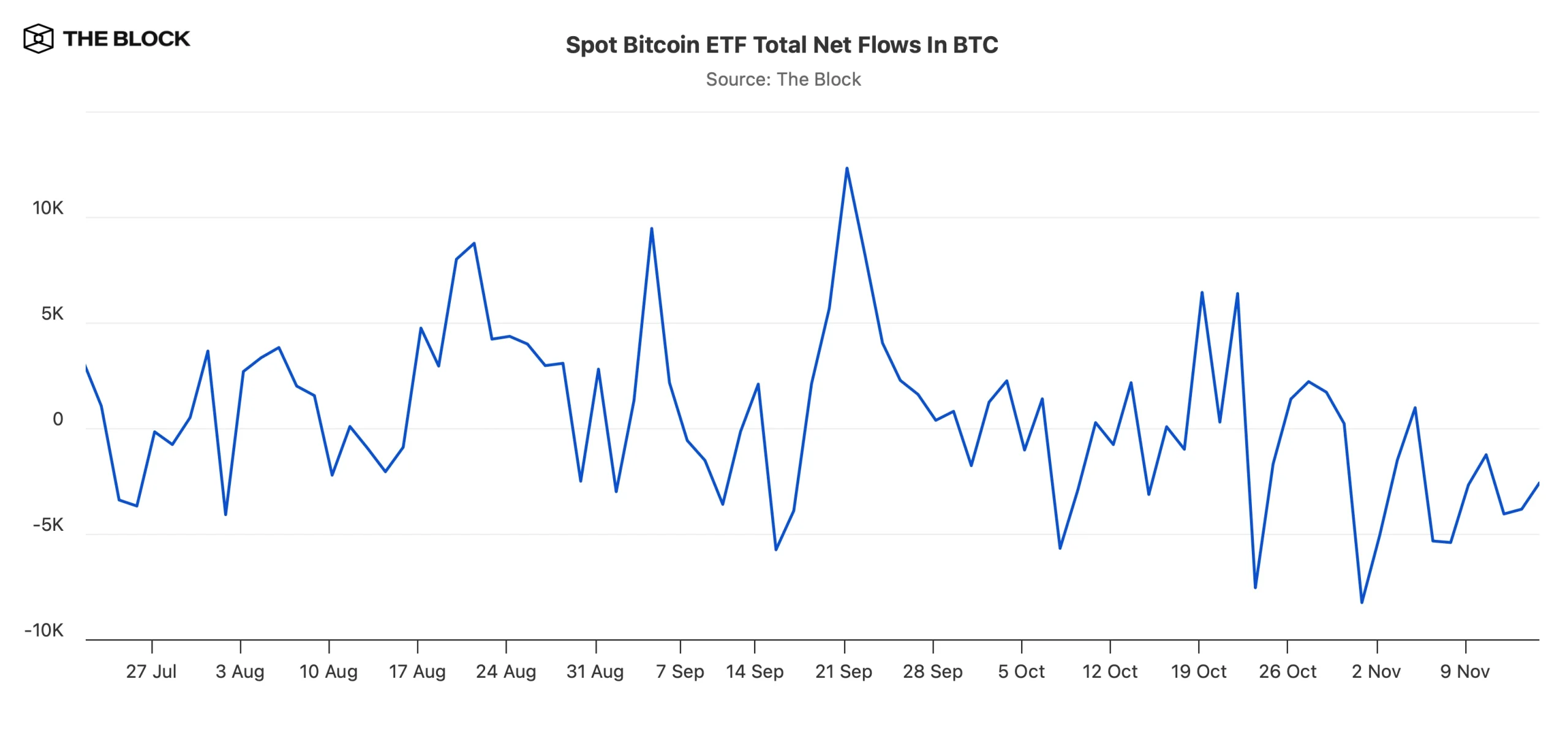
Spot BTC ETFs have been experiencing consistent outflows this month. Net flows were positive on only two days, while outflows were recorded on the remaining days, including seven consecutive days of outflows. Some of the most notable outflows occurred in late October and early November. Daily net flows dropped to nearly 8,000 to 9,000 BTC in the negative during the sharpest outflow sessions. Another session recorded withdrawals of roughly 5,500 BTC, while several sessions continued to register negative flows of around 3,000 to 4,500 BTC.
The derivatives market may also have amplified the decline.
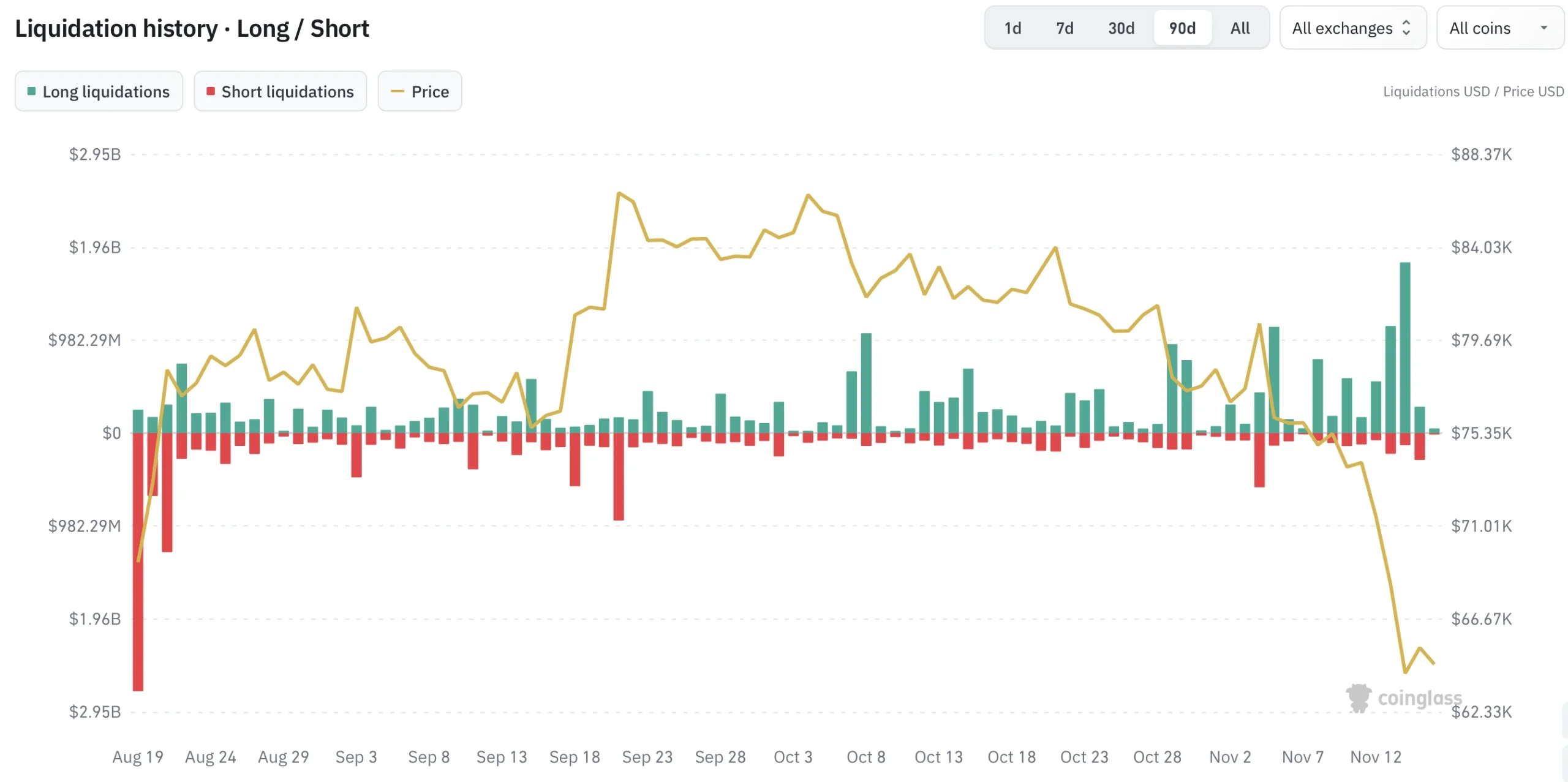
The derivatives market has played a significant role in intensifying Bitcoin’s recent correction. CoinGlass’s 90-day liquidation history shows several notable spikes in forced position closures, with long liquidations dominating during some of the sharpest price declines. More recently, the chart shows long liquidations climbing to about $1.1 billion and then nearly $1.8 billion, well above the corresponding short liquidations. This suggests that bullish traders carrying leveraged positions were particularly exposed as the BTC price tested key levels.
Macroeconomic conditions add another layer of pressure. Persistent inflation concerns have strengthened expectations of tighter monetary policy, raising the opportunity cost of holding non-yielding assets such as Bitcoin. Higher Treasury yields and a stronger USD can further reduce demand for speculative investments, including cryptos.
Can Bitcoin Recover From the Latest Crypto Market Sell-Off?
Bitcoin’s drop to $62,000 highlights the selling pressure expanding across the crypto market quickly when investor confidence weakens. While no single catalyst fully explains the correction, a combination of persistent ETF outflows, heavy long liquidations, macroeconomic uncertainty and deteriorating market sentiment appears to have created a challenging environment for risk assets. The repeated waves of long liquidations suggest leveraged bullish positions amplifying the downside, while continued weakness in spot ETF flows points to a lack of consistent institutional buying support.
Bitcoin price recovery above $66,000 could offer some relief, but it does not necessarily point towards the end of the correction. However, improving ETF net flows and easing liquidation pressure may bring back traders’ confidence. Until these conditions improve, the broader crypto market could remain vulnerable to further volatility and renewed selling pressure.
Was this writing helpful?

Trust with CoinPedia:
CoinPedia has been delivering accurate and timely cryptocurrency and blockchain updates since 2017. All content is created by our expert panel of analysts and journalists, following strict Editorial Guidelines based on E-E-A-T (Experience, Expertise, Authoritativeness, Trustworthiness). Every article is fact-checked against reputable sources to ensure accuracy, transparency, and reliability. Our review policy guarantees unbiased evaluations when recommending exchanges, platforms, or tools. We strive to provide timely updates about everything crypto & blockchain, right from startups to industry majors.
Investment Disclaimer:
All opinions and insights shared represent the author's own views on current market conditions. Please do your own research before making investment decisions. Neither the writer nor the publication assumes responsibility for your financial choices.
Sponsored and Advertisements:
Sponsored content and affiliate links may appear on our site. Advertisements are marked clearly, and our editorial content remains entirely independent from our ad partners.