



 Advertise



XRP Institutional Holdings Report 2026: Corporate, Fund, and Treasury Ownership





Nidhi is a Certified Digital Marketing Executive and Passionate crypto Journalist covering the world of alternative currencies. She shares the latest and trending news on Cryptocurrency and Blockchain.



XRP institutional holdings have expanded through several channels in 2026, including U.S. spot XRP exchange-traded funds (ETFs), corporate treasury structures, Ripple equity exposure and financial infrastructure.
As of Aug. 17, 2026, SoSoValue data showed U.S. XRP spot ETFs with approximately $1.51 billion in cumulative net inflows and $934.04 million in total net assets. XRP Insights reported that seven U.S. spot XRP ETFs collectively held approximately 994.74 million XRP.
These figures measure different things. Cumulative net inflows show the capital that has entered the ETFs over time, while total net assets show the current value of assets held by the funds. The 994.74 million XRP figure represents the reported token holdings of the seven ETFs.
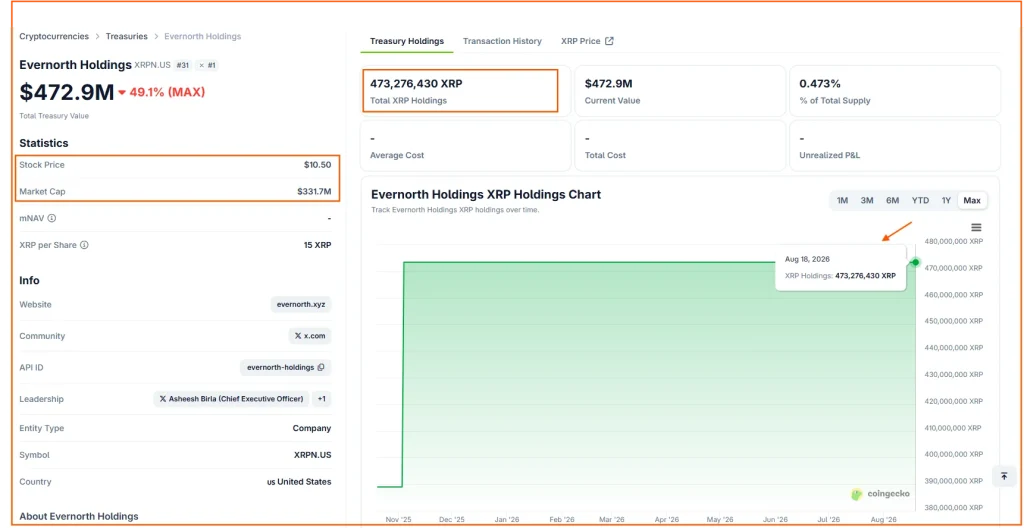
Corporate treasury structures provide another source of direct XRP exposure. Evernorth’s SEC filings disclose that it had purchased and committed to more than 473,276,430 XRP, including an additional purchase of 84,365,876.3625 XRP using $214 million in cash proceeds. The transaction had more than $1 billion in investor commitments, including a $200 million commitment from SBI.

SBI Holdings requires separate treatment because its exposure is through Ripple equity, not direct XRP ownership. SBI’s materials state that the group owns approximately 9% of Ripple, making it a major equity investor in the company. This does not establish the frequently circulated claim that SBI directly holds $10 billion worth of XRP.
Ripple has also expanded the infrastructure supporting institutional digital-asset activity. It acquired Hidden Road for $1.25 billion, with Ripple reporting that the resulting Ripple Prime business clears more than $3 trillion annually across markets. Ripple Prime later secured a $200 million financing facility from Neuberger Berman. Ripple also announced a $1 billion acquisition of GTreasury, expanding into corporate treasury management.
XRP Institutional Holdings Through ETFs
The U.S. spot XRP ETF market provides the strongest current measurement of XRP institutional holdings because the underlying products disclose holdings and flows through established financial market reporting systems.
The Aug. 17 SoSoValue data shows cumulative net inflows of approximately $1.51 billion and total net assets of $934.04 million from 5 AUMs.
The token-level picture comes from XRP Insights. Its ETF tracker reports seven active XRP spot ETFs, collectively holding approximately 994.7 million XRP. The dashboard’s Aug. 18 update continues to show approximately 994.7 million XRP held across seven products.
The seven products listed in the XRP Insights data were:
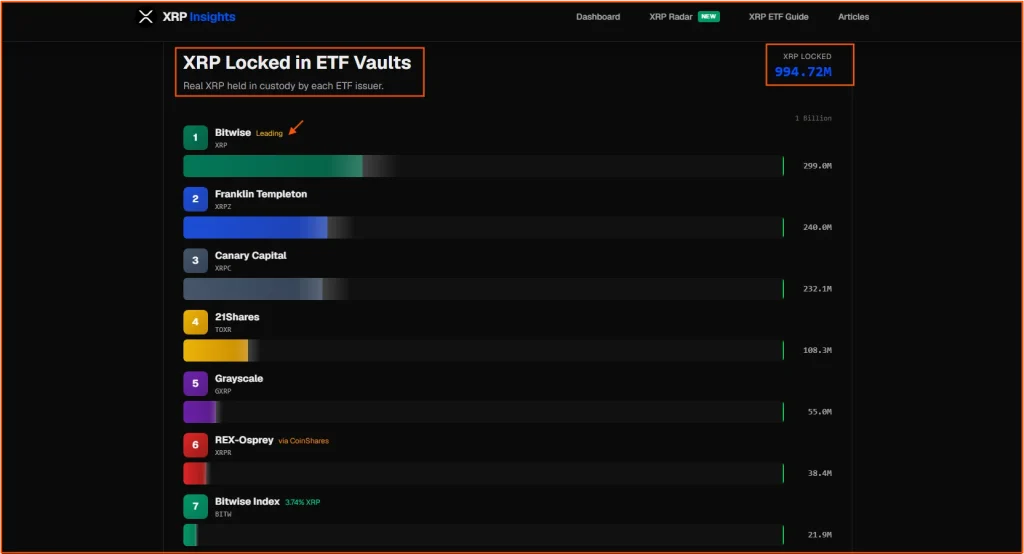
The distribution shows a significant concentration among the largest products. Bitwise, Franklin Templeton and Canary collectively account for approximately 771.1 million XRP, or roughly three quarters of the total reported ETF holdings.
Also Read : Ripple (XRP) Price Prediction 2026, 2027-2030: Will XRP Reach $5?
Corporate Treasuries Add Direct Exposure
ETF exposure is only one component of XRP institutional holdings. Corporate treasury vehicles represent a different structure because companies can accumulate XRP directly on their balance sheets or through dedicated subsidiaries.
The clearest documented example is Evernorth. An SEC filing states that Evernorth had purchased and committed to more than 473,276,430 XRP. The filing followed an additional purchase of 84,365,876.3625 XRP using $214 million in aggregate cash proceeds at an average price of $2.53657058 per XRP.
The SEC filing specifically describes the transaction as an additional XRP purchase that brought Evernorth’s total purchased and committed XRP above 473,276,430.
Therefore, the appropriate description is Evernorth’s 473.276 million-plus XRP purchased-and-committed position, rather than describing the entire amount as XRP bought on the open market.
The SEC documentation shows that the position consists of multiple sources:
- XRP purchased with cash;
- XRP contributed by Ripple;
- XRP associated with the sponsor;
- XRP from other contributors;
- XRP committed as part of the transaction structure.
The $214 million cash-funded purchase represents only one component of the overall XRP position. The SEC disclosure confirms that the 84.3659 million XRP acquired in that transaction was purchased using part of the $214 million in proceeds from an earlier private placement.
The capital backing the structure is also substantial. Evernorth’s transaction documents state that the company secured more than $1 billion in commitments, with the October 2025 announcement identifying $200 million from SBI alongside investments from Ripple, Pantera Capital, Kraken, GSR and other investors.
This makes Evernorth an important institutional XRP structure, while its holdings remain distinct from the 994.74 million XRP held by ETFs because the two represent different ownership structures and reporting frameworks.
SBI Exposure Is Equity, Not $10B XRP
SBI Holdings represents another important distinction in measuring XRP institutional holdings, because its approximately 9% stake in Ripple represents corporate equity exposure rather than direct ownership of XRP.
SBI’s investor materials describes Ripple as an SBI Group investee company and identifies SBI’s position as an equity investment in Ripple.
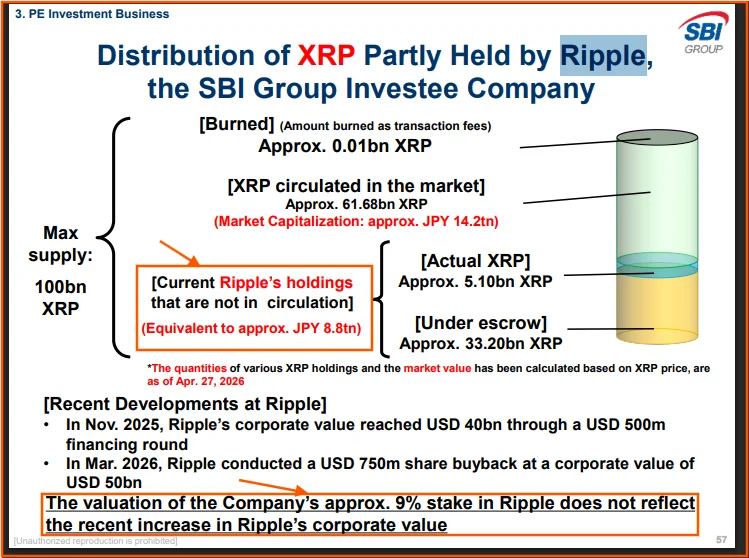
SBI’s corporate disclosure provides additional confirmation. The company states that it invested in Ripple in 2016 and currently holds approximately 9% of Ripple’s shares, describing itself as Ripple’s largest external shareholder.
This evidence establishes SBI’s significant equity exposure to Ripple. It does not establish that SBI owns $10 billion worth of XRP.
The distinction can be summarized as follows:
| Exposure type | What it represents |
| XRP tokens | Direct exposure to XRP’s market price |
| Ripple equity | Ownership interest in Ripple’s corporate value |
| Evernorth investment | Exposure to a dedicated XRP treasury vehicle |
A claim that SBI holds $10 billion of XRP therefore cannot be substituted with the fact that SBI owns approximately 9% of Ripple. The two assets have different ownership structures, accounting treatment and economic characteristics.
The more defensible conclusion is that SBI has a major institutional relationship with the XRP ecosystem and approximately 9% equity ownership of Ripple, while the available corporate disclosures do not establish a $10 billion direct XRP treasury.
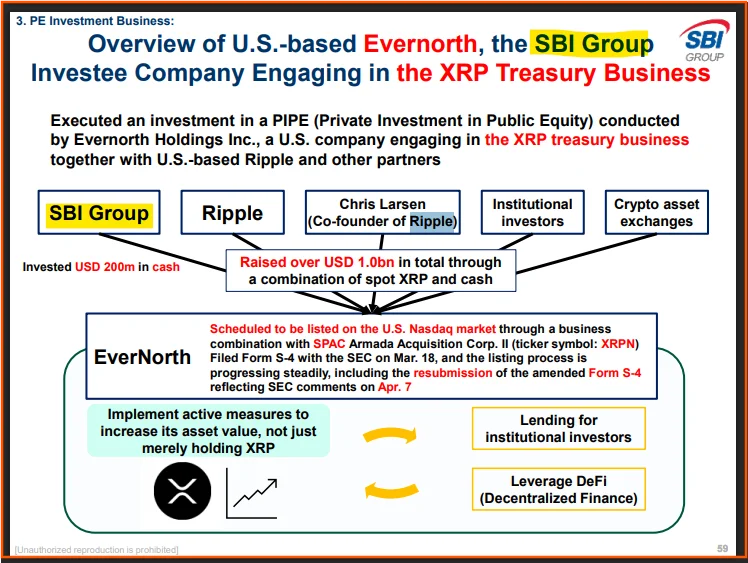
This distinction also removes a potential source of double counting from the institutional XRP narrative. Ripple’s own XRP holdings, SBI’s Ripple equity stake and Evernorth’s XRP treasury represent separate forms of exposure.
Ripple Builds Institutional Infrastructure
The institutional XRP market is not limited to funds and treasury companies; infrastructure supporting XRP institutional holdings is also expanding through brokerage, financing and treasury-management services.
The largest transaction in this area was Ripple’s acquisition of Hidden Road for $1.25 billion. Ripple announced that Hidden Road cleared approximately $3 trillion annually across markets and served more than 300 institutional customers. Reuters independently reported the same transaction value, clearing volume and institutional-client base.
Ripple subsequently rebranded the business as Ripple Prime. Its current prime-brokerage materials report more than $3 trillion in annual clearing across markets and more than 300 institutional customers.
The acquisition is relevant to XRP because Ripple stated that Hidden Road would use RLUSD as collateral and migrate post-trade activity toward the XRP Ledger. Ripple also identified potential applications for the XRP Ledger in institutional post-trade processes.
This is different from direct XRP accumulation. Ripple Prime’s clearing volume does not mean that $3 trillion of XRP is being traded. It represents the scale of the prime brokerage’s broader institutional market activity.
Ripple has also added financing capacity to this institutional platform. In May 2026, Ripple Prime secured a $200 million debt facility from Neuberger Specialty Finance, intended to support the growth of its prime brokerage and margin-financing capabilities.
The development adds another layer to Ripple’s institutional strategy: rather than relying solely on XRP-related market activity, the company is building services that facilitate institutional trading, financing and market access across digital and traditional assets.
Treasury Infrastructure Expands
Ripple’s institutional strategy has also expanded into corporate treasury management. Ripple announced its $1 billion acquisition of GTreasury in October 2025. The company described GTreasury as a treasury-management systems provider with more than four decades of experience supporting corporate treasury operations.
The transaction is relevant to the institutional XRP story because corporate treasury systems sit closer to the operational management of cash, liquidity and payments than conventional crypto-trading infrastructure. Ripple positioned the acquisition around treasury operations, liquidity, payments and risk management.
The combined picture therefore consists of several separate institutional layers:
ETF layer: Nearly 994.74 million XRP held by seven U.S. spot XRP ETFs.
Treasury layer: Evernorth’s disclosed 473.276 million XRP purchased and committed within its corporate treasury structure.
Corporate-equity layer: SBI’s approximately 9% ownership of Ripple, which is not equivalent to direct XRP ownership.
Prime-brokerage layer: Ripple Prime following the $1.25 billion Hidden Road acquisition, with more than $3 trillion in annual clearing according to Ripple.
Financing layer: A $200 million Neuberger Berman facility for Ripple Prime’s institutional financing capacity.
Treasury-management layer: Ripple’s $1 billion GTreasury acquisition.
These layers should not be aggregated into one dollar figure because they measure different forms of institutional involvement.
Regulatory Framework Adds Another Layer
The market for XRP institutional holdings is also operating under a clearer U.S. regulatory framework following the SEC’s March 17, 2026 interpretation.
The SEC’s interpretation established a taxonomy covering digital commodities, digital collectibles, digital tools, stablecoins and digital securities. The SEC’s subsequent materials identify 18 digital assets, including XRP, as digital commodities as of the release date. Sixteen of those assets underlay futures contracts available on CFTC-regulated designated contract markets.
On March 17, 2026, the SEC issued its Commission-level interpretation addressing how federal securities laws apply to certain crypto assets and transactions involving them. The CFTC joined the interpretation and stated that its staff would administer the Commodity Exchange Act consistently with the SEC’s interpretation.
The regulatory development is relevant to the institutional market because ETFs, treasury companies and financial infrastructure operate within defined legal and regulatory frameworks. The SEC describes the document as an interpretive release, rather than legislation enacted by Congress.
This places the regulatory development within a broader institutional framework: the classification establishes the agencies’ current interpretation of federal securities and commodities law, while individual investment products and corporate structures remain subject to their respective legal and regulatory requirements.
For XRP, the significance is that the asset is explicitly identified among the digital commodities in the SEC’s 2026 framework.
The Institutional XRP Picture
The available evidence supports a clear conclusion: XRP’s institutional market has developed across regulated investment products, dedicated treasury structures, corporate equity exposure and financial infrastructure.
The strongest current quantitative evidence for XRP institutional holdings is the 994.74 million XRP held by seven spot ETFs, alongside $1.51 billion in cumulative ETF net inflows and $934.04 million in total net assets in the Aug. 17 SoSoValue data.
The second major exposure is Evernorth, whose SEC filings document more than 473.276 million XRP purchased and committed, including the additional 84.3659 million XRP purchased for $214 million.
SBI provides evidence of institutional participation through its approximately 9% Ripple equity stake, but this represents ownership in Ripple rather than a documented $10 billion XRP treasury.
Meanwhile, Ripple is building infrastructure around the market through the $1.25 billion Hidden Road acquisition, Ripple Prime’s reported $3 trillion-plus annual clearing, a $200 million Neuberger Specialty Finance facility, and the $1 billion GTreasury acquisition.
The current evidence establishes that XRP has developed a substantial regulated ETF presence, a dedicated corporate treasury segment and an expanding institutional financial-infrastructure layer.
The evidence does not support reducing these different categories to a single dollar value for institutional XRP holdings. ETF assets, corporate treasury balances, Ripple equity, prime-brokerage activity and treasury-management infrastructure measure different forms of institutional participation.
The most defensible assessment is therefore that institutional XRP exposure has become measurable across regulated ETFs and dedicated treasury vehicles, while Ripple has simultaneously expanded the brokerage, financing and treasury infrastructure surrounding institutional digital-asset markets.
Quantitative Indicators Summary
The key quantitative indicators are now clearly separated:
| Institutional indicator | Reported figure |
| XRP held by seven U.S. spot ETFs | 994.74M XRP |
| Cumulative XRP ETF net inflows | $1.51B |
| SoSoValue ETF total net assets, Aug. 17 | $934.04M |
| Evernorth XRP purchased and committed | 473.276M+ XRP |
| Evernorth additional cash purchase | 84.366M XRP |
| Evernorth cash purchase | $214M |
| SBI Ripple ownership | approx. 9% |
| Ripple–Hidden Road transaction | $1.25B |
| Ripple Prime clearing | $3T+ annually |
| Neuberger facility | $200M |
| Ripple–GTreasury transaction | $1B |
The institutional XRP market is therefore no longer represented by a single ownership metric. Its development can be measured through token balances, ETF capital flows, corporate treasury accumulation, equity participation and financial-market infrastructure.
That framework provides a more precise view of XRP’s institutionalization while preserving the underlying figures without combining fundamentally different forms of exposure.
Was this writing helpful?

Trust with CoinPedia:
CoinPedia has been delivering accurate and timely cryptocurrency and blockchain updates since 2017. All content is created by our expert panel of analysts and journalists, following strict Editorial Guidelines based on E-E-A-T (Experience, Expertise, Authoritativeness, Trustworthiness). Every article is fact-checked against reputable sources to ensure accuracy, transparency, and reliability. Our review policy guarantees unbiased evaluations when recommending exchanges, platforms, or tools. We strive to provide timely updates about everything crypto & blockchain, right from startups to industry majors.
Investment Disclaimer:
All opinions and insights shared represent the author's own views on current market conditions. Please do your own research before making investment decisions. Neither the writer nor the publication assumes responsibility for your financial choices.
Sponsored and Advertisements:
Sponsored content and affiliate links may appear on our site. Advertisements are marked clearly, and our editorial content remains entirely independent from our ad partners.