


 Advertise



XRP Rich List 2026 Crosses 8 Million Accounts, How Much XRP is Needed for the Top 1%?



The XRP Ledger quietly crossed 8 million funded accounts this year in August, and the number that gets passed around every time this milestone comes up is ‘the top 1% threshold’ talk on the XRP rich list. Right now it sits at 44,771 XRP. That figure gets treated like a fixed target in crypto Twitter threads, but it isn’t one. In fact, it moves every day, and understanding why it moves is more useful than memorizing the number itself.
This XRP rich list report breaks down how that threshold is actually computed, what the full balance distribution looks like underneath it, and where the numbers mislead if you take them at face value. XRPL is a good case study for this kind of analysis because, unlike Bitcoin’s UTXO model, every account is a discrete ledger object with an explicit balance, an explicit reserve requirement, and in many cases an explicit escrow lock. That structure makes rich-list math more tractable, but it also makes it easier to get wrong if you don’t account for how the ledger actually stores value.
1. How an Account Gets Ranked
Two mechanical details matter here, and most casual coverage of XRP rich list skips both.
First, ranking has to include escrow, not just spendable balance. On XRPL, an account can lock XRP into an ‘Escrow ledger’ object that releases on a time condition or a crypto-condition. That XRP leaves the spendable balance but is still economically controlled by the account. Several of the largest Ripple-linked wallets hold only a few hundred thousand XRP spendable against billions sitting in escrow. Consequently, Rank on spendable balance alone and you’d drop the six largest true holders on the network out of the top tier entirely, which defeats the purpose of the exercise.

Second, what counts as a “funded account” changed underneath everyone in December 2024. XRPL validators cut the base reserve from 10 XRP down to 1 XRP. That’s a 90% drop in the cost of opening a wallet that actually exists on the ledger. A lot of the account growth since then, including the run to 8 million, is a direct consequence of that reserve cut rather than organic adoption. Therefore, its a must to keep that in mind before reading population growth as a bullish signal on its own.
Also Read : Ripple (XRP) Price Prediction 2026, 2027-2030
The walk behind these numbers checks out, too. Every figure here comes from a full pass over every AccountRoot object at ledger 106,212,250, reconciled against the ledger’s own reported total supply. The gap came out to about 87,543 XRP, roughly 0.000088% of total supply, attributable to XRP sitting in non-account ledger objects like payment channels rather than any error in the walk. A walk that missed pages of accounts would show a gap in the billions, not the thousands, so a discrepancy this small is a reasonable sanity check that the underlying data holds up.
2. Current Thresholds
| Percentile tier | Minimum XRP controlled | Approx. accounts at/above | USD value (approx.) |
| Top 0.1% | 275,106 XRP | 8,096 | $278,000 |
| Top 1% | 44,771 XRP | 80,564 | $45,300 |
| Top 5% | 7,499 XRP | 402,952 | $7,580 |
| Top 10% | 2,143 XRP | 805,508 | $2,166 |
| Top 25% | 109 XRP | 2,013,574 | $110 |
| Top 50% (median) | 20 XRP | 4,225,434 | $20 |
Moreover, on comparison here’s the latest ledger snapshot data.
| Tier | Jul 31, 2026 | Aug 11, 2026 | Change |
| Top 10% | 2,150 XRP | 2,143 XRP | down 0.3% |
| Top 1% | 44,926 XRP | 44,771 XRP | down 0.3% |
Nobody sold anything to cause that shift. New low-balance accounts, many holding nothing more than the 1 XRP reserve, keep getting added to the denominator faster than XRP accumulates at the top. That mechanically pulls every percentile cutoff down even in a flat market. It’s dilution, not distribution.
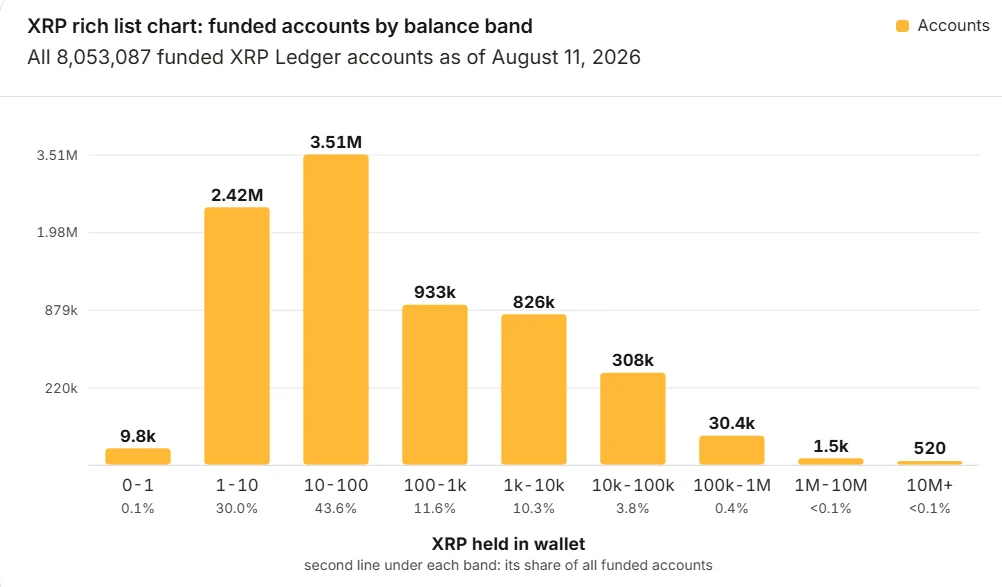
3. XRP Rich List Balance Distribution: The Full Balance Curve
This is where the shape of the ledger actually shows itself, and it’s steep.
| Band (XRP) | Accounts | % of accounts | XRP held | % of supply |
| 0-1 | 9,770 | 0.12% | 7,526 | under 0.01% |
| 1-10 | 2,419,061 | 30.04% | 3,829,820 | under 0.01% |
| 10-100 | 3,514,892 | 43.65% | 82,405,173 | 0.08% |
| 100-1,000 | 932,828 | 11.58% | 342,301,374 | 0.34% |
| 1,000-10,000 | 825,679 | 10.25% | 2,729,996,426 | 2.73% |
| 10,000-100,000 | 308,158 | 3.83% | 8,049,825,910 | 8.05% |
| 100,000-1,000,000 | 30,404 | 0.38% | 6,370,392,869 | 6.37% |
| 1,000,000-10,000,000 | 1,530 | 0.02% | 3,856,267,932 | 3.86% |
| 10,000,000+ | 521 | under 0.01% | 78,551,725,554 | 78.56% |
Three things jump out immediately. Nearly three-quarters of all accounts (the 1-10 and 10-100 bands combined) hold under 100 XRP and together control a rounding error’s worth of total supply. Eighty-five percent of all funded accounts hold under 1,000 XRP, and that entire group controls just 0.43% of everything in circulation. And on the other end, 521 accounts, a group small enough to fit in a mid-size office building, hold 78.6% of all XRP that exists.
That last number is the one worth sitting with. It’s not that XRP is unusually concentrated compared to other large-cap crypto assets; most of them look similar once you account for exchange custody and early allocation. It’s that address count alone tells you almost nothing about how many actual people are behind any given tier, which brings us to the next section.
4. Why Address Rank Isn’t the Same as Wealth Rank
This is the caveat that gets dropped from most coverage of the XRP rich list, and it changes the picture more than any other single factor.
Exchanges pool customer funds into a handful of wallets. In the current snapshot, 25 identified exchange addresses inside the top 500 hold roughly 14.7 billion XRP between them, about 14.7% of total supply. That’s not one whale. That’s the aggregated deposits of however many thousands or millions of retail customers happen to use that exchange. Counting it as a single point of concentration misreads what the ledger is showing you.
Ripple’s own holdings are mostly locked, not liquid. Ripple the company controls few addresses holding around 35.6% of supply, but roughly 32.14 billion of that sits in escrow, released on a fixed monthly schedule rather than sitting there as spendable capital the company could dump tomorrow. Two more address clusters tied to Ripple’s co-founders add a further few percent on top of that.
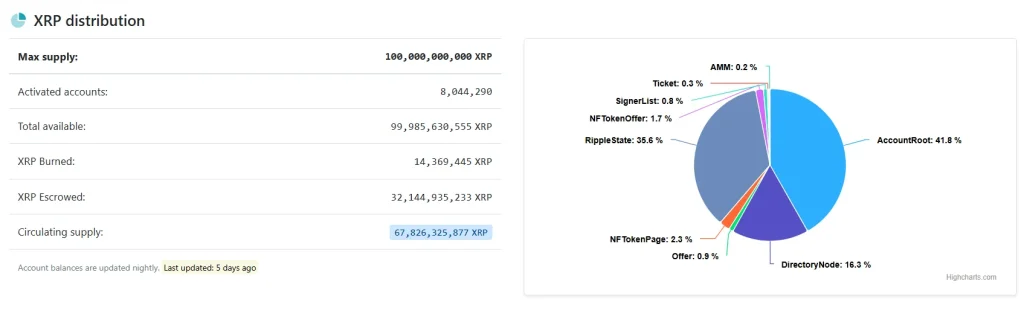
Strip out the identifiable custodial and issuer wallets and the picture changes noticeably. The top 100 addresses hold about 64% of supply as a raw figure. Pull out the known exchange wallets and that drops to roughly 50%. Still a concentrated market by any conventional standard, but a materially different number than the headline figure suggests.
And the distortion runs the other way too. A single person can spread holdings across dozens of self-custodied addresses for operational security or plain habit. That tends to understate individual concentration at the address level, working in the opposite direction from the custodial effect above. The two biases don’t cancel out cleanly, but they’re both real, and any serious reading of a rich list needs to hold both in mind at once.
5. Supply Mechanics Behind the Numbers
| Measure | XRP | Share of total |
| Total supply on ledger | 99,985,630,555 | 100% |
| Locked in on-chain escrow | 32,144,935,233 | 32.15% |
| Circulating, escrow excluded | 67,826,325,877 | 67.85% |
| Destroyed by transaction fees since launch | 14,369,445 | 0.01% |
XRP was minted once at genesis, 100 billion units, with no protocol mechanism to create more. Every transaction burns a small fee, so total ledger supply only ever goes down from here, never up. That’s structurally different from how percentile compression works on an inflationary chain, where new issuance can mechanically ease entry into upper tiers over time. On XRPL, the compression you’re seeing right now is being driven almost entirely by account proliferation, new wallets opening at very low balances, rather than by any change in the supply side of the equation.
6. Price Sensitivity
The thresholds themselves are denominated in XRP and don’t care what the token is trading at. What does move with price is the dollar cost of actually reaching a given tier. Here’s what holding the current top 1% threshold, 44,771 XRP, would cost at different price points:
| XRP price | Cost to hold top 1% threshold |
| $1.00 | about $44,800 |
| $2.00 | about $89,500 |
| $5.00 | about $224,000 |
| $10.00 | about $448,000 |
This decoupling trips people up constantly in secondary reporting. Headlines describe the XRP-denominated threshold trending down, account growth pushing entry requirements lower, while the dollar cost of actually getting there moves independently on price alone. Both things can be true at once and they usually are.
7. Where This Leaves Things
Crossing 8 million accounts made the top-tier thresholds look dramatically easier to reach, and in XRP terms they genuinely are: the top 1% cutoff has fallen from figures well above 60,000 XRP a few years back to under 45,000 XRP today. But that drop is not a story about wealth spreading out across the network. It’s almost entirely a story about the December 2024 reserve cut making it ten times cheaper to open a wallet, which flooded the denominator with low-balance accounts and mechanically pulled every percentile line downward.
Underneath that shift, concentration at the top hasn’t really moved. The top 1% of accounts still controls roughly 92% of all XRP in circulation, and the top 0.1% alone accounts for about 85% of it. A meaningful chunk of both figures is exchange custody and Ripple’s own escrow schedule rather than individual net worth, which means the real distribution of who owns XRP is flatter than the raw address data implies, but not by as much as optimists tend to claim.
If you’re checking your own balance against this XRP rich list, the more useful number to hold onto isn’t the top 1% figure that gets quoted everywhere. It’s this: 85% of all funded accounts hold under 1,000 XRP. Anything meaningfully above that already puts you ahead of the overwhelming majority of wallets on the ledger, even if it’s nowhere near whale territory.
Was this writing helpful?

Trust with CoinPedia:
CoinPedia has been delivering accurate and timely cryptocurrency and blockchain updates since 2017. All content is created by our expert panel of analysts and journalists, following strict Editorial Guidelines based on E-E-A-T (Experience, Expertise, Authoritativeness, Trustworthiness). Every article is fact-checked against reputable sources to ensure accuracy, transparency, and reliability. Our review policy guarantees unbiased evaluations when recommending exchanges, platforms, or tools. We strive to provide timely updates about everything crypto & blockchain, right from startups to industry majors.
Investment Disclaimer:
All opinions and insights shared represent the author's own views on current market conditions. Please do your own research before making investment decisions. Neither the writer nor the publication assumes responsibility for your financial choices.
Sponsored and Advertisements:
Sponsored content and affiliate links may appear on our site. Advertisements are marked clearly, and our editorial content remains entirely independent from our ad partners.