


 Advertise



Bitcoin Mining Under Strain as Miners Sell Over 32K BTC in H1 2026 & Difficulty Drops 15.1%





Nidhi is a Certified Digital Marketing Executive and Passionate crypto Journalist covering the world of alternative currencies. She shares the latest and trending news on Cryptocurrency and Blockchain.



The fresh Q2 2026 earnings data from the two top Bitcoin miners reveals a critical trend. The industry is in a structured retreat from the asset it was built to mine. MARA sold 23,093 BTC and Riot sold 9,665 BTC in first half of 2026 alone.
Together they have liquidated more Bitcoin in six months than most nation-states hold. Yet their stocks outperformed spot Bitcoin in terms of percentage gains. The decoupling is now confirmed in audited numbers, not just equity sentiment.
Bitcoin Mining Difficulty Falls After 10 Downward Adjustments
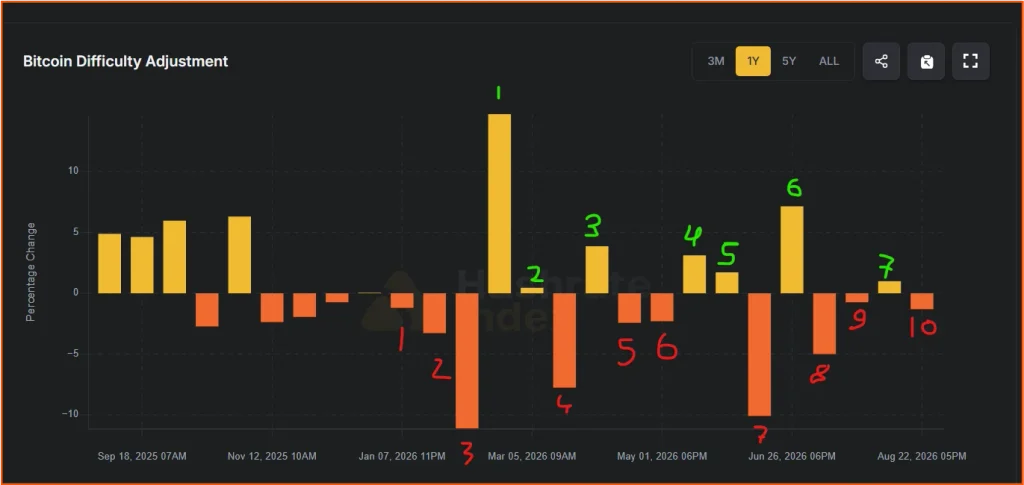
Bitcoin’s difficulty mechanism has now recorded ten downward adjustments against just seven increases in 2026, per data from hashrateindex dashboard. A “-1.31%’ drop on August 23rd that pushed difficulty to 125.81 trillion. That leaves it just above 0.7% above its 2026 low of 124.93 trillion set on June 13. Nearly every meaningful recovery attempt miners have managed since that June floor has been reversed within two epochs.
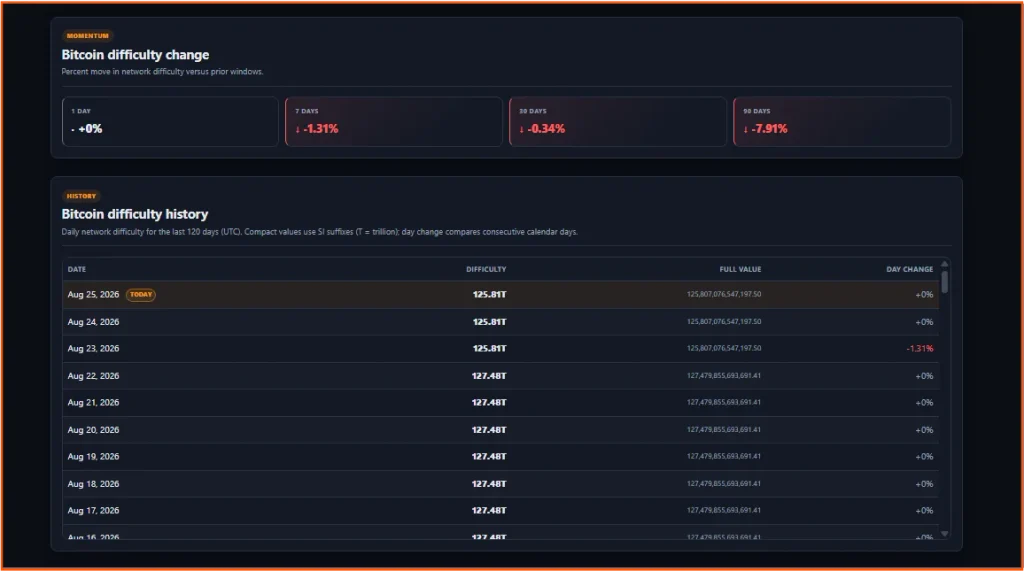
The full-year arc tells the structural story clearly. Per the Bitcoin Difficulty chart, the DIfficulty entered 2026 near 148.25 trillion. It now sits at 125.81 trillion, representing a 15.1% decline from the January 1 level and a 19.1% drop from all-time high of 156 trillion set in November 2025. That ATH-to-current drawdown ranks as the third deepest in the ASIC era, behind only China ban aftermath of 2021 and the 2018 market capitulation. Unlike either of those historical situations, this contraction has no singular external catalyst. Therefore, mining economics can no longer support the hardware that built the November peak.

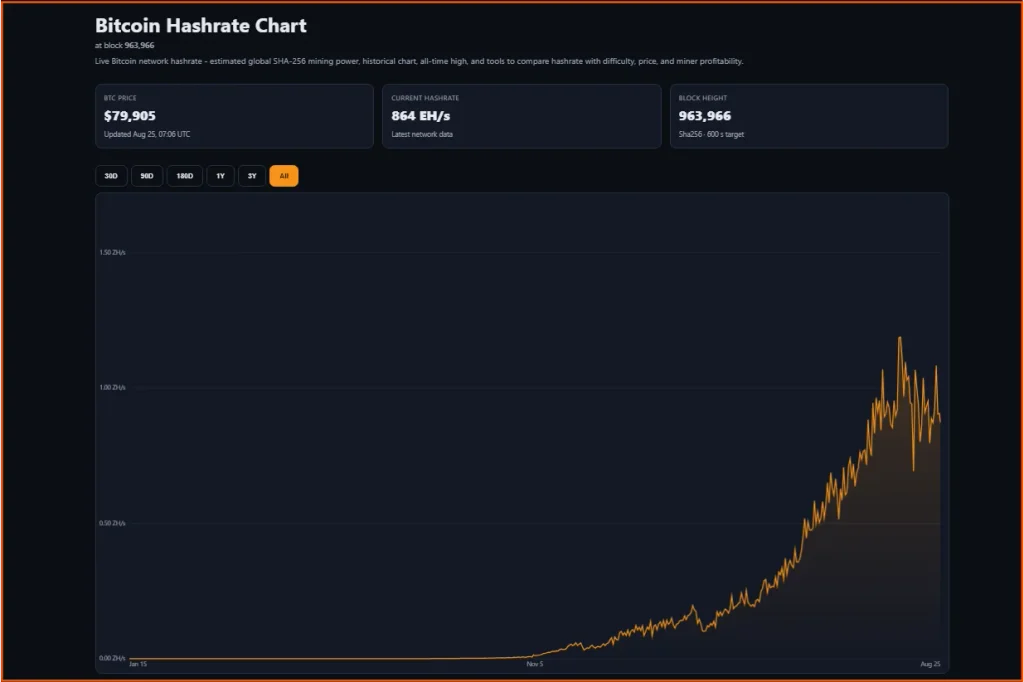
Hashrate tells the same story from the supply side. The Bitcoin Hashrate Chart shows that at 855 to 928 EH/s depending on the smoothing window used, the network is running roughly 25% below the all-time high of 1.23 ZH/s recorded in october 2025. Over 300 EH/s of effective mining capacity has gone dark in this span. Also, despite a sharp rally in BTC price in August hashrate hasn’t flinched.
The MARA Earnings: Growing Faster, Earning Less, Losing More
MARA Holdings filed its Q2 2026 results on August 6, providing the most detailed public window into what sustained difficulty compression and Bitcoin price decline look like inside the largest publicly traded miner’s P&L. The numbers are instructive precisely because MARA did everything operationally right and still produced a $611 million quarterly loss.
Energized hashrate climbed 22% year over year to 70.3 EH/s. Bitcoin production rose to 2,422 BTC in Q2, up from 2,247 in Q1. Cost per petahash per day improved 4% to $27.7.
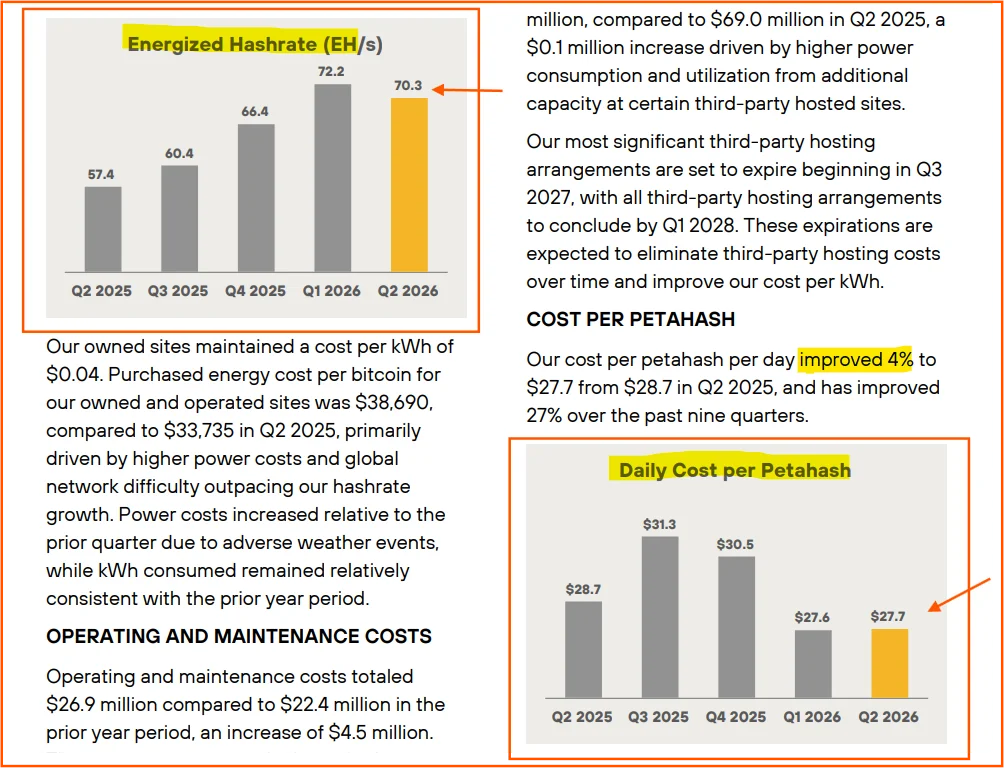
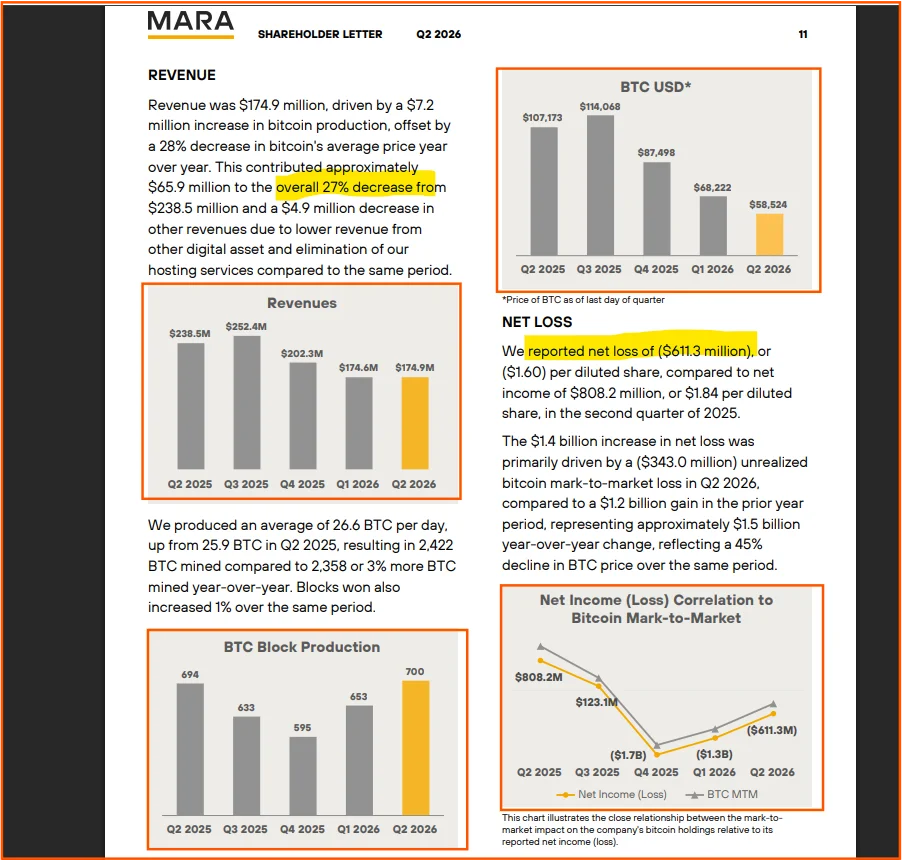
By every operational metric MARA manages directly, the quarter showed disciplined execution. But Bitcoin’s average price fell 28% year over year, and that single variable overwhelmed every operational gain.
Revenue dropped 27% to $174.9 million from $238.5 million in Q2 2025. The net loss of $611.3 million compared against net income of $808.2 million. But, in the same quarter a year earlier showed a swing of $1.42 billion driven almost entirely by a $343 million mark to market loss on digital assets and the underlying revenue compression from lower BTC prices.
Rising Energy Costs and Break-Even Economics
The purchased energy cost per Bitcoin tells the break-even story with precision: $38,690 in Q2 2026, up from $33,735 in Q2 2025. At MARA’s owned sites, electricity cost $0.04 per kWh, one of the most competitive rates in the industry.
Yet even at that rate, the energy cost alone consumed more than half of Bitcoin’s spot price during the quarter’s lower price windows. Total cost to mine for MARA, including depreciation and SBC, runs materially higher. The economics of mining at scale with low electricity costs are real, but they are not enough to overcome a 28% price decline in the underlying asset.
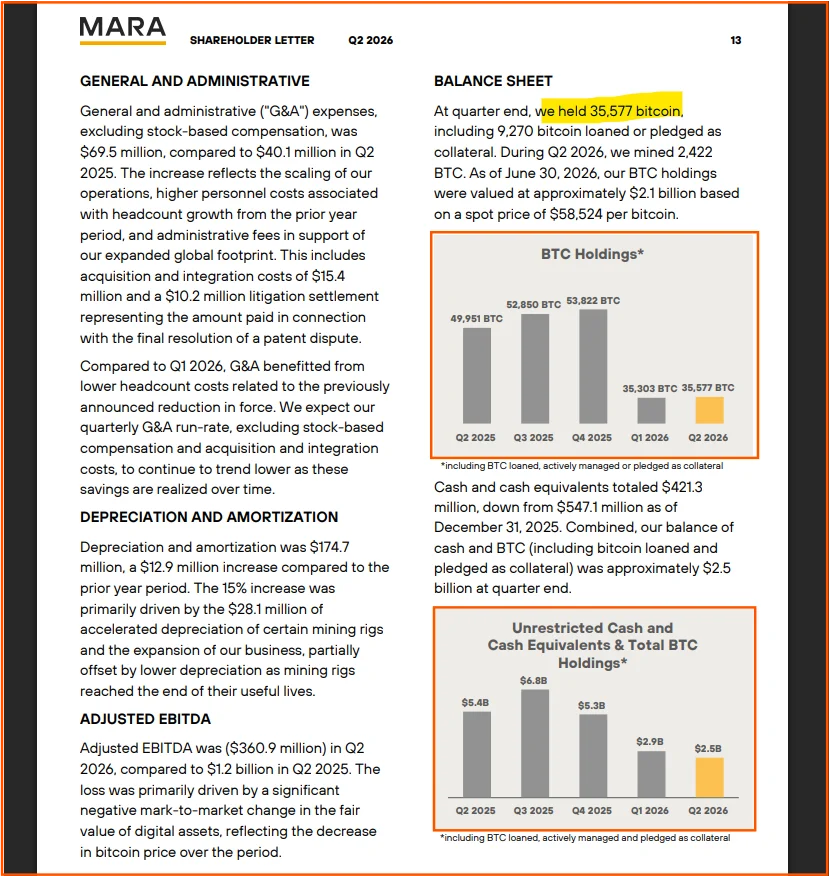
The treasury position reveals the most significant shift. MARA held 35,577 BTC at quarter end, down 29% year over year. During Q1 2026 alone, the company sold 20,880 BTC at an average of $70,137, bringing in roughly $1.46 billion. In Q2 it sold a further 2,213 BTC.
The $1.5 billion Long Ride acquisition, a 505 MW gas plant in Ohio targeted for AI and HPC which explains the scale of Q1 selling. MARA is converting its Bitcoin treasury into power structure. That is not a mining trade. It is a capital reallocation trade, executed using the only liquid asset the company holds in quantity.
The RIOT Earnings: Mining at a Loss, Selling BTC to Fund Anthropic
Riot Platforms filed Q2 2026 results on August 5, providing the second data point needed to confirm whether MARA’s trajectory is idiosyncratic or sector-wide. It is sector-wide.
Riot mined 1,587 BTC in Q2 at an all-in cost of $90,631 per Bitcoin. Bitcoin’s average production value during the quarter was $71,667. The arithmetic is unambiguous, Riot spent $90,631 to produce each coin worth $71,667 at the time of production. All-in mining costs ran 126.5% of the coin’s market value. Riot was mining Bitcoin at a structural loss in Q2 2026, not through operational failure, but because the combination of network difficulty, post-halving rewards, and spot price did not support profitable production at current industrial cost structures.
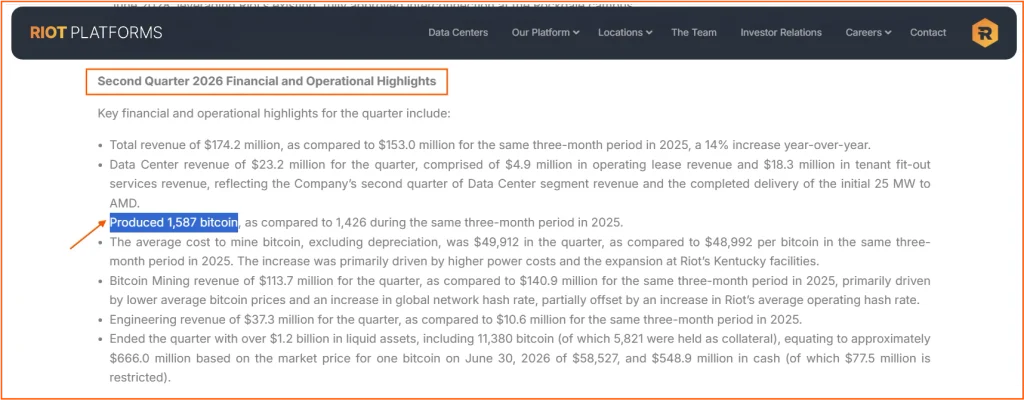
The BTC sales confirm what the cost data implies. Riot sold 4.300 BTC in Q2, bringing its H1 2026 total to 9.665 BTC. The Q1 component of 3,778 BTC generated roughly $289.5 million. The H1 total of 9.665 BTC at blended average prices represents approximately $680 million in proceeds.
A significant portion of that capital is funding the company’s 191 MW lease with Anthropic at its Rockdale, Texas campus, a 20-year agreement with initial term revenue of approximately $9.1 million and potential total contracted value of $16.1 billion across two extension options. Total capital expenditure for the build is estimated at $2.1 to 2.3 billion, implying $11 to $12 million per IT megawatt with an estimated NOI margin of 80 to 90%.
Balance Sheet Liquidity and Data Center Expansion
Riot ended Q2 with $1.2 billion in liquidity, $549 million in cash and 11,380 BTC valued at $666 million. More than half of that BTC is pledged or loaned as collateral. The company’s data center engineering segment (ESS Metron and E4A) generated $37.3 million in Q2 revenue, up 252% year over year, with backlog at $177 million of which approximately 90% is data center-related. Bitcoin mining contributed $113.7 million. The direction of travel is evident in those numbers without requiring extrapolation.
The Divergence Confirmed in Audited Numbers
Against this backdrop of operational losses, collapsing mining revenue, and mass BTC liquidation, mining equities have outperformed spot Bitcoin by a margin that markets did not previously consider plausibly. Riot is up 58% year to date as of August 24. Bitcoin is down 27% over the same window. The IBIT ETF, a direct proxy for spot Bitcoin exposure, is down 27% year to date. The divergence between RIOT and IBIT on identical calendar dates represents 85 percentage points of relative performance.
CoinShares data confirmed the valuation bifurcation with precision: miners with secured HPC contracts now trade at EV/NTM sales multiples of 12.3x, while pure-play miners trade at 5.9x. The premium for AI contract exposure is 108%, more than double the multiple for comparable hashrate without AI optionality. MARA, despite its $611 million Q2 loss, trades at a premium to pure-play miners because of its Long Ridge acquisition and the optionality it creates. Its 4.8 GW land pipeline and $600 million Texas site acquisition are priced as future AI infrastructure, not future mining capacity.
The companies without AI contracts pipelines tell the inverse theory with equal clarity. Bitdeer is down approximately 20% year to date. Argo Blockchain is down 24%. Canaan, a pure-play ASIC manufacturer with no meaningful AI pivot underway, is down 71% year to date, its $264 million market cap representing what the market assigns to mining exposure without the AI optionality premium. The same sector, priced across a 130-percentage-point range, based almost entirely on a single variable, whether the company’s power infrastructure has been committed to AI compute contracts.
Bitcoin Miners Sold 32K+ BTC in H1: What It Means
MARA sold 23,093 BTC in H1 2026 and in same window Riot sold 9,665 BTC. Together, the two largest publicly traded miners liquidated 32,758 BTC in the first six months of 2026, at blended prices averaging approximately $70,000 to $73,000, generating roughly $2.3 billion in proceeds. That figure does not include selling from Clean Spark, Hut 8, TeraWulf, Cipher, Bitfarms, Bit Digital, or any of the other dozen publicly traded miners with active treasury management programs.
The conventional framework for interpreting large-scale miner BTC selling is capitulation: forced liquidation driven by inability to cover operating costs. That framework is insufficient for 2026 conditions. A portion of H1 selling was genuinely forced, MARA’s Q2 purchased energy cost of $38,690 per BTC, combined with $611 million in quarterly losses, created real liquidity pressure.
But the dominant driver of the aggregate selling was strategic , converting the Bitcoin treasury into the USD capital required to build AI data centre infrastructure that will not generate revenue for 12 to 36 months. Riot’s 191 MW Anthropic contract requires approximately $2.1 to $2.3 billion in construction spending.
MARA’s Long Ridge acquisition cost $1.5 billion. These are not break-even transactions funded by distress. They are capital formation events funded by an asset that happened to be available in quantity.
The implication for on-chain Bitcoin analysis is material. Standard miner capitulation models assume BTC selling flows from miners who cannot sustain operations and will exit the network. The 2026 selling is flowing from miners who are expanding operations, into a different market. The sellers are not leaving. They are funding their next business, which happens to require different inputs than SHA-256 hashing.
The Network Security Question the AI Pivot Cannot Resolve
Bitcoin’s difficulty mechanism will continue adjusting downward until the remaining hashrate is profitable. At 125.81 trillion, with 300 EH/s estimated offline and a 2026 scorecard showing ten downward adjustments against seven upward ones, the network is still finding its post-ATH equilibrium.
The protocol is designed for exactly this scenario and will resolve it through further difficulty compression until marginal operators return to profitability which, at current hashprice around $30 per PH/s per day and BTC at $64,000, likely requires either a BTC price recovery above $80,000 or further difficulty decline of 10 to 15%.
What the difficulty mechanism cannot address is the question of where the equilibrium stabilises in a world where the highest return use of new grid connected megawatts is AI compute rather than Bitcoin mining. Riot signed a 20-year, 191 MW lease. MARA is building a 1GW AI campus. These are not 12 month pilot programmes.
They are decade-scale capital commitments that permanently remove power capacity from the Bitcoin mining addressable market. When miners describe mining power as ‘symbiotic’ with AI monetising capacity while data centres are built, they are describing mining as a transitional use case, not a permanent one.
August 2026 Market Snapshot: Decoupling Confirmed
The August 2026 snap shot is this: Bitcoin’s network difficulty is 15.1% below where it started the year, sitting 0.7% above its annual floor after the majority of recovery attempts have been reversed. The two largest public miners lost a combined $611 million and $150+ million respectively in a single quarter while growing their hashrate. They sold a combined 32,758 BTC in six months to fund infrastructure that has nothing to do with Bitcoin mining.
And their stocks beat Bitcoin by massive percentage points year to date. The decoupling is no longer a thesis. It is a reported fact, sourced from SEC filings, confirmed in earnings calls, and visible in every relative performance chart that compares RIOT or MARA against IBIT across any timeframe in 2026.
Was this writing helpful?

Trust with CoinPedia:
CoinPedia has been delivering accurate and timely cryptocurrency and blockchain updates since 2017. All content is created by our expert panel of analysts and journalists, following strict Editorial Guidelines based on E-E-A-T (Experience, Expertise, Authoritativeness, Trustworthiness). Every article is fact-checked against reputable sources to ensure accuracy, transparency, and reliability. Our review policy guarantees unbiased evaluations when recommending exchanges, platforms, or tools. We strive to provide timely updates about everything crypto & blockchain, right from startups to industry majors.
Investment Disclaimer:
All opinions and insights shared represent the author's own views on current market conditions. Please do your own research before making investment decisions. Neither the writer nor the publication assumes responsibility for your financial choices.
Sponsored and Advertisements:
Sponsored content and affiliate links may appear on our site. Advertisements are marked clearly, and our editorial content remains entirely independent from our ad partners.