
 Advertise



NVDA Stock Set for a Strong Rebound After Earnings: Can Bulls Take Control?


Nvidia reported Q3 FY2027 revenue of $115.8 billion, up 103% year over year, beating Wall Street expectations.
Data Center revenue surged 110% to $107.6 billion, while adjusted EPS reached $2.68.
Nvidia projected $130 billion in Q4 revenue, sending NVDA shares approximately 2.5% higher in premarket trading.
Nvidia stock (NASDAQ: NVDA) is showing signs of a potential rebound after delivering another blockbuster quarterly earnings report, with strong AI demand and an upbeat revenue forecast giving investors fresh reasons to turn bullish. The chipmaker exceeded Wall Street expectations across its latest results and projected another quarter of substantial growth.
Why Is Nvidia Stock Rising in Premarket Today?
Nvidia shares gained approximately 2.5% in premarket trading on November 18, following the company’s third-quarter fiscal 2027 earnings announcement after Tuesday’s closing bell. The stock had ended the previous session at $155.46, down 0.44%, as investors remained cautious ahead of the results.
However, the earnings release shifted attention back to Nvidia’s business momentum, with revenue growth exceeding 100% and management offering a stronger-than-expected outlook for the next quarter.
The initial reaction suggests investors are responding positively to continued demand for AI computing infrastructure. Nvidia’s results also provide fresh evidence that major technology companies are continuing to invest heavily in data centers and advanced processors.

Nvidia Q3 Earnings Beat: Revenue Jumps 103% to $115.8 Billion
Nvidia reported third-quarter fiscal 2027 revenue of $115.8 billion, up 103% from $57 billion in the same quarter last year. Revenue also increased 20% from the previous quarter, highlighting the continued acceleration in demand for its computing platforms.
The company reported adjusted earnings per share of $2.68, compared with $1.27 a year earlier. GAAP diluted EPS reached $2.70, while net income climbed 105% year over year to $65.3 billion. The Data Center division remained the primary growth engine, generating $107.6 billion in revenue, up 110% year over year. The segment accounted for the overwhelming majority of Nvidia’s quarterly sales, reflecting continued demand for AI accelerators, networking systems and data-center infrastructure.
Nvidia’s $130 Billion Q4 Forecast Strengthens Bullish Outlook
Beyond the quarterly earnings beat, Nvidia’s forward guidance is another major factor supporting the positive market reaction. The company expects fourth-quarter fiscal 2027 revenue of $130 billion, plus or minus 3%. This compares with analyst expectations of slightly more than $125 billion, suggesting Nvidia sees demand continuing to expand into the next quarter.
Nvidia also confirmed that its next-generation Vera Rubin NVL72 platform has entered production shipments. The systems are already operating with several infrastructure partners, including Microsoft Azure, Google Cloud, Oracle Cloud Infrastructure and CoreWeave.
Nvidia expects fourth-quarter gross margins of 71% to 72%, below the 74.8% GAAP margin reported in Q3. The decline suggests that revenue growth and margin performance will both remain important measures of the company’s execution.
AI Demand Remains Strong, but Leadership Uncertainty Adds Risk
Nvidia’s latest results reinforce the strength of AI infrastructure demand, but the stock’s outlook is not without challenges. Technology companies continue to invest in advanced computing capacity to support AI models, cloud services and enterprise applications. Nvidia’s Data Center growth demonstrates that these investments are still translating into significant chip demand.
Leadership uncertainty adds another consideration. Nvidia’s results arrived amid a major transition following Jensen Huang’s departure, with interim CEO Colette Kress leading the company while the board searches for a permanent successor. The transition could become an important factor in investor confidence, particularly given Huang’s central role in Nvidia’s strategy and product roadmap.
NVDA Stock Outlook: Can Bulls Take Control After Earnings?
Nvidia’s earnings beat and $130 billion revenue forecast have strengthened the bullish case, but the stock needs to reclaim key key levels to confirm a meaningful recovery.
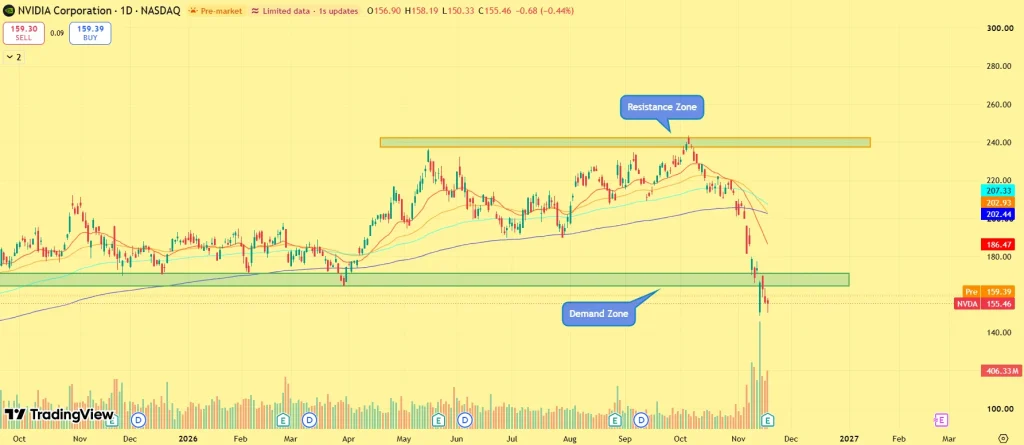
On the upside, $158–$159 is the first resistance zone to watch. A sustained breakout above this region could open the door toward $170–$171, followed by a stronger resistance area near $181–$182. These levels could become important if post-earnings buying continues.
On the downside, $154 is the immediate support level, followed by $149 and the recent 52-week low near $148.80. A break below this zone could weaken the recovery attempt and expose NVDA to further selling pressure.
Overall, a sustained move above $159 would strengthen the bullish setup, while failure to hold $154 could bring sellers back into control. The earnings reaction needs confirmation through regular-session volume and price action.
Was this writing helpful?

Trust with CoinPedia:
CoinPedia has been delivering accurate and timely cryptocurrency and blockchain updates since 2017. All content is created by our expert panel of analysts and journalists, following strict Editorial Guidelines based on E-E-A-T (Experience, Expertise, Authoritativeness, Trustworthiness). Every article is fact-checked against reputable sources to ensure accuracy, transparency, and reliability. Our review policy guarantees unbiased evaluations when recommending exchanges, platforms, or tools. We strive to provide timely updates about everything crypto & blockchain, right from startups to industry majors.
Investment Disclaimer:
All opinions and insights shared represent the author's own views on current market conditions. Please do your own research before making investment decisions. Neither the writer nor the publication assumes responsibility for your financial choices.
Sponsored and Advertisements:
Sponsored content and affiliate links may appear on our site. Advertisements are marked clearly, and our editorial content remains entirely independent from our ad partners.