


 Advertise



How Binance Crossed 300 Million Users With High Institutional Volume & Left Other Crypto Exchanges Behind?





Nidhi is a Certified Digital Marketing Executive and Passionate crypto Journalist covering the world of alternative currencies. She shares the latest and trending news on Cryptocurrency and Blockchain.


Between 2023 and 2026, Binance underwent one of the largest corporate transformations in crypto history.
The company moved from:
- A $4.3 billion regulatory settlement,
- The imprisonment and resignation of founder CZ,
- Lawsuits from the SEC and CFTC,
- Intense global scrutiny,
To becoming:
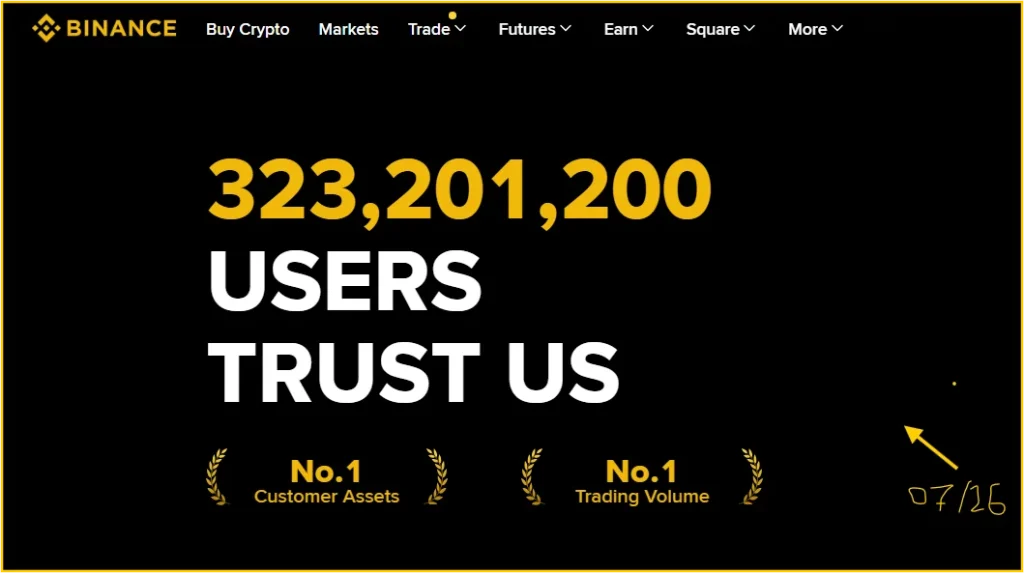
- The first crypto exchange to exceed 300 million users, currently 323 million users,
- The largest liquidity venue in digital assets,
- One of the largest holders of crypto assets globally it held $127.45 Billion worth assets,
- An increasingly institutional and compliance-focused financial infrastructure company. To date, Binance has supported several global authorities across 313,653 law-enforcement requests.
At the same time, competitors carved out their own strength in institutional custody and trading infrastructure, mainly creating three distinct exchange models that now dominate the industry, Binance, Coinbase, and OKX these are the top CEX in 2026.

The Big Question
“How did Binance continue growing while facing the largest regulatory assault ever directed at a crypto company?”
The answer lies in six major pillars:
- Liquidity dominance
- Global distribution
- Product expansion
- Institutional onboarding
- Compliance transformation
- Ecosystem ownership
1. Binance by the Numbers
Binance 2025 Performance Snapshot
| Metric | Value |
| Registered Users | 300M+ |
| Trading Volume | $34 Trillion |
| Historical Trading Volume | $125T+ |
| User Assets Held | $162.8B |
| Spot Market Share | 42.09% |
| Derivatives Market Share | 34.74% |
| Supported Assets | 449+ |
| Trading Pairs | 1,880+ |
| Daily Trading Volume | $65B+ average |
| Institutional Volume Growth | 21% YoY |
| Retail Trading Growth | 125% YoY |
| Fiat and P2P Growth | 38% YoY |
| OTC Fiat Volume Growth | 210% YoY |
Binance’s scale today is larger than most competitors combined and represents one of the largest financial marketplaces globally, per the report 2025.
2. The Liquidity Flywheel
Most exchanges compete on fees. But, Binance is an exception that competes on liquidity.
The process is self-reinforcing:
More users → More liquidity → Better execution → More institutions → More liquidity
Pretty clean practical concept Binance utilizes and this liquidity advantage creates:
- tighter spreads,
- lower slippage,
- larger executable block trades,
- deeper derivatives books,
- better price discovery.
For institutional traders executing eight-figure positions, execution quality matters far more than fee discounts. This is Binance’s largest moat.
3. Binance vs Coinbase vs OKX
The crypto exchange market is no longer one battle. It has evolved into three separate business models.
| Category | Binance | Coinbase | OKX |
| Core Strength | Liquidity | Trust | Trading Infrastructure |
| Main User Base | Global Retail | US Institutions | Global Active Traders |
| Exchange Token | BNB | None | OKB |
| Registered Users | 300M+ | 120M+ | 120M+ |
| Global Ranking | #1 | #2 | #3 |
| Monthly Trading Volume | $250B | $43B | $44B |
| Spot Share | 42.09% | 6-8% | 5-7% |
| Derivatives Share | 34.74% | 0.51% Limited | 16.51% Very Large |
That said, Binance dominates liquidity. Coinbase dominates custody. OKX dominates trading infrastructure and CeDeFi integration.
4. On-Chain Asset Comparison
According to Arkham Intelligence data, Binance and Coinbase are the two largest crypto entities in the world by on-chain assets.
| Holdings | Binance | Coinbase | OKX |
| Total Assets | $127.45B | $85.08B | $22.71B |
| BTC Holdings | 669.90K BTC | 973.96K BTC | 123.11K BTC |
| ETH Holdings | 4.056M ETH | 4.14M ETH | 1.17M ETH |
| USDT Holdings | $41.04B | $407.41M | $9.42B |
| USDC Holdings | $7.80B | $11.45B | $1.22B |
| USD1 Holdings | $3.03B | $8.33M | $5.17M |
| Arkham Tracking | Binance holdings | Coinbase holdings | OKX holdings |
However, these figures tell very different stories. Coinbase’s BTC is largely institutional ETF custody. It is primarily driven by their role as the underlying institutional custodian for the majority of US Spot Bitcoin ETFs, most notably BlackRock’s iShares Bitcoin Trust (IBIT).
Binance’s balances largely represent exchange liquidity and customer assets. As in USDT its $41.04B while Coinbase holds a meager $407.41M. This massive difference shows that Coinbase is a clear vault for US Wall Street asset managers, whereas Binance holds the literal fuel (USDT velocity) that powers global crypto trading volumes.
5. Stablecoins Explain Binance’s Dominance
Perhaps Binance’s biggest hidden advantage is stablecoin concentration. By H1 2026, total stablecoins are worth over $54B+.
These reserves provide:
- deeper order books,
- tighter spreads,
- superior OTC liquidity,
- faster settlement,
- stronger derivatives support.
In crypto markets, liquidity follows stablecoins.
Binance owns more stablecoin liquidity than any exchange in the industry.
6. Institutional Expansion
Binance quietly transformed itself into an institutional exchange.21% Institutional Volume growth, 210% frowth in OTC Volume, and has expanded fund accounts. Also, Binance has expanded wealth products and even introduced off-exchange settlement.
Meanwhile competitors targeted different segments.
| Category | Binance | Coinbase | OKX |
| Institutional Product | Ceffu (Custody Partner) / VIP Services | Coinbase Prime | OKX Institutional (Includes OKX VIP Pass and Nitro Spreads) |
| ETF Custody / Strategy | Global Synthetic Overlay – Deploys stablecoin-settled ETFs and tokenized US equities directly on-chain for international traders. | Physical Spot Custody – Dominant and primary custodian for the vast majority of US Spot Bitcoin and Ethereum ETFs. | Synthetic Derivative Overlays – Provides ETF X-Perps (Perpetual Futures) tracking traditional indices like SPY/QQQ. |
| Off-Exchange Settlement | Industry Pioneer – Utilizes MirrorX & MirrorRSV allowing asset mirroring from cold storage and triparty bank accounts. | Internal Clearing Model – Operates a siloed, integrated internal prime broker clearing engine without external triparty custody. | Multi-Custodian Network – Integrates via BitGo OES and a Standard Chartered-BlackRock framework using BUIDL tokens as collateral. |
| Institutional AUC | Not Public – Financial allocations are kept confidential, obscured via Ceffu corporate structures and private banking setups. | Over 12% of Global Crypto Market Cap – Publicly listed, transparently holding massive institutional spot volume under custody. | Over $31.5 Billion – Transparently verified via a consistent, audited monthly Proof of Reserves (PoR) program. |
| Core Market Advantage | Deepest International Liquidity – Unmatched global spot/derivative order book depth and dominant global stablecoin volume. | US Regulatory Monopoly – Strongest compliance framework targeting US institutions, corporations, and pension funds. | The Advanced Spread Hub – Industry-best API infrastructure tailored for basis trading and high-frequency programmatic market makers. |
7. Regulation: From Weakness to Strength
In 2023 Binance represented the industry’s biggest regulatory target. But by 2026 it had become one of crypto’s largest compliance organizations.
| 2023 Binance | 2026 Binance |
| DOJ Settlement | Multi-Jurisdiction Licensing |
| $4.3B Fine | Compliance Expansion |
| Regulatory Uncertainty | Institutional Relationships |
| Leadership Crisis | Governance Stability |
| Adversarial Stance | Regulatory Engagement |
Binance reportedly now spends millions annually on compliance, exceeding spending levels of many traditional financial institutions.
8. The SEC Victory
One of the biggest developments for Binance and BNB holders came when the SEC agreed to dismiss its remaining lawsuit against Binance with prejudice.
This means:
- the SEC cannot refile the same case,
- legal uncertainty surrounding BNB decreased substantially,
- institutional confidence improved.
For Binance, this represented one of the largest legal victories in company history.
9. Security and User Protection
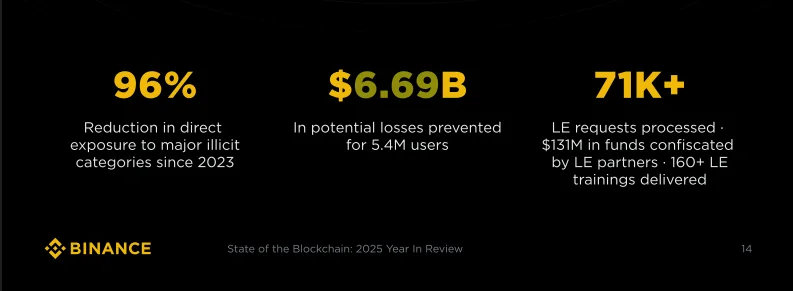
| Metric | Result |
| Fraud Prevented | $6.69B |
| Users Protected | 5.4M |
| Annual Compliance Spend | $300M |
| Major Fraud Blocked by AI | $10.53B |
| Law Enforcement Requests Processed | 71,000+ |
| Recovery Assistance | $131M |
Binance’s use of AI-driven fraud detection increasingly resembles large financial institutions rather than early crypto exchanges.
10. The Ecosystem Strategy
Most exchanges stop at trading. But, Binance built an entire economy.
Binance Ecosystem Components
| Category | Product |
| Layer 1 | BNB Chain |
| Layer 2 | opBNB |
| Data Layer | BNB Greenfield |
| Wallet | Binance Wallet |
| Launch Platform | Binance Launchpad |
| Payment Network | Binance Pay |
| Custody | Ceffu |
| Web3 Discovery | Binance Alpha |
Meanwhile:
11. Binance Pay and Real World Adoption
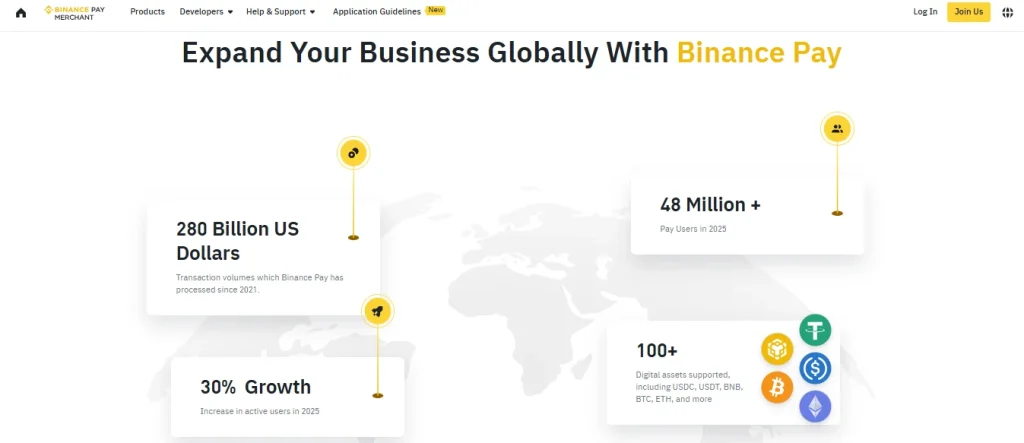
One of Binance’s least discussed successes is payments.This data positions Binance as one of the largest crypto payment infrastructures globally.
| Metric | Value |
| Merchant Ecosystem (B2B- total number of physical stores, e-commerce websites, platforms, and service providers) | 20M+ (1,700x YoY Increase) |
| Active User Growth | 30% Increase in 2025 |
| Total Pay Users | 48 Million+ in 2025 |
| Cumulative Volume | $280 Billion USD (Since 2021) |
| Fiat & P2P Volume | +38% YoY |
12. Native Asset Valuation and Network Fundamentals
An evaluation of Binance’s ecosystem acceleration is reflected in the market performance, on-chain utility, and derivatives architecture of its native asset, BNB.
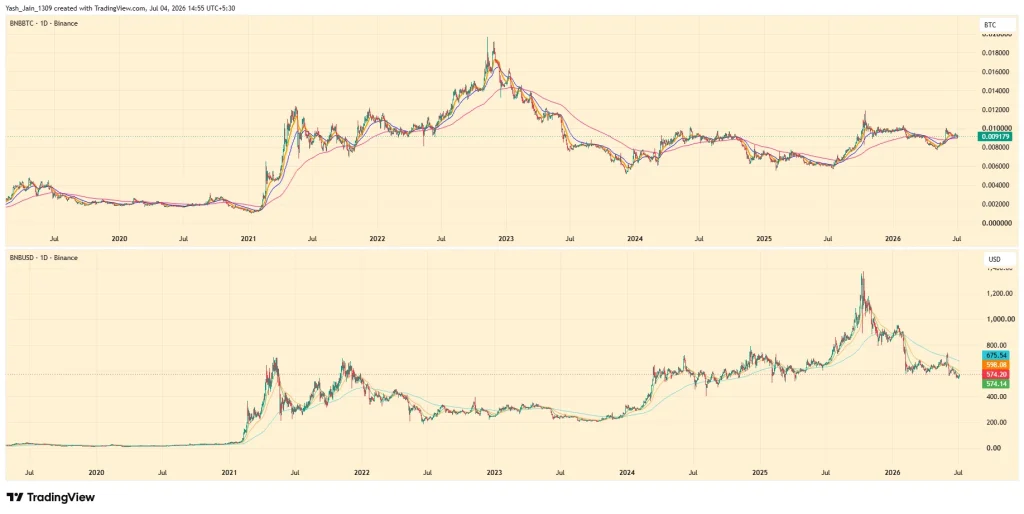
Macro Price Action and Structural Inversion
A technical evaluation of the weekly charts highlights a structural shift in both the fiat and cryptocurrency denominational pairs:
- BNB/USD Matrix: Following the localized consolidation patterns of 2024–2025, BNB experienced an expansion phase, setting an all-time high above $1,200 before entering a healthy structural retest. As of July 4, 2026, BNB/USD trades at $574.20, holding firmly above the multi-year support/resistance (S/R) flip zones established during the 2021 and 2024 macro cycles.
- BNB/BTC Relative Strength: The BNBBTC weekly pair demonstrates systemic market outperformance. BNB/BTC maintains a highly consolidated position at 0.009174 BTC, printing consecutive higher lows relative to historical cycles. This reveals that the asset functions as an institutional capital sink rather than a speculative instrument, retaining value during periods of capital rotation out of major digital assets.
Also Read : Binance Coin (BNB) Price Prediction 2026, 2027 – 2030: Will BNB Price Hit $2000?
On-Chain Velocity and Network Architecture
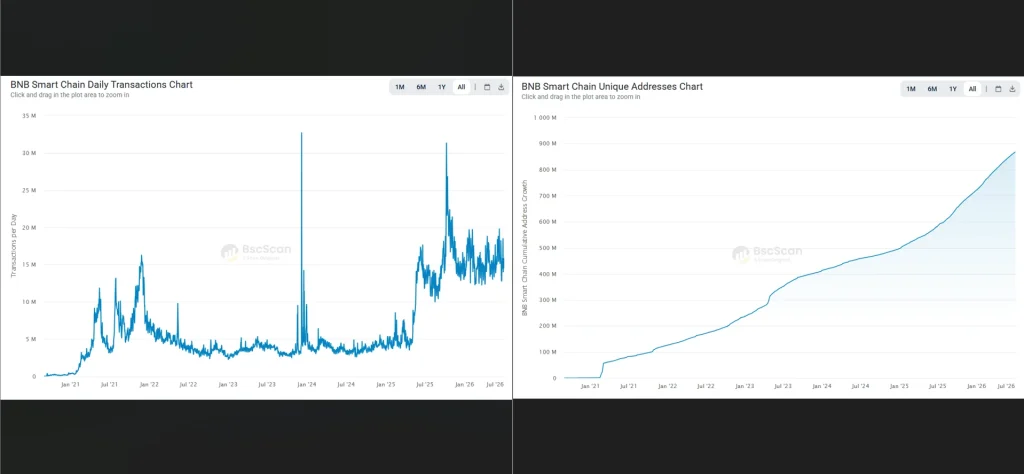
The baseline fundamentals on the BNB Smart Chain (BSC) confirm that asset valuation is driven by processing demand and network utility rather than speculative sentiment:
- Daily Transaction Volume: Long-term transaction data demonstrates that after a prolonged baseline consolidation throughout 2022–2024, network velocity expanded violently in mid-2025, printing a major activity spike over 30 million daily transactions. As of mid-2026, the network maintains a consistent, high-density equilibrium of 15 million transactions per day, reflecting real-world gas consumption from CeDeFi integrations and ecosystem utility.
- Address Accumulation Vectors: The unique address growth profile displays a continuous, unyielding upward trajectory. By July 2026, cumulative unique addresses on the BNB Smart Chain broke past 870 million addresses, demonstrating an accelerating network-effect moat that matches the broader exchange platform’s client acquisition metrics.
Derivatives Capital Density
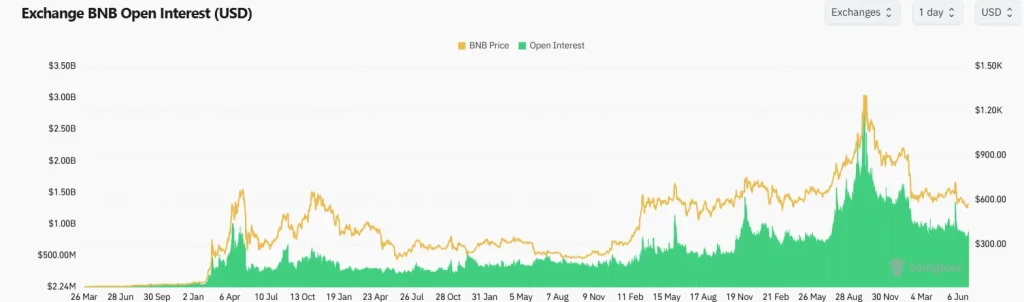
An analysis of the derivatives layout underscores a structural shift in institutional market-making behavior:
Risk Premium Mitigation: Following the localized price contraction to the current $570 zone, Open Interest compressed symmetrically toward a healthy floor of around $1.00 Billion USD. This leverage wipeout without a breakdown of the core support shelf indicates that the systemic downside risk premium has been fully absorbed, cementing a structurally sound market architecture for the second half of 2026.
Open Interest Concentration: During the historic price expansion to macro highs, aggregate exchange Open Interest (OI) scaled past $2.50 Billion USD, signaling deep liquidity deployment by programmatic participants.
13. The CZ Chapter
The June 2026 CoinDesk interview provided important insight into CZ’s post-Binance future.
CZ’s Portfolio Allocation
| Sector | Allocation |
| Crypto & Blockchain | 70% |
| AI | 20% |
| Biotechnology | 10% |
CZ’s Views
| Topic | Position |
| Returning as CEO | No |
| Binance Role | Largest Shareholder |
| AI Agents | Major Growth Driver |
| Crypto Payments | Native AI Currency |
| DePIN | Long-Term Opportunity |
| Security | AI Will Help Defenders |
| US Outlook | Improved Environment |
CZ described himself as a “zero-to-one founder” who prefers building startups rather than operating large corporations. He stated that he has no intention of returning as Binance CEO while remaining deeply invested in the ecosystem’s long-term success.
14. Why AI Could Become Binance’s Next Growth Engine
CZ believes AI agents will eventually:
- search for products,
- negotiate services,
- book travel,
- hire software,
- purchase compute power,
- transact autonomously.
The missing component today is payments.
According to CZ: Crypto becomes the native payment layer for AI agents.
If that thesis proves correct, exchanges may evolve from human trading venues into machine-to-machine financial infrastructure.
15. Challenges Still Facing Binance
Despite its success, Binance still faces important challenges:
- Continued geopolitical scrutiny, especially, MiCA licensing difficulties in Europe.
- Competition from Coinbase in institutions.
- Competition from OKX in derivatives and CeDeFi.
- Decentralized exchanges capturing market share.
The exchange’s future growth increasingly depends on regulation rather than technology alone.
16. Forward Outlook: H2 2026 Macro Trajectory
- The Post-July 1st MiCA Reality: Euro Liquidity Fragmentation: The absolute final deadline for MiCA’s transitional period passed on July 1, 2026. Any offshore exchange operating without a full CASP license has officially lost its legal cover to serve the EEA. For Binance, the immediate hurdle in H2 2026 is stablecoin migration. Because MiCA’s strict e-money token (EMT) rules make non-compliant giants like USDT illegal for EU platforms, Binance’s $54B+ stablecoin concentration faces a structural reshuffle. To protect its massive spot liquidity moat, the exchange must aggressively rotate European volume into compliant alternatives like USDC or newly authorized Euro stablecoins.
- Machine-to-Machine (M2M) Economy: Bots with Wallets: Building directly on CZ’s June 2026 thesis, the human-to-human trading era is sharing the stage with automated agents. As AI bots scale from booking flights to autonomously purchasing raw compute power and API data, they require a native, frictionless payment rail. In H2 2026, expect Binance Pay to shift from a consumer payment tool into a foundational infrastructure layer, rolling out specialized AI-SDKs. If crypto becomes the native currency for AI agents, Binance is positioned to capture the earliest wave of machine-to-machine transaction fees.
- Institutional Vault Battles: The Cold War for Collateral: With Binance’s institutional volumes tracking at a 21% YoY baseline, the growth engine for late 2026 is pure capital efficiency. The battleground isn’t lower trading fees; it’s off-exchange settlement velocity. Binance’s reliance on Ceffu and MirrorX will go head-to-head with OKX’s newly established Standard Chartered-BlackRock framework. The winning exchange will be whichever platform allows Wall Street market makers to trade massive eight-figure blocks on deep central limit order books without their assets ever leaving independent third-party banks or cold storage.
Conclusion
Binance did not survive its regulatory crisis by returning to its old model. It survived by becoming something entirely different.
| Old Binance | New Binance |
| Founder Driven | Institution Led |
| Regulatory Target | Compliance Organization |
| Retail Exchange | Financial Infrastructure |
| Trading Platform | Multi-Product Ecosystem |
| Crypto Startup | Global Financial Network |
The competitive landscape now looks remarkably clear:
| Exchange | What They Won |
| Binance | Liquidity |
| Coinbase | Trust |
| OKX | Infrastructure |
Binance won the first era of crypto by dominating liquidity. Coinbase won the institutional era by dominating custody.
OKX is trying to win the next era by becoming the infrastructure layer connecting tokenized finance, real-world assets, and institutional capital.
The result is that Binance already crossed 300 million users not because it avoided crisis, but because it used that crisis to reinvent itself faster than the rest of the industry.
Was this writing helpful?

Trust with CoinPedia:
CoinPedia has been delivering accurate and timely cryptocurrency and blockchain updates since 2017. All content is created by our expert panel of analysts and journalists, following strict Editorial Guidelines based on E-E-A-T (Experience, Expertise, Authoritativeness, Trustworthiness). Every article is fact-checked against reputable sources to ensure accuracy, transparency, and reliability. Our review policy guarantees unbiased evaluations when recommending exchanges, platforms, or tools. We strive to provide timely updates about everything crypto & blockchain, right from startups to industry majors.
Investment Disclaimer:
All opinions and insights shared represent the author's own views on current market conditions. Please do your own research before making investment decisions. Neither the writer nor the publication assumes responsibility for your financial choices.
Sponsored and Advertisements:
Sponsored content and affiliate links may appear on our site. Advertisements are marked clearly, and our editorial content remains entirely independent from our ad partners.