



 Advertise



Is Bitcoin Price Approaching Its Final Capitulation? Here’s What Whale Data Suggests




Bitcoin whale data shows growing stress among large market participants, which brings the price to a crucial turning point
BTC could reclaim $65,000 if buyers defend $60,000, while a breakdown below that level may trigger another wave of capitulation.
Bitcoin price has erased nearly all the gains from its latest bullish move that pushed the price above $64,000, reflecting growing uncertainty among traders as buying strength continues to struggle against persistent selling pressure. As sentiment weakens, liquidity has increasingly rotated into emerging altcoins like Humanity and Audiera, fundamentally strong projects such as Hyperliquid, and privacy-focused tokens like Zcash.
Meanwhile, BTC is gradually making its way back toward the $61,000 level, placing the market at a critical juncture. The key question now is whether Bitcoin will sweep below $60,000 to complete a capitulation phase or recover and reclaim the $65,000 mark.
Bitcoin Whale Data Paints a Picture of a Market Under Stress
The latest on-chain data from CryptoQuant suggests that Bitcoin’s largest market participants are entering a critical phase of the current correction. These metrics help determine whether Bitcoin price is approaching a final capitulation event before recovery or whether additional selling pressure could drive the price lower in the near term.
Short-Term Bitcoin Whales Are Under Extreme Stress
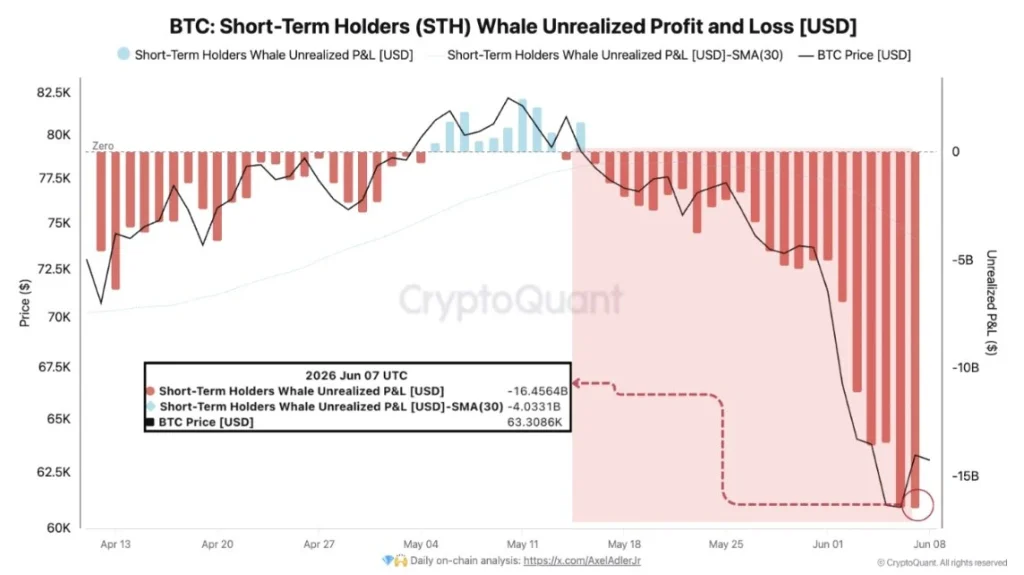
The first on-chain indicator suggests that recent Bitcoin whales are facing one of the most stressful periods of the current cycle. Data from CryptoQuant shows that the unrealized profit and loss (P&L) of short-term whale holders has plunged to nearly -$16.5 billion, marking one of the deepest negative readings in recent months.

As Bitcoin slipped below key support zones, these investors quickly moved into significant unrealized losses. Although the chart does not flash a bearish signal, it indicates that the market is entering a high-stress environment where volatility is likely to increase. Hence, the next directional move could be decisive.
Whale Capitulation Has Already Begun as Billions in Losses Are Realized
The second chart highlights the potential loss, which may have intensified the pressure on the token. According to CryptoQuant’s whale cohort data, Bitcoin whales have already realized more than $2.5 billion in losses, indicating that some large holders are actively exiting positions instead of waiting for a recovery.
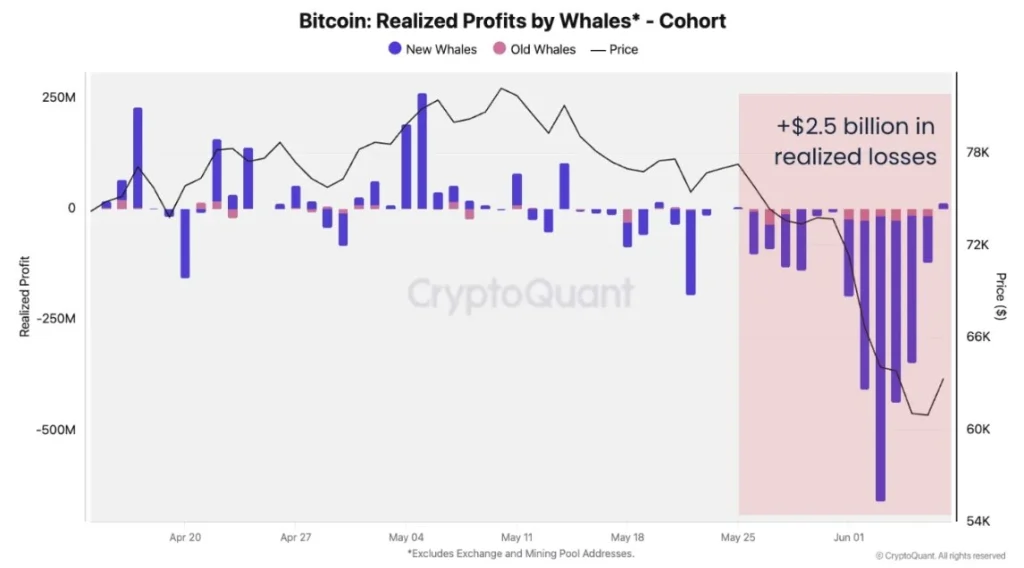
Such behaviour typically appears during periods of panic or forced liquidation, when conviction weakens, and risk management takes priority over long-term expectations. Historically, large clusters of realized losses often coincide with capitulation phases, where the transfer of coins from weaker holders to stronger hands sets the stage for the next major trend.
Rising Whale Exchange Inflows Suggest Selling Pressure Has Yet to Fully Ease
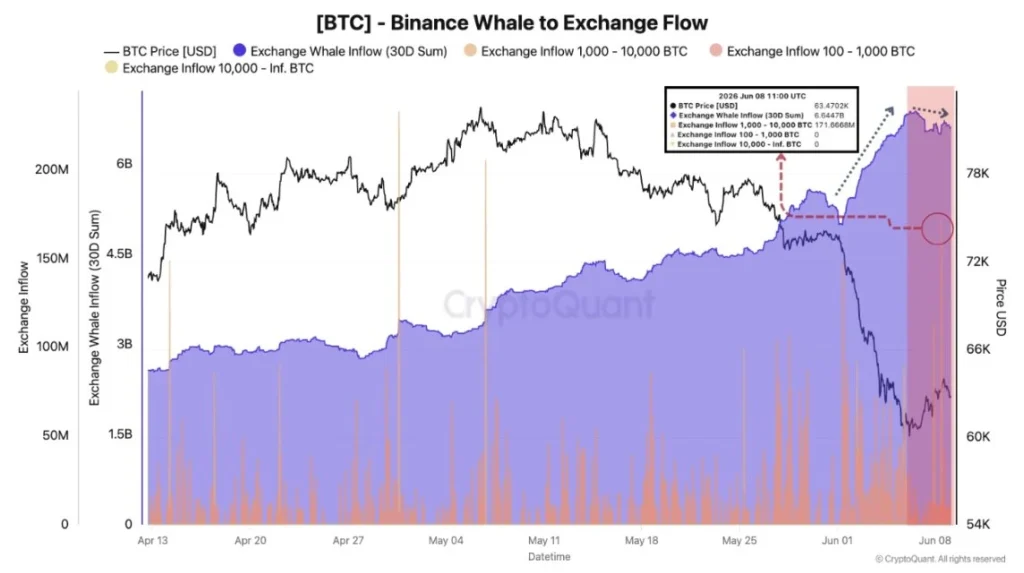
This chart highlights the cautious outlook. The Bitcoin whale-to-exchange inflows continue to trend higher, with the 30-day cumulative flow reaching elevated levels. Meaning, more BTC controlled by large holders is being transferred to exchanges, where it becomes readily available for selling.
Combined with deep unrealized losses and rising realized losses, the data suggest that large market participants remain under considerable pressure. If exchange inflows begin to stabilize while capitulation subsides, Bitcoin could be approaching a final stress phase before recovery.
Is Bitcoin Near Its Final Capitulation or Another Leg Lower?
Taken together, the three whale indicators suggest that Bitcoin price is entering a high-stress phase rather than confirming a definitive bearish breakdown. Such conditions have often emerged during late-stage capitulation events, when weaker hands exit the market before a new trend develops. However, they can also precede another liquidity sweep if selling pressure persists.
Currently, the $60,000 level remains the key psychological support. A successful defense of this zone could allow BTC to regain momentum and target $65,000 in the near term. Conversely, a decisive break below $60,000 would likely trigger another wave of liquidations, increasing the probability of a deeper correction before a sustainable recovery begins.
In other words, the whale data does not guarantee that Bitcoin has found its bottom, but it does suggest that the market is approaching a critical turning point where the next major trend is likely to be decided.
Was this writing helpful?

Trust with CoinPedia:
CoinPedia has been delivering accurate and timely cryptocurrency and blockchain updates since 2017. All content is created by our expert panel of analysts and journalists, following strict Editorial Guidelines based on E-E-A-T (Experience, Expertise, Authoritativeness, Trustworthiness). Every article is fact-checked against reputable sources to ensure accuracy, transparency, and reliability. Our review policy guarantees unbiased evaluations when recommending exchanges, platforms, or tools. We strive to provide timely updates about everything crypto & blockchain, right from startups to industry majors.
Investment Disclaimer:
All opinions and insights shared represent the author's own views on current market conditions. Please do your own research before making investment decisions. Neither the writer nor the publication assumes responsibility for your financial choices.
Sponsored and Advertisements:
Sponsored content and affiliate links may appear on our site. Advertisements are marked clearly, and our editorial content remains entirely independent from our ad partners.