


 Advertise



AAVE Price Drops After DeFi Exploit Triggers Liquidation Cascade — Is $85 Next?



A DeFi exploit triggered the initial shock, creating structural damage and prolonging pressure on AAVE price action.
AAVE remains near support, but weak recovery and rising open interest suggest downside risk is active unless key resistance levels are reclaimed.
Aave is dealing with the aftermath of a DeFi exploit, but the real damage came after. The event sparked a liquidation cascade that wiped out leveraged positions and pushed the price into a weak demand zone. Now, with support under pressure and traders reloading positions, the market looks far from stable. Is this where the AAVE price finds a floor—or is another move lower already in motion?
Exploit Triggered the Drop — Aave Moves to Contain Risk
The trigger came from an exploit tied to rsETH collateral (linked to KelpDAO), which exposed a structural weakness rather than a direct flaw in Aave itself. Attackers used rsETH within Aave’s lending markets to borrow large amounts of ETH, and when those positions turned unstable, it left the protocol with bad debt exposure. This wasn’t a smart contract hack on Aave — it was a case of collateral risk spilling into the lending layer.
Aave responded quickly to contain the damage. The protocol froze rsETH markets across Aave V3 (and related deployments, including upcoming V4 considerations) to prevent further borrowing and limit risk propagation. At the same time, liquidity stress intensified as users rushed to withdraw funds, pushing utilization rates higher and triggering forced liquidations. That combination — exploit-driven stress + defensive protocol action + user-driven exits — is what ultimately accelerated the downside move in AAVE.

Liquidations Accelerated the Downside
The exploit didn’t just trigger selling — it forced it. As liquidity tightened and prices started slipping, leveraged positions were pushed into liquidation. That created a cascade effect, where each forced exit added more pressure to the downside.
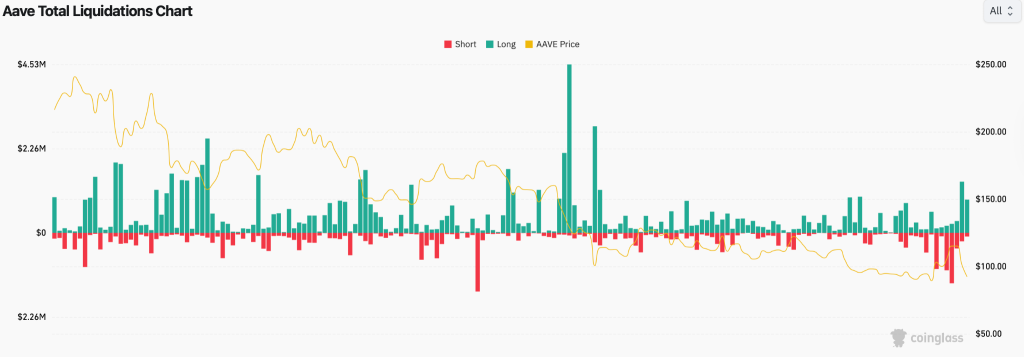
This type of move is typically fast and aggressive, and that’s exactly what played out. The sell-off wasn’t gradual — it was driven by forced unwinds rather than organic selling, which explains the sharp breakdown in price and the speed of the move.
AAVE at a Critical Level — Breakdown or Bounce Ahead?
AAVE is now testing a key demand zone near the $88–$92 range, a level that has already seen multiple reactions. Price also failed to reclaim the $95–$100 range, suggesting buyers are not in control yet. From here, the next move depends on how the price reacts at this level. A clean break below $88 could open the door toward the $85 region, with a deeper move toward $80 if selling pressure continues.
On the other hand, any recovery would first need a strong reclaim of $95, followed by acceptance above $100.
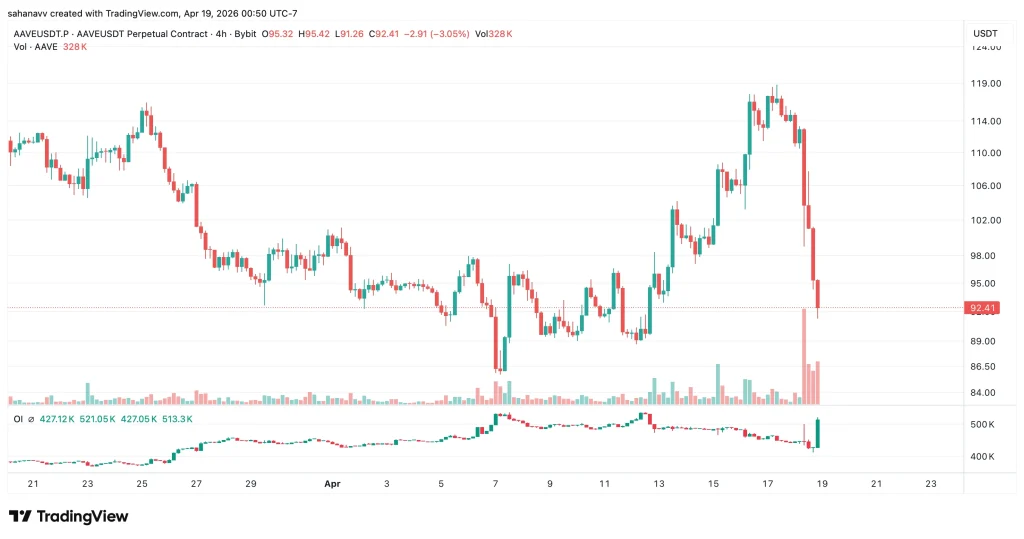
With the initial drop complete, the focus has now shifted to positioning. Open Interest (OI), which declined during the liquidation phase, has started to rise again, but the price has not shown a strong recovery. This matters. When OI builds while the price remains weak, it often signals new positions entering without clear directional control.
In many cases, this leans bearish, as markets tend to continue lower when fresh positions build into weakness. At the same time, it also increases the risk of sudden volatility if those positions get squeezed.
What Happens Next for the AAVE Price Rally?
The initial trigger is known. The liquidation phase has played out. Now, the AAVE price is entering a more uncertain phase where positioning and reaction at key levels will decide direction. Whether this turns into stabilization or another leg lower will depend on how the market responds here, but for now, the pressure hasn’t fully eased.
Was this writing helpful?

Trust with CoinPedia:
CoinPedia has been delivering accurate and timely cryptocurrency and blockchain updates since 2017. All content is created by our expert panel of analysts and journalists, following strict Editorial Guidelines based on E-E-A-T (Experience, Expertise, Authoritativeness, Trustworthiness). Every article is fact-checked against reputable sources to ensure accuracy, transparency, and reliability. Our review policy guarantees unbiased evaluations when recommending exchanges, platforms, or tools. We strive to provide timely updates about everything crypto & blockchain, right from startups to industry majors.
Investment Disclaimer:
All opinions and insights shared represent the author's own views on current market conditions. Please do your own research before making investment decisions. Neither the writer nor the publication assumes responsibility for your financial choices.
Sponsored and Advertisements:
Sponsored content and affiliate links may appear on our site. Advertisements are marked clearly, and our editorial content remains entirely independent from our ad partners.