

 Advertise



- Rizwan Ansari
 Rizwan Ansari
- Reviewed by:
 Sohrab Khawas
Sohrab is a passionate cryptocurrency news writer with over five years of experience covering the industry. He keeps a keen interest in blockchain technology and its potential to revolutionize finance. Whether he's trading or writing, Sohrab always keeps his finger on the pulse of the crypto world, using his expertise to deliver informative and engaging articles that educate and inspire. When he's not analyzing the markets, Sohrab indulges in his hobbies of graphic design, minimal design or listening to his favorite hip-hop tunes.
- Dec 11, 2025 11:54 UTC
-


U.S. Lawmakers Push to Let Crypto Into 401(k) Plans, Bitcoin Eye $250,000
Lawmakers urge SEC to open $12.5 trillion 401(k) market for Bitcoin investment access.
Industry experts say Bitcoin may soon appear in regular 401(k) plans nationwide.
Analysts predict even 1–3% 401(k) allocations could drive Bitcoin toward massive $250,000 target.
U.S. lawmakers have urged the SEC’s Paul Atkins to implement a new executive order that could let Americans invest in Bitcoin and other digital assets inside 401(k) retirement plans.
If approved, this move may unlock trillions in long-term retirement capital for the crypto market, which could push the bitcoin price toward $250K.
Lawmakers Ask SEC to Open the $12.5 Trillion 401(k) Market to Crypto
On December 11, U.S. lawmakers sent a formal letter to the SEC Chairman Paul Atkins, showing support for President Trump’s executive order that aims to allow alternative assets like Bitcoin in retirement plans.
The order, signed in August 2025, directs the Department of Labor and the SEC to update rules that currently limit what 401(k) plans can offer.
The goal of this letter is to give everyday workers the same investment choices that large pension funds enjoy. U.S. 401(k) plans hold around $12.5 trillion, and even a small opening for Bitcoin or other crypto assets could bring billions of dollars into the market.
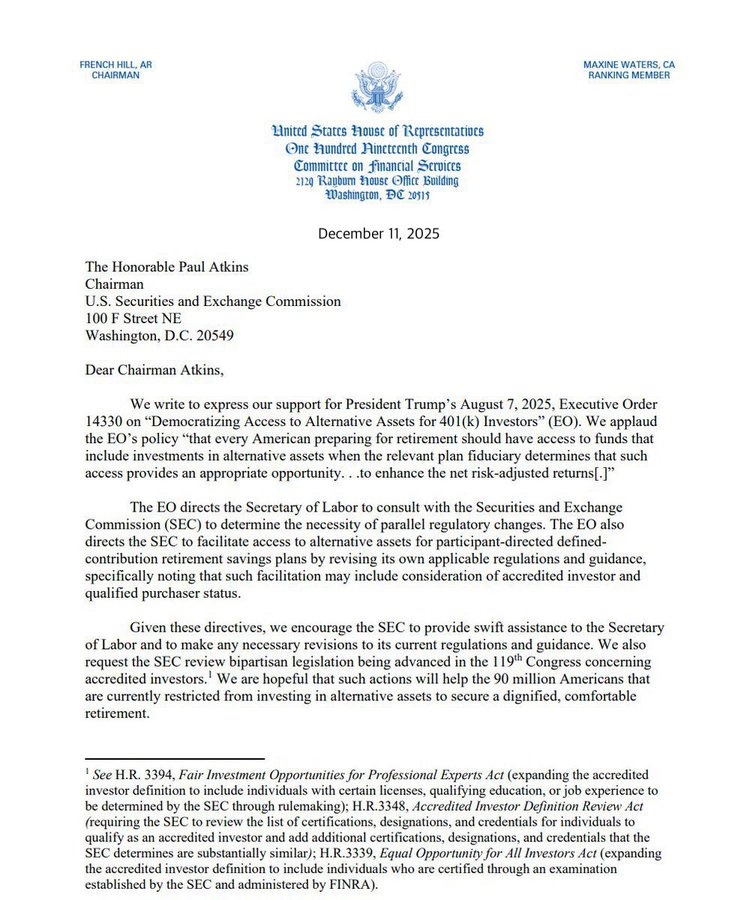
Meanwhile, Lawmakers asked the SEC to speed up these changes so people can invest in more than just stocks and bonds.
Institutional Adoption May Arrive Faster Than Expected
Industry experts believe this policy shift could be a major turning point for crypto in traditional finance. Coinbase’s CEO recently said that Bitcoin and other cryptocurrencies will eventually become a normal part of “everyone’s 401(k).”
Some companies are already preparing for this change. For example, ForUsAll has partnered with Coinbase Institutional to let employees put up to about 5% of their 401(k) savings into crypto.
This shows that the system is already in place and could expand quickly if national rules are updated.
Small 401(k) Allocations Could Push Bitcoin Toward $250,000
The shift complements other industry developments. U.S. spot Bitcoin ETFs from major firms like BlackRock and Fidelity now hold tens of billions of dollars and are widely available in IRAs and brokerage accounts.
Investors and retirement savers alike are already using these products to gain Bitcoin exposure.
If 401(k) plans also start adding Bitcoin, even a small amount like 1–3%, it could bring tens of billions in new buying.
Crypto analysts predict that such steady demand can push BTC price toward $250,000.
Never Miss a Beat in the Crypto World!
Stay ahead with breaking news, expert analysis, and real-time updates on the latest trends in Bitcoin, altcoins, DeFi, NFTs, and more.
FAQs
U.S. lawmakers are urging the SEC to allow Bitcoin in 401(k) plans, potentially giving everyday workers access to crypto investments.
Even a small 1–3% allocation in 401(k) plans could drive billions of dollars into crypto, possibly pushing Bitcoin toward $250,000.
Yes, some firms like ForUsAll already let employees invest a portion of their 401(k) in crypto, preparing for broader adoption.
Industry experts predict Bitcoin could become a normal part of 401(k) plans, similar to how large pension funds already include alternative assets.
Trust with CoinPedia:
CoinPedia has been delivering accurate and timely cryptocurrency and blockchain updates since 2017. All content is created by our expert panel of analysts and journalists, following strict Editorial Guidelines based on E-E-A-T (Experience, Expertise, Authoritativeness, Trustworthiness). Every article is fact-checked against reputable sources to ensure accuracy, transparency, and reliability. Our review policy guarantees unbiased evaluations when recommending exchanges, platforms, or tools. We strive to provide timely updates about everything crypto & blockchain, right from startups to industry majors.
Investment Disclaimer:
All opinions and insights shared represent the author's own views on current market conditions. Please do your own research before making investment decisions. Neither the writer nor the publication assumes responsibility for your financial choices.
Sponsored and Advertisements:
Sponsored content and affiliate links may appear on our site. Advertisements are marked clearly, and our editorial content remains entirely independent from our ad partners.

 Yes
Yes  No
No