



 Advertise



South Korea May Ban Planned 22% Crypto Tax After Investor Backlash Grows



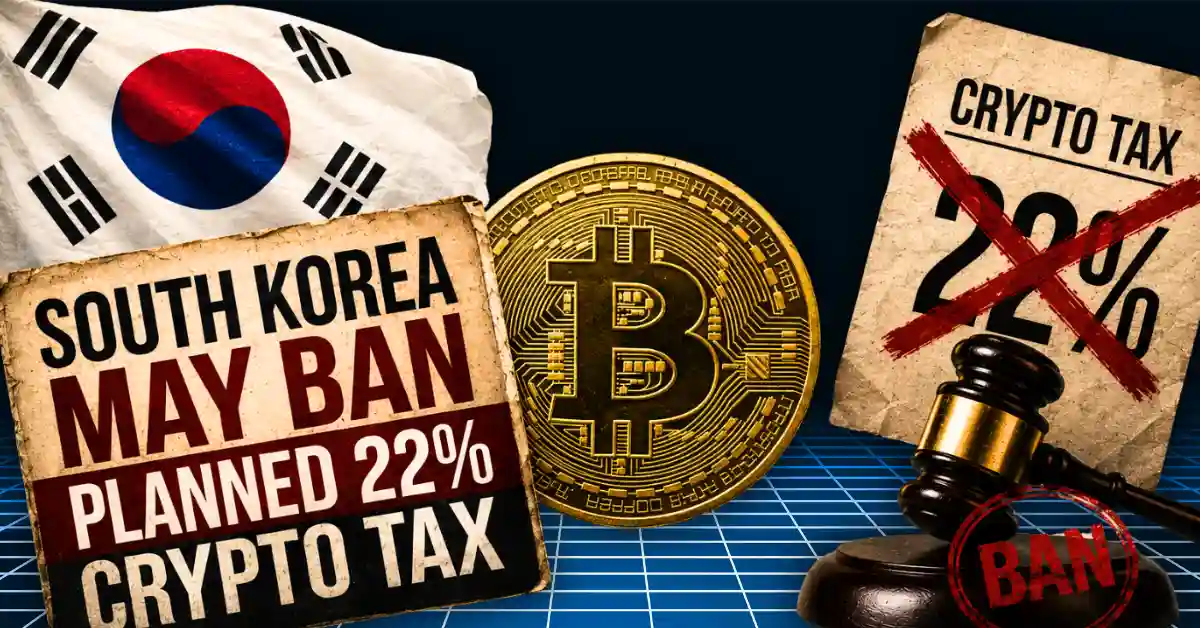
South Korea may scrap its planned 22% crypto gains tax after growing public backlash.
Proposed tax would apply to annual crypto profits above 2.5 million won, roughly $1,650 threshold.
Public petition against the crypto tax crossed 50,000 signatures, forcing parliament to formally review proposal.
South Korea is now reconsidering banning its planned 22% crypto tax after the country’s main opposition party officially introduced a bill to completely remove digital asset taxation before it takes effect in 2027.
Under the plan, crypto investors would pay a 20% capital gains tax plus an additional 2% local tax on annual crypto profits above 2.5 million won, or roughly $1,650. Now this seems to be coming to an end before it is even implemented.
Petition Pushes Crypto Tax Back Into Parliament
The biggest change in the proposal is the complete removal of all digital asset taxation rules currently included under South Korea’s Income Tax Act. The proposal was introduced by Song Eon-seok of the People Power Party (PPP), which submitted an amendment to South Korea’s Income Tax Act on May 18.
Pressure against the tax increased sharply after a public petition demanding its cancellation crossed 50,000 signatures on May 21. That threshold now requires South Korea’s National Assembly to formally review the issue through its Finance and Economic Committee.

PPP lawmaker Song Eon-seok argued the current proposal unfairly targets crypto investors compared to traditional stock traders.
Why Many Investors Oppose the Tax?
One of the biggest complaints is tax fairness. Most retail stock investors in South Korea currently do not pay taxes on trading profits unless they hold very large positions.Crypto investors, however, would face a blanket tax structure with far lower exemption protections.
The PPP also argues the policy could lead to double taxation because digital assets are already treated as goods subject to value-added tax rules in certain situations.
Another concern involves enforcement. Lawmakers warned that tracking overseas crypto transactions and calculating acquisition costs for foreign platform users could become extremely difficult for tax authorities.
South Korea Fears Losing Crypto Capital
Supporters of abolishing the tax also warn the policy could push crypto traders, startups, and investment capital outside South Korea.
The country remains one of the world’s largest retail crypto markets, with heavy trading activity across Bitcoin, altcoins, and stablecoins. Thus lawmakers now fear aggressive taxation could weaken South Korea’s position in the global digital asset industry while other countries continue easing crypto regulations.
So far, the ruling Democratic Party has not fully supported or rejected the proposal.However, officials confirmed the bill will now undergo parliamentary review as pressure from retail investors continues building.
Was this writing helpful?

Trust with CoinPedia:
CoinPedia has been delivering accurate and timely cryptocurrency and blockchain updates since 2017. All content is created by our expert panel of analysts and journalists, following strict Editorial Guidelines based on E-E-A-T (Experience, Expertise, Authoritativeness, Trustworthiness). Every article is fact-checked against reputable sources to ensure accuracy, transparency, and reliability. Our review policy guarantees unbiased evaluations when recommending exchanges, platforms, or tools. We strive to provide timely updates about everything crypto & blockchain, right from startups to industry majors.
Investment Disclaimer:
All opinions and insights shared represent the author's own views on current market conditions. Please do your own research before making investment decisions. Neither the writer nor the publication assumes responsibility for your financial choices.
Sponsored and Advertisements:
Sponsored content and affiliate links may appear on our site. Advertisements are marked clearly, and our editorial content remains entirely independent from our ad partners.