


 Advertise



Crypto India: Nischal Shetty Says India’s 1% Crypto TDS Has Hurt Market Liquidity



Nidhi is a Certified Digital Marketing Executive and Passionate crypto Journalist covering the world of alternative currencies. She shares the latest and trending news on Cryptocurrency and Blockchain.


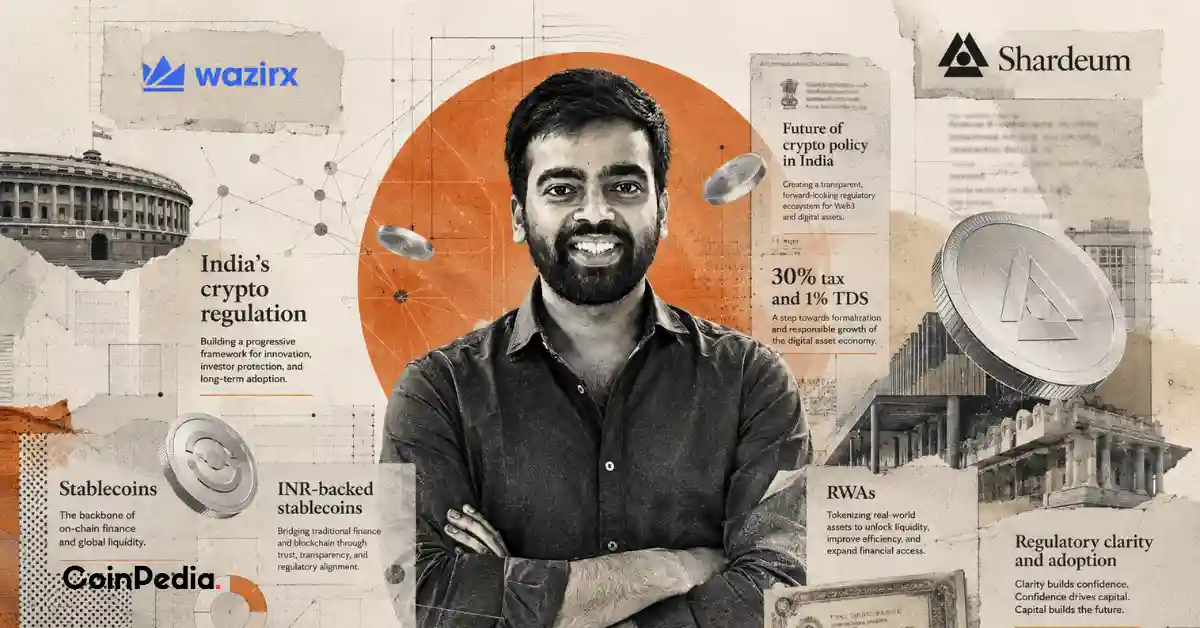
India’s crypto industry continues to await regulatory clarity and tax reforms. In an interview with Coinpedia, Nischal Shetty shared his views on the country’s crypto tax structure, the impact of the 1% TDS, stablecoin adoption, tokenized real-world assets (RWAs), and the future of crypto regulation in India.
Nischal Shetty Wants TDS Reduced or Removed
Shetty said he remains hopeful about future changes to India’s crypto tax regime, although he declined to put a timeline on policy decisions.
“My honest wish is that we either scrap the TDS or bring it down to something like 0.01%.”
According to Shetty, the current 1% TDS pulls working capital from the market and hurts liquidity. However, he pointed to recent moves toward reporting norms and FIU guidelines as signs that the government is building toward a proper framework rather than stepping away from the sector.

He added that tax rationalisation usually follows regulatory maturity and noted that the Indian ecosystem has continued to adapt and grow despite challenges.
1% TDS Has Damaged Market Liquidity
When asked about the biggest damage caused by the 1% TDS rule, Shetty’s response was direct:
“Liquidity. That’s the one-word answer.”
He explained that the TDS compounds across every transaction for active traders, making serious trading on Indian platforms difficult. Combined with the inability to offset losses, the structure has pushed many active users away.
According to Shetty, the impact goes beyond lower volumes on Indian exchanges and has affected market depth, price discovery, and trading talent within the country.
Offshore Exchanges Benefited From India’s Tax Structure
Shetty believes the current tax and regulatory environment has encouraged traders to move to offshore platforms.
“The tax didn’t stop Indians from trading crypto it just changed where they do it.”
He noted that a significant share of trading volume shifted to platforms operating outside Indian tax collection systems, jurisdiction, and consumer-protection frameworks.
To address this, he called for favourable taxation and clear rules that make it attractive for users to remain on locally registered, KYC- and AML-compliant platforms.
Stablecoins Could Drive Mass Adoption
On stablecoins, Shetty described them as a key component of crypto’s future in India.
“Stablecoins are the bridge that turns blockchain from a speculative asset class into something an ordinary person uses for payments, remittances, settlements.”
He said many people are less interested in the volatility of Bitcoin or Ethereum and instead want money that is fast, inexpensive to move, and programmable.
According to Shetty, stablecoins could serve as the starting point if blockchain adoption reaches population scale in India.
INR Stablecoin Could Expand Global Rupee Usage
Shetty also spoke about the potential of an INR-backed stablecoin.
He said a properly backed and regulated INR stablecoin would allow businesses to settle in rupees directly on-chain, instantly and around the clock across global markets.
For trade corridors where India already has strong partnerships, he believes this could help expand the international use of the rupee. However, he stressed that reserves must be transparent, audited, and properly overseen.
According to Shetty, an INR stablecoin would complement rather than compete with the RBI’s digital rupee.
Tokenized Real-World Assets Present a Major Opportunity
Shetty sees tokenized real-world assets as a significant opportunity for India, particularly through institutional adoption.
“The bottleneck here was never the technology. It’s regulatory clarity on what a tokenised claim legally means.”
He expects early adoption in government securities and bonds, where tokenisation can improve settlement speed and transparency.
He also identified gold, commodities, and fractional real estate as sectors that could benefit from tokenisation. According to Shetty, once legal clarity is established, the market could open up quickly.
Three Policy Priorities for Regulators
Looking ahead, Shetty outlined three areas he would like regulators to focus on.
First, he called for tax reforms, including removing or significantly reducing the TDS and allowing loss offsetting.
Second, he said the industry needs a comprehensive regulatory framework that treats compliant, FIU-registered exchanges as legitimate and regulated financial businesses.
Third, he urged policymakers to move from a “Blockchain yes, crypto no” approach to embracing both blockchain and crypto, arguing that consumer-focused use cases are essential for creating jobs, fostering innovation, and building a domestic startup ecosystem.
Standing Committee Meeting Signals Progress
Commenting on the May 20 Standing Committee on Finance meeting, Shetty described it as a positive development.
He said Parliament’s decision to invite WazirX, Binance, and ZebPay to participate in its study on Virtual Digital Assets represents a meaningful step toward regulatory clarity.
According to Shetty, India cannot simply adopt crypto regulations from other jurisdictions and must instead develop a framework suited to its own needs and population.
While acknowledging the challenge, he expressed confidence that ongoing efforts and discussions will eventually help India arrive at the right regulatory framework for crypto.
Was this writing helpful?

Trust with CoinPedia:
CoinPedia has been delivering accurate and timely cryptocurrency and blockchain updates since 2017. All content is created by our expert panel of analysts and journalists, following strict Editorial Guidelines based on E-E-A-T (Experience, Expertise, Authoritativeness, Trustworthiness). Every article is fact-checked against reputable sources to ensure accuracy, transparency, and reliability. Our review policy guarantees unbiased evaluations when recommending exchanges, platforms, or tools. We strive to provide timely updates about everything crypto & blockchain, right from startups to industry majors.
Investment Disclaimer:
All opinions and insights shared represent the author's own views on current market conditions. Please do your own research before making investment decisions. Neither the writer nor the publication assumes responsibility for your financial choices.
Sponsored and Advertisements:
Sponsored content and affiliate links may appear on our site. Advertisements are marked clearly, and our editorial content remains entirely independent from our ad partners.