


 Advertise



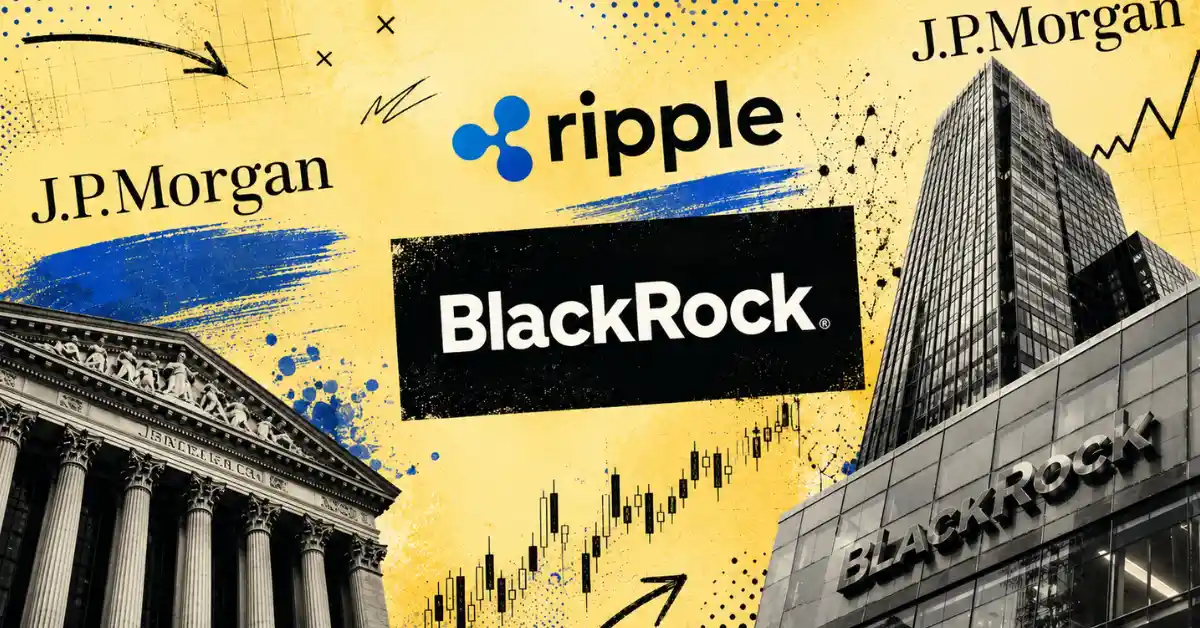
BlackRock, JPMorgan, and Ripple Are Racing Into a $65 Billion RWA Market That Could Reach $30 Trillion



BlackRock's tokenized Treasury fund BUIDL has already attracted $2.3 billion assets.
JPMorgan processed billions in tokenized transactions through its Kinexys blockchain platform.
Standard Chartered forecasts tokenized real-world assets market reaching $30.1 trillion globally.
Wall Street’s biggest players are making a surprising bet, and it isn’t on Bitcoin or Altcoins. BlackRock, JPMorgan, and Ripple are pouring money into tokenized real-world assets (RWAs), a market already worth about $65 billion.
Industry experts predict that this RWA market could grow from $2 trillion to $30 trillion over the next decade.
Wall Street Is Going All In RWA
BlackRock, the world’s largest asset manager with AUM of $13.9 trillion, has emerged as one of tokenization’s biggest advocates. CEO Larry Fink has repeatedly described tokenization as the “next generation for markets.”
Its tokenized Treasury fund, BUIDL, has already attracted approximately $2.3 billion in assets.

Franklin Templeton moved even earlier. Its OnChain U.S. Government Money Fund (FOBXX), one of the first regulated tokenized money market funds, now manages around $822 million.
Just a few years ago, many banks saw blockchain as a threat. Today, they are helping build it. JPMorgan’s Kinexys platform, formerly known as Onyx, has already handled billions of dollars in tokenized transactions, including settlements, deposits, and repo trades.
Goldman Sachs, BNY Mellon, Citi, and HSBC have launched similar initiatives as competition intensifies.
Ripple Sees Trillion-Dollar Growth
Ripple believes the industry is approaching a tipping point. The company estimates tokenized assets could expand from roughly $600 billion in 2026 to $18.9 trillion by 2033.
To support that vision, Ripple has expanded tokenized asset capabilities on the XRP Ledger and launched RLUSD, its dollar-backed stablecoin designed for settlement and liquidity.
Advantages of Tokenized Treasuries
Treasuries are already one of the most trusted and widely used assets in global finance, making them the easiest place to test the benefits of blockchain technology.
The advantages are hard to ignore:
- Faster Settlement: Transactions can settle within minutes instead of waiting days.
- 24/7 Access: Investors can buy, sell, or transfer assets at any time, not just during market hours.
- Better Capital Efficiency: Tokenized Treasuries can be used as collateral instantly, helping institutions move capital more efficiently.
- Lower Costs: Fewer intermediaries mean lower operational and settlement costs.
Because of this, many see tokenized Treasuries as the first major step toward bringing traditional finance on-chain.
RWA Could Reach $30 Trillion
What’s making investors pay attention is the prediction around RWA. McKinsey sees a $2 trillion market by 2030. Boston Consulting Group estimates $16 trillion.
Meanwhile, Standard Chartered goes even further, forecasting $30.1 trillion by 2034.
Was this writing helpful?

Trust with CoinPedia:
CoinPedia has been delivering accurate and timely cryptocurrency and blockchain updates since 2017. All content is created by our expert panel of analysts and journalists, following strict Editorial Guidelines based on E-E-A-T (Experience, Expertise, Authoritativeness, Trustworthiness). Every article is fact-checked against reputable sources to ensure accuracy, transparency, and reliability. Our review policy guarantees unbiased evaluations when recommending exchanges, platforms, or tools. We strive to provide timely updates about everything crypto & blockchain, right from startups to industry majors.
Investment Disclaimer:
All opinions and insights shared represent the author's own views on current market conditions. Please do your own research before making investment decisions. Neither the writer nor the publication assumes responsibility for your financial choices.
Sponsored and Advertisements:
Sponsored content and affiliate links may appear on our site. Advertisements are marked clearly, and our editorial content remains entirely independent from our ad partners.