


 Advertise



RWA Market Hits $36 Billion: Why Tokenization Is Transforming Global Finance



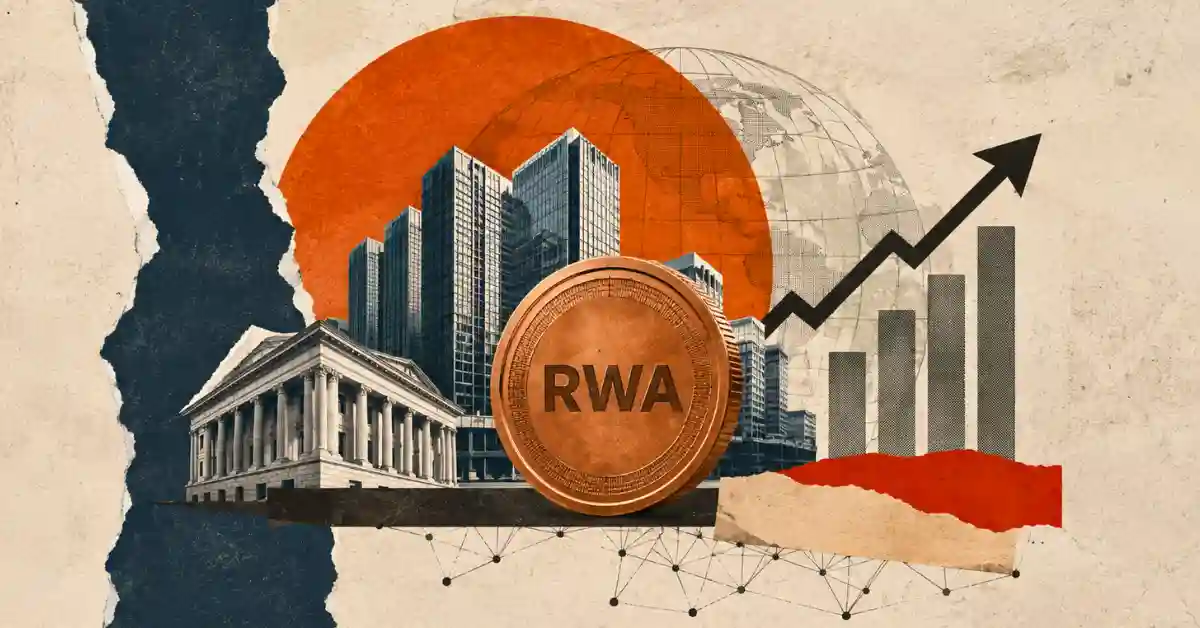
Tokenization has evolved from an experimental blockchain application into one of the fastest-growing segments of digital finance. By converting ownership rights of traditional assets into blockchain-based digital representations, tokenization aims to modernize issuance, settlement, ownership transfer, and post-trade operations across capital markets.
According to RWA.xyz, distributed on-chain real-world assets (RWAs) have surpassed approximately $36 billion in value, rising from a low of $4.66 billion in 2024 and around $15 billion during 2025. The pace of expansion highlights accelerating institutional adoption rather than speculative demand, with asset managers increasingly using blockchain infrastructure for tokenized Treasury products, private credit, funds, commodities, and other financial instruments.
Despite this milestone, tokenization still represents only a minute fraction of global financial markets. Traditional capital markets remain measured in hundreds of trillions of dollars, illustrating that blockchain-based assets have penetrated only a small portion of the available market.
Current estimates place global financial assets at approximately:

| Asset Class | Estimated Market Size |
| Global Bonds | $130T+ |
| Global Equities | $115T+ |
| Money Market Funds | $11T+ |
| Private Credit | $3T+ |
| Distributed On-chain RWAs | approx.$36B |
This disparity explains why many market participants increasingly view tokenization as a long-term infrastructure transformation instead of a short-term investment trend. Even limited migration of existing financial products onto blockchain infrastructure could substantially increase the size of tokenized markets over the coming decade.
The report examines the current state of tokenized assets, institutional adoption, blockchain infrastructure, stablecoin settlement, oracle networks, and long-term market projections using only the supplied research material.
1. Tokenization Reaches an Inflection Point
Tokenization refers to the process of converting ownership rights to traditional assets into digital tokens recorded on blockchain infrastructure. Unlike conventional securities that rely on multiple centralized record-keeping systems, tokenized assets exist directly on blockchain networks where ownership transfers can occur through smart contracts.
Broadly, tokenized assets fall into two structural categories:
- Distributed tokens, which circulate across public blockchain networks.
- Represented tokens, which function as digital receipts inside permissioned or private ledger environments.
Although both models digitize financial assets, distributed tokenization has experienced the strongest recent growth because it combines programmable settlement with public blockchain liquidity.
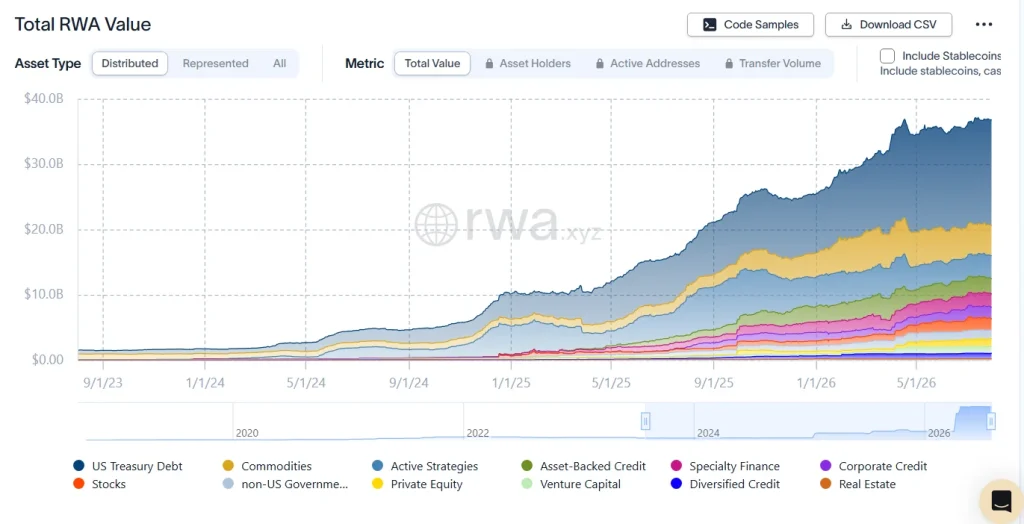
According to RWA.xyz, distributed tokenized assets now exceed approximately $36 billion, representing one of the strongest multi-year growth trajectories within blockchain infrastructure.
The increase reflects a structural shift rather than isolated product launches. Instead of testing blockchain technology through limited pilots, institutions are increasingly issuing financial products directly on-chain.
This development also aligns with Ethereum’s original vision established in 2015, positioning blockchain as programmable financial infrastructure capable of automating trust, execution, and settlement across capital markets.
While tokenized RWAs remain relatively small compared with traditional markets, their growth rate demonstrates increasing institutional willingness to migrate selected financial products onto blockchain rails where settlement, ownership verification, and asset servicing can become significantly more efficient.
2. Tokenization Remains a Tiny Fraction of Global Finance
Although recent growth has attracted considerable attention, tokenized assets still account for only a very small share of global financial markets.
Traditional financial markets remain several thousand times larger than current blockchain-based assets.
Current tokenized assets represent well below one percent of global capital markets. Consequently, future industry growth does not necessarily require blockchain to replace existing financial infrastructure. Even partial migration of selected asset classes could substantially increase tokenized market size.
Supportive regulation is expected to play an important role in this transition by providing greater legal certainty around issuance, settlement, custody, and ownership rights while preserving many of blockchain’s operational efficiencies.
Rather than replacing traditional finance, tokenization increasingly appears positioned as an extension of existing capital markets infrastructure where selected financial products migrate onto programmable blockchain networks.
For institutional investors, the opportunity therefore depends less on today’s market size and more on the potential migration of existing financial assets over time.
This perspective explains why several industry participants describe tokenization as an infrastructure transition rather than an entirely new asset class.
3. Why Asset Managers Are Moving On-Chain
The rapid increase in tokenized assets is closely linked to institutional participation. According to RWA.xyz, the number of participating asset managers has grown to 106, with organizations such as BlackRock, Franklin Templeton, Circle, Ondo, and Tether among the leading participants based on tokenized asset metrics.
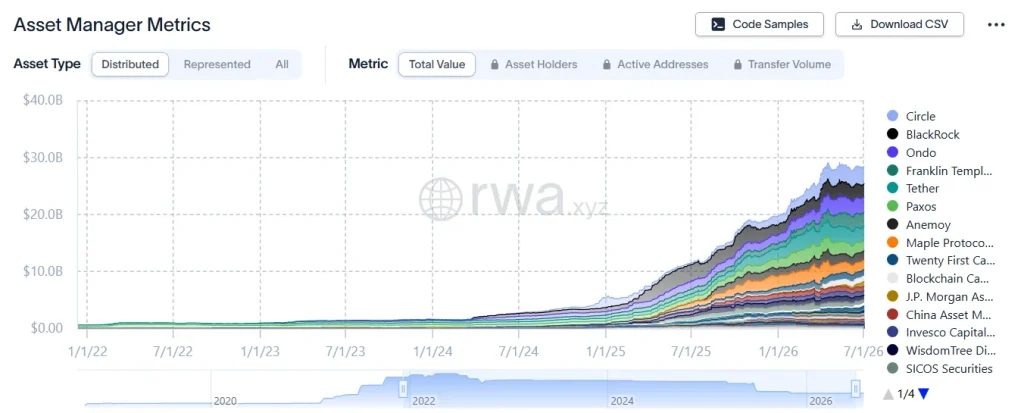
Institutional participation is primarily driven by operational efficiency rather than blockchain experimentation.
Traditional securities markets involve multiple intermediaries across execution, custody, reconciliation, clearing, and settlement. Each participant maintains separate records that must continually be reconciled throughout the transaction lifecycle.
This fragmented structure contributes to higher operational costs, longer settlement periods, and increased administrative complexity.
Industry analysis referenced in the supplied research estimates that tokenized securities could reduce middle- and back-office costs by approximately 22% to 85% by 2028, largely through:
- Reduced manual reconciliation
- Faster settlement
- Lower intermediary involvement
- Shared ledger architecture
- Greater automation through smart contracts
The magnitude of potential savings varies across financial products. Markets involving numerous intermediaries generally offer the largest efficiency improvements because blockchain consolidates several post-trade processes into a single programmable infrastructure.
As a result, tokenization is increasingly being evaluated not simply as a digital asset innovation but as a mechanism for modernizing financial market infrastructure.
The central question for institutional investors is gradually shifting from whether blockchain can support regulated financial assets to how institutions should position themselves for a long-term migration from traditional finance toward regulated decentralized financial infrastructure.
4. Blockchain Infrastructure Determines Where Capital Flows
As institutional adoption expands, blockchain selection has become an increasingly important competitive factor. While tokenized assets can technically be issued across multiple blockchain networks, market activity demonstrates that institutional capital is concentrating on a relatively small number of ecosystems.
According to RWA.xyz, tokenized assets are currently distributed across 38 blockchain networks. However, issuance remains heavily concentrated on three networks, with Ethereum maintaining a substantial lead.
| Blockchain Network | Tokenized RWA Value |
| Ethereum | $17.14 Billion |
| BNB Chain | $5.23 Billion |
| Solana | $3.50 Billion |
Ethereum currently represents the largest settlement layer for distributed tokenized assets, accounting for nearly half of the value issued across supported blockchain networks.
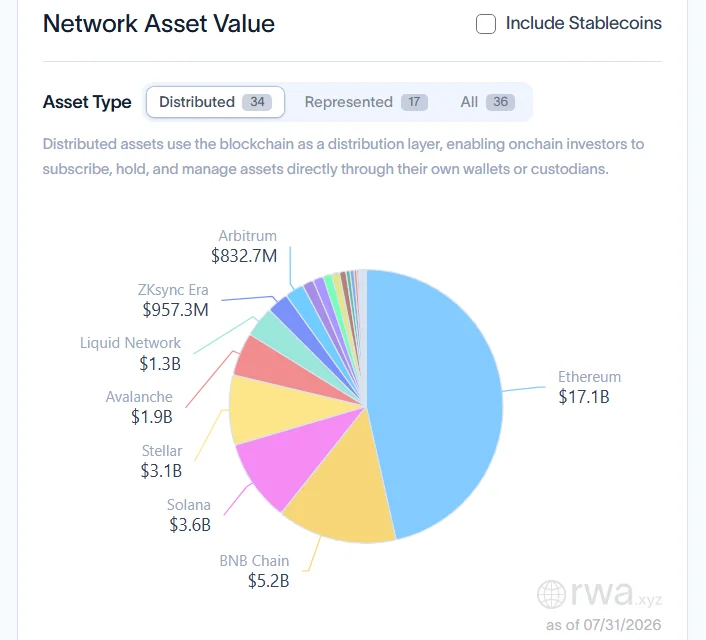
This leadership extends beyond market share. Institutional issuers continue selecting Ethereum because liquidity, infrastructure providers, custodians, developer tools, and secondary market activity are already deeply established on the network.
A reinforcing network effect is beginning to emerge. As more issuers launch tokenized Treasury products, private credit funds, and investment vehicles on Ethereum, liquidity naturally follows those assets. Increased liquidity attracts additional institutional participation, encouraging further issuance and expanding the surrounding financial ecosystem.
This self-reinforcing cycle creates higher blockchain activity while simultaneously increasing network revenue generated through transaction fees.
Although Ethereum remains the dominant platform, BNB Chain and Solana have established themselves as meaningful alternatives.
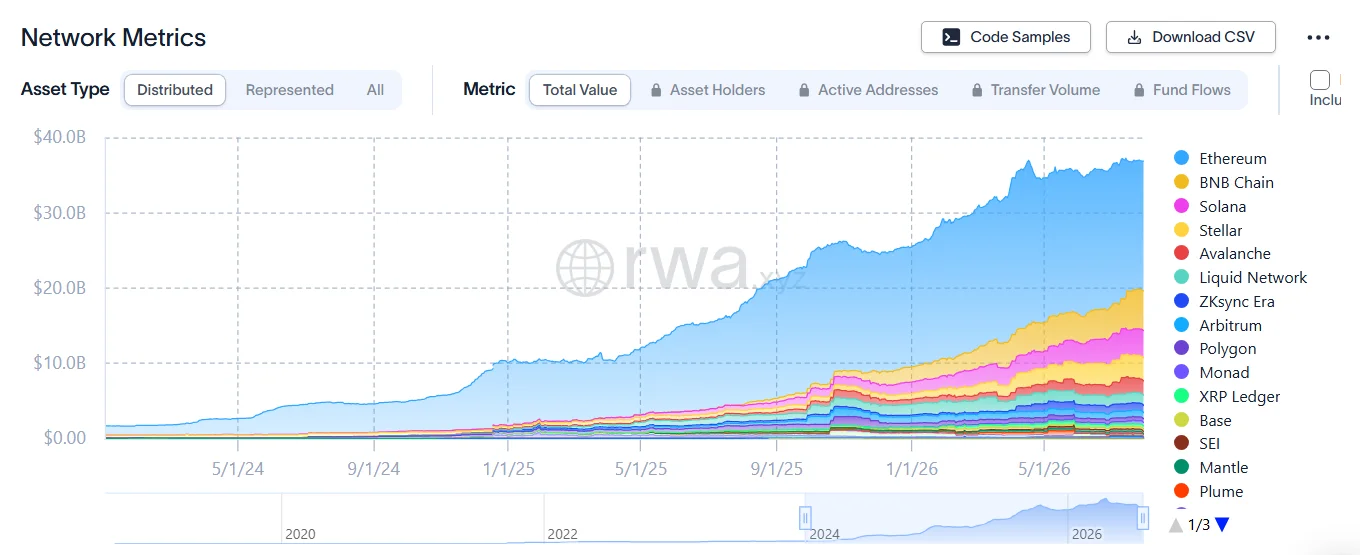
BNB Chain currently supports approximately $5.23 billion of tokenized assets, while Solana hosts roughly $3.50 billion.
Rather than replacing Ethereum, these networks appear to be expanding overall industry capacity by providing alternative environments for tokenized asset issuance.
Current market data therefore indicates that institutional adoption is concentrating around a limited number of blockchain ecosystems instead of fragmenting across dozens of competing networks.
5. Stablecoins Become the Settlement Layer
While tokenized securities attract significant attention, they cannot operate efficiently without digital cash.
Stablecoins provide the settlement asset required for subscriptions, redemptions, collateral management, lending, and secondary market trading.
Every purchase or redemption of a tokenized Treasury fund, private credit product, or on-chain investment vehicle ultimately requires settlement in a stable digital currency.
According to RWA.xyz, total stablecoin value has reached approximately $296 billion, supported by nearly 278 million holders.
Current blockchain distribution also reveals where on-chain dollar liquidity is concentrated.
| Blockchain | Stablecoin Value |
| Ethereum | approx.$156 Billion |
| Tron | approx.$89 Billion |
Ethereum currently hosts the largest stablecoin ecosystem, accounting for more than half of total value tracked within the supplied research.
This concentration carries important implications for tokenization.
Institutional financial products require reliable settlement assets that can facilitate:
- Primary subscriptions
- Investor redemptions
- Secondary market trading
- Lending transactions
- Repo-style financing
- Collateral management
Without sufficient stablecoin liquidity, tokenized securities would face settlement constraints regardless of how efficiently assets are issued.
Consequently, the blockchain supporting the deepest pool of on-chain dollars gains an important competitive advantage.
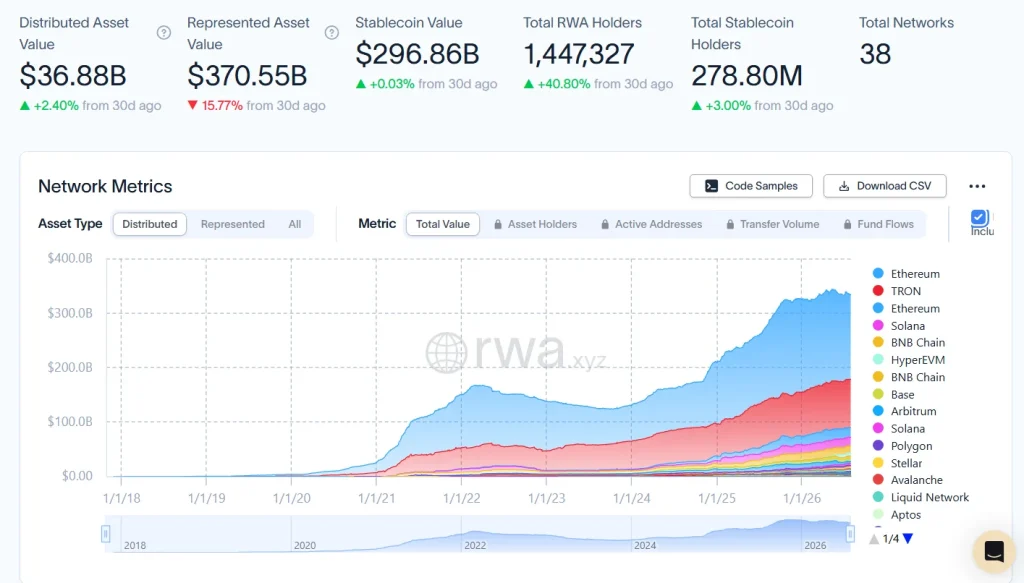
Ethereum’s leadership in both tokenized assets and stablecoin liquidity reinforces its position within the broader tokenization ecosystem.
Rather than functioning as separate markets, stablecoins and tokenized securities increasingly appear interconnected.
Tokenized assets generate demand for stablecoin settlement, while deep stablecoin liquidity supports larger tokenized financial markets.
This mutually reinforcing relationship explains why blockchain networks with established stablecoin ecosystems continue attracting institutional tokenized asset issuance.
6. Oracles Form the Data Infrastructure
While blockchain networks record ownership and stablecoins facilitate settlement, tokenized assets require continuous access to real-world financial information.
This function is performed by oracle networks.
Tokenized securities depend on external data that cannot originate from the blockchain itself.
Examples include:
- Market price feeds
- Net Asset Value (NAV) calculations
- Interest rate updates
- Corporate actions
- Proof of reserves
- Asset backing verification
- Compliance triggers
Without these data inputs, blockchain-based financial assets cannot accurately represent their underlying real-world counterparts.
Oracle networks therefore act as the bridge between traditional financial information systems and blockchain infrastructure.
Within tokenized finance, they support a wide range of applications including:
- Tokenized Treasury products
- Investment funds
- Private credit markets
- Collateralized lending
- Structured yield products
According to VanEck, Chainlink currently controls more than 62% of oracle market share, making it the industry’s largest data infrastructure provider.
Chronicle ranks second with approximately 12% market share.
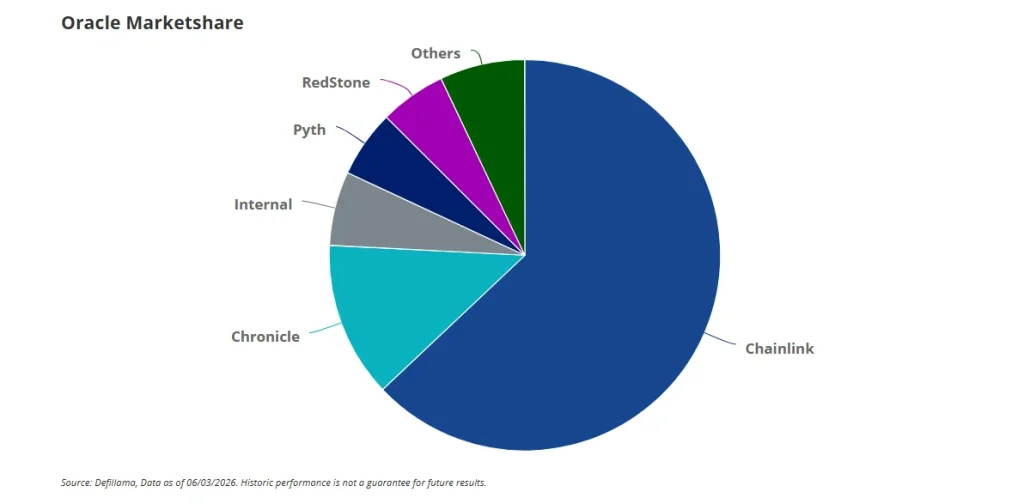
The concentration of oracle market share indicates that institutional tokenization increasingly depends upon a relatively small number of trusted data providers.
If blockchain networks represent the execution layer of tokenized finance, oracle providers supply the external information required for smart contracts to execute correctly.
As tokenized financial products expand across multiple asset classes, reliable data delivery becomes increasingly important for maintaining pricing accuracy, collateral integrity, and investor confidence.
Instead of operating as optional infrastructure, oracle networks have become a foundational component supporting the broader tokenized asset ecosystem.
7. Capital Markets Infrastructure Is Being Rebuilt
Beyond cost savings, tokenization changes the way financial markets process transactions.
Traditional securities markets rely on multiple independent institutions to complete a single transaction. A trade typically begins with execution through a broker before moving through clearing houses, custodians, and central securities depositories. Each participant maintains its own ledger, requiring continual reconciliation before settlement is finalized.
Under this structure, final settlement generally occurs on a T+1 basis, meaning ownership and cash transfer are completed one business day after execution.
The traditional workflow can be summarized as follows:
- Trade executed through brokers or dealer networks.
- Trade routed through clearing and custody infrastructure.
- Multiple ownership records updated independently.
- Continuous reconciliation between participants.
- Final settlement completed after post-trade verification.
Tokenized assets replace much of this fragmented process with a shared blockchain ledger.
Instead of multiple institutions maintaining separate records, ownership exists directly on-chain. Smart contracts automate transfer conditions, while settlement and ownership updates occur within the same distributed system.
This creates a significantly shorter transaction lifecycle.
| Traditional Capital Markets | Tokenized Capital Markets |
| Broker executes trade | Smart contract executes transaction |
| Clearing and custody process | Shared blockchain ledger |
| Multiple independent records | Single synchronized ledger |
| Manual reconciliation | Automated verification |
| T+1 settlement | Near-instant settlement |
By combining execution, settlement, and ownership recording into one programmable infrastructure, blockchain reduces operational complexity while enabling faster and more continuous financial markets.
For institutions managing large transaction volumes, these efficiency gains complement the previously discussed reductions in middle- and back-office costs, strengthening the economic case for tokenization.
8. Industry Forecasts Point Toward Trillion-Dollar Markets
Although today’s distributed tokenized RWA market stands at approximately $36 billion, several industry forecasts anticipate substantially larger markets over the coming decade.
The Forbes research contains projections from multiple institutions, each measuring different segments of tokenized finance.
| Institution | Projection |
| McKinsey | $2 trillion in tokenized assets by 2030 (excluding stablecoins) |
| Boston Consulting Group (BCG) | $600 billion–$1 trillion in tokenized fund Assets Under Management by 2030 |
| Standard Chartered | Up to $30 trillion tokenized market by 2034, including trade finance and bonds |
Although these estimates vary considerably, they are not directly comparable because each evaluates different portions of the market.
McKinsey focuses specifically on tokenized assets while excluding stablecoins.
BCG concentrates on tokenized investment funds and assets under management.
Standard Chartered adopts a broader definition by incorporating trade finance, bonds, and other financial assets that could eventually migrate onto blockchain infrastructure.
Despite these methodological differences, all three forecasts share one common conclusion.
Each projects continued institutional adoption over the coming decade rather than a plateau in current market activity.
The projections also reinforce an observation established earlier in this report.
Since global financial markets exceed $250 trillion across major asset classes, tokenization does not require complete replacement of traditional infrastructure to reach trillion-dollar valuations. Even modest migration across selected financial products could significantly expand blockchain-based capital markets.
Consequently, current market size should be viewed within the context of the much larger addressable opportunity rather than as the ultimate limit of tokenized finance.
Final Assessment
The data presented throughout this report indicates that tokenization has progressed beyond the experimental stage and is increasingly becoming part of institutional financial infrastructure.
Distributed on-chain RWAs have expanded from approximately $4.66 billion in 2024 to around $36 billion in 2026, supported by growing participation from more than 100 asset managers, expanding blockchain infrastructure, deeper stablecoin liquidity, and specialized oracle networks.
At the same time, tokenized assets remain extremely small compared with traditional capital markets valued in the hundreds of trillions of dollars. This contrast explains why many industry participants continue to describe tokenization as a long-term infrastructure transition rather than a mature financial market.
Several factors are converging to support this transition:
- Continued institutional issuance of tokenized financial products.
- Growing operational efficiencies through blockchain settlement.
- Expanding stablecoin liquidity supporting on-chain transactions.
- Concentration of tokenized assets on established blockchain networks.
- Reliable oracle infrastructure connecting real-world data with blockchain execution.
Long-term forecasts differ in scale, ranging from $600 billion in tokenized fund assets to $30 trillion across broader tokenized financial markets. However, every projection included in the supplied research anticipates continued expansion rather than contraction.
While the pace of adoption will depend on market participation, infrastructure development, and regulatory progress, the available data suggests tokenization is increasingly being integrated into existing financial markets instead of developing as an isolated blockchain application.
At present, tokenized RWAs remain only a small fraction of global financial assets. Nevertheless, the rapid growth recorded over the past two years, combined with increasing institutional participation and long-term market projections, indicates that tokenization is transitioning from an emerging technology into a developing layer of global financial infrastructure.
Was this writing helpful?

Trust with CoinPedia:
CoinPedia has been delivering accurate and timely cryptocurrency and blockchain updates since 2017. All content is created by our expert panel of analysts and journalists, following strict Editorial Guidelines based on E-E-A-T (Experience, Expertise, Authoritativeness, Trustworthiness). Every article is fact-checked against reputable sources to ensure accuracy, transparency, and reliability. Our review policy guarantees unbiased evaluations when recommending exchanges, platforms, or tools. We strive to provide timely updates about everything crypto & blockchain, right from startups to industry majors.
Investment Disclaimer:
All opinions and insights shared represent the author's own views on current market conditions. Please do your own research before making investment decisions. Neither the writer nor the publication assumes responsibility for your financial choices.
Sponsored and Advertisements:
Sponsored content and affiliate links may appear on our site. Advertisements are marked clearly, and our editorial content remains entirely independent from our ad partners.