
 Advertise



Microsoft Stock Has More Than an Outage to Worry About. Here’s Why



Microsoft stock has another problem beyond its latest global outage. While the disruption to Outlook, Teams and Copilot has put cloud reliability under scrutiny, the company’s aggressive AI infrastructure spending is creating a separate challenge for investors. Microsoft is growing rapidly, but sustaining that momentum requires enormous capital commitments. With MSFT approaching a key technical resistance zone, investors have more than one risk to assess.
Global Outage Puts Microsoft’s Cloud Reliability Under Scrutiny
Microsoft’s latest global outage has exposed the risks of its growing dependence on cloud-based workplace services. The disruption, which began on November 12, affected Outlook, Exchange Online, Teams, SharePoint and Copilot across multiple regions.
The incident lasted more than 12 hours, disrupting businesses, government agencies and other organizations. Microsoft attributed the problem to server and infrastructure issues and said it had found no indication of malicious activity. Its recovery efforts initially struggled as some restored servers became unresponsive under returning traffic.

The disruption also follows another Microsoft 365 service incident earlier this year, bringing reliability concerns back into focus. For enterprise customers, consistent uptime is central to Microsoft’s competitive position. Repeated failures could encourage large organizations to reconsider their dependence on a single cloud ecosystem.
The immediate financial damage remains unclear, but the reputational risk is harder to measure. Investors will be watching Microsoft’s post-incident explanation and whether the company can demonstrate that its infrastructure is becoming more resilient.
Microsoft’s $170 Billion AI Spending Plan Raises Return Questions
The second concern is the scale of Microsoft’s AI investment. The company is expanding data-center capacity to support Azure, AI workloads and growing demand for computing infrastructure. Microsoft reported $45.2 billion in capital expenditure for fiscal Q1 2027, while management expects calendar-year 2026 spending to reach approximately $170 billion. It also indicated that quarterly capital expenditure could exceed $50 billion in the December quarter.
The investment is supported by strong demand. Azure revenue increased 48% in the September quarter, while Microsoft Cloud revenue rose 30% to $63.9 billion. Commercial remaining performance obligations also climbed 73% to $677 billion.
However, the central question is how quickly that demand translates into returns. Heavy infrastructure spending can pressure free cash flow and operating margins, particularly when new capacity takes time to become productive.
Microsoft’s own filings warn that slower AI adoption, underutilized infrastructure and rising computing costs could affect future returns. The company is therefore facing a demanding balance: invest enough to capture AI growth without allowing capital costs to outrun revenue generation.
Azure Growth Is Strong, but Competition and Capacity Matter
Microsoft’s cloud business remains a major strength, but sustaining its current growth rate will not be straightforward. Azure grew 48% in the latest quarter, and management expects growth of 49% to 50% in constant currency for the December quarter. However, Microsoft also acknowledged that customer demand continues to exceed available supply, while some third-party GPU capacity deliveries have been delayed.
Microsoft Stock Price Analysis: Can MSFT Break Above $550?
Microsoft stock price closed at $539.44 on November 13, gaining 1.08%. The stock is approaching a major supply zone between $550 and $560, where previous advances have encountered selling pressure. A sustained breakout above this region could strengthen the recovery and bring $575 into focus.
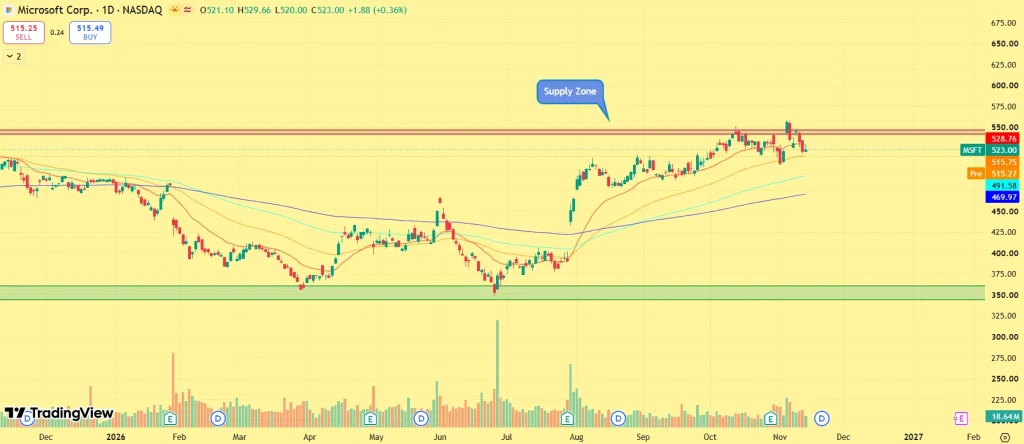
On the downside, $515 is the immediate support area, followed by $490–$500. The broader demand zone sits around $375–$390, although that remains well below the current trading range. The moving averages continue to provide support beneath the current price, but the recent rejection near the supply zone suggests buyers have yet to establish control. A breakout above $560 would improve the technical outlook, while a decline below $515 could weaken the recovery.
What Should Microsoft Investors Watch Next?
Microsoft’s long-term growth story remains supported by Azure expansion, enterprise software and AI demand. However, the latest outage has highlighted operational risks, while the company’s infrastructure spending raises questions about capital efficiency and future profitability.
The next phase will depend on whether Microsoft can restore customer confidence, convert AI demand into sustainable revenue and maintain cloud growth without sacrificing margins.
Was this writing helpful?

Trust with CoinPedia:
CoinPedia has been delivering accurate and timely cryptocurrency and blockchain updates since 2017. All content is created by our expert panel of analysts and journalists, following strict Editorial Guidelines based on E-E-A-T (Experience, Expertise, Authoritativeness, Trustworthiness). Every article is fact-checked against reputable sources to ensure accuracy, transparency, and reliability. Our review policy guarantees unbiased evaluations when recommending exchanges, platforms, or tools. We strive to provide timely updates about everything crypto & blockchain, right from startups to industry majors.
Investment Disclaimer:
All opinions and insights shared represent the author's own views on current market conditions. Please do your own research before making investment decisions. Neither the writer nor the publication assumes responsibility for your financial choices.
Sponsored and Advertisements:
Sponsored content and affiliate links may appear on our site. Advertisements are marked clearly, and our editorial content remains entirely independent from our ad partners.