
 Advertise



CrowdStrike Stock Falls 9% Despite Record Earnings: Why the $43.9 Billion Zscaler Deal Spooked Investors



CrowdStrike (CRWD) shares fell 8.92% to $208.97 on November 24, despite reporting record quarterly results.
The company announced a $43.9 billion all-stock acquisition of Zscaler, one of the largest cybersecurity deals.
Q3 FY2027 revenue increased 28% to $1.58 billion, while annual recurring revenue reached $6.26 billion.
CrowdStrike stock is facing selling pressure despite delivering a strong quarterly earnings report, as investors weigh its $43.9 billion acquisition of cybersecurity rival Zscaler. CRWD shares declined 8.92% to $208.97 on November 24, reversing some of the optimism surrounding the company’s record operating performance. The acquisition has become the primary focus for investors, raising questions about deal valuation, shareholder dilution and integration risks.
While CrowdStrike is expanding its cybersecurity footprint through the transaction, Wall Street appears more concerned about the financial commitment required to complete it.
$43.9 Billion Zscaler Deal Triggers Investor Concerns
The biggest catalyst behind the sell-off is CrowdStrike’s agreement to acquire Zscaler in an all-stock transaction valued at approximately $43.9 billion.
Under the agreement, Zscaler shareholders will receive 1.135 shares of CrowdStrike for each Zscaler share. The transaction represents a significant expansion of CrowdStrike’s cybersecurity business, combining endpoint protection with Zscaler’s cloud security and Zero Trust capabilities.

The companies expect the combined business to begin with more than $10 billion in annual recurring revenue. They also see opportunities to cross-sell their platforms across approximately 8,000 Zscaler customers.
However, the size of the transaction introduces execution risks. CrowdStrike shareholders must assess the potential dilution, integration challenges and whether the acquisition can generate sufficient returns to justify its valuation.
CrowdStrike Q3 Earnings Beat Estimates
CrowdStrike’s operating performance was considerably stronger than its stock reaction suggests. For the third quarter of fiscal 2027, revenue reached $1.58 billion, up 28% year-over-year, exceeding the estimated $1.53 billion. Adjusted earnings came in at $0.34 per share, compared with expectations of $0.31.
Management also raised its FY2027 revenue guidance to $6.078 billion–$6.084 billion. Its revised outlook reflects stronger demand across the Falcon cybersecurity platform.
The company described Q3 as the strongest quarter in its history, supported by record net new ARR and accelerating customer adoption. Importantly, the updated financial guidance does not include contributions from the proposed Zscaler acquisition.
CrowdStrike Stock Analysis: Can CRWD Hold $200?
CrowdStrike’s daily chart shows increasing selling pressure after the stock failed to sustain its recent recovery attempts. CRWD closed at $208.97, approaching the psychological $200 support region. The price action also shows that the stock trading below its shorter-term moving averages, indicating that sellers currently have control of the near-term trend.
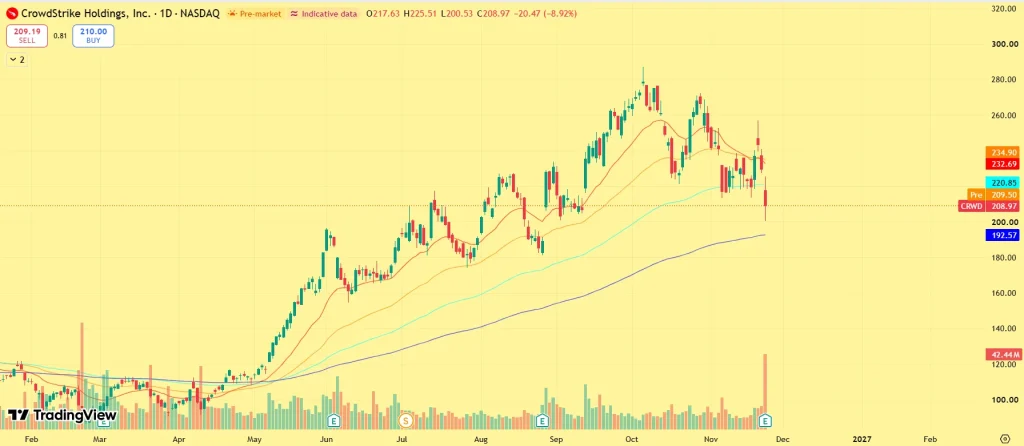
A recovery above $220 could improve the short-term technical structure, with $234–$235 emerging as the next resistance zone. However, a sustained breakdown below $200 could expose the stock to further downside toward $190.
What Comes Next for CrowdStrike Stock?
CrowdStrike now faces two competing narratives: record operating growth and an expensive strategic acquisition. The Zscaler deal could strengthen its position in enterprise cybersecurity, particularly as companies seek integrated protection against AI-driven threats. However, investors will want clearer evidence that the transaction can deliver revenue synergies and stronger cash generation.
The company’s earnings performance remains strong, but the market’s next assessment will focus on whether the Zscaler acquisition creates enough long-term value to justify its substantial cost.
Was this writing helpful?

Trust with CoinPedia:
CoinPedia has been delivering accurate and timely cryptocurrency and blockchain updates since 2017. All content is created by our expert panel of analysts and journalists, following strict Editorial Guidelines based on E-E-A-T (Experience, Expertise, Authoritativeness, Trustworthiness). Every article is fact-checked against reputable sources to ensure accuracy, transparency, and reliability. Our review policy guarantees unbiased evaluations when recommending exchanges, platforms, or tools. We strive to provide timely updates about everything crypto & blockchain, right from startups to industry majors.
Investment Disclaimer:
All opinions and insights shared represent the author's own views on current market conditions. Please do your own research before making investment decisions. Neither the writer nor the publication assumes responsibility for your financial choices.
Sponsored and Advertisements:
Sponsored content and affiliate links may appear on our site. Advertisements are marked clearly, and our editorial content remains entirely independent from our ad partners.