
 Advertise



T+1 Settlement: What Did Wall Street Learn, and What Must Change Before 2027?



T+1 settlement is reshaping global financial markets, releasing billions in clearing capital while exposing operational gaps across Wall Street’s post-trade infrastructure. The U.S. transition delivered measurable efficiency gains, but securities lending, foreign exchange funding and trade processing continue to test institutions operating within tighter settlement windows. As Europe prepares for its October 2027 transition, rising failed trades and uneven automation are bringing these challenges into sharper focus.
This report examines the financial impact of T+1, where settlement delays continue to tie up time and capital, and what market participants must improve to make faster settlement more efficient at scale.
T+1 Released $3.7 Billion in Clearing Capital
The U.S. transition to T+1 on May 28, 2024, shortened the standard settlement cycle for most securities transactions from two business days to one. The shift delivered a measurable improvement in clearing efficiency, with clearing fund requirements declining by an estimated $3.7 billion compared with the previous quarter’s average.
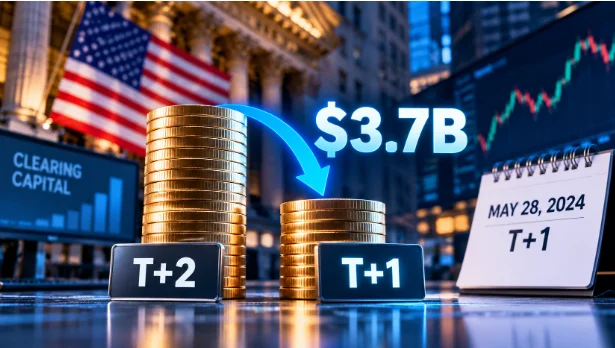
Faster settlement reduces the period during which clearing agencies and market participants remain exposed to unsettled transactions. It can also lower counterparty exposure and reduce the amount of capital firms need to maintain against outstanding obligations.

Operational performance improved alongside the reduction in clearing requirements. By May 29, 2024, approximately 94.55% of transactions were affirmed by 9 p.m. ET on trade date, compared with 73% at the end of January 2024. The improvement demonstrated how earlier trade confirmation and tighter processing windows helped firms adapt to the accelerated cycle.
However, these figures represent the initial U.S. transition period rather than current 2026 performance. They establish the financial and operational benefits achieved during implementation, not a measure of settlement efficiency across the entire market today.
European Failed Trades Are Growing Faster Than Settlement Volumes
Europe’s post-trade infrastructure faces a more demanding test as firms prepare for the 2027 transition. Settlement activity increased 15% in 2025, but failed trades grew 21% over the same period, indicating that operational exceptions are increasing faster than transaction volumes.

The gap points to persistent weaknesses in trade matching, settlement instructions and post-trade data exchange. A recent industry assessment found that only 33% of European middle offices had automated the storage and exchange of Standing Settlement Instructions (SSIs), while 68% continued to rely on some manual trade-matching processes.
These processes become more difficult to manage under T+1. Firms will have less time to identify mismatched instructions, resolve allocation discrepancies and secure the securities or cash needed to complete settlement. Manual intervention that could be absorbed within a two-day cycle may create a greater risk of failed trades when the available processing window is halved.
The challenge is not simply processing transactions faster. Market participants need reliable data and automated workflows across brokers, custodians, investment managers and settlement infrastructures.
Securities Lending and FX Funding Remain Key Pressure Points
Securities lending and foreign exchange funding remain important sources of operational pressure during a shorter settlement cycle. International investors often need to convert currencies, arrange securities availability and coordinate delivery across different market time zones. Under T+1, delays in any of these processes can leave firms with less time to complete settlement.

A 2024 industry survey covering nearly 500 institutions highlighted the impact on securities lending. Half of respondents reported that T+1 had affected their securities-lending operations, up from 33% in the previous year’s survey. Among sell-side firms, 56% reported significant disruption to lending and recall activity.
These findings are historical evidence from the U.S. transition period, rather than a fresh measure of conditions in 2026. They nevertheless identify a structural challenge: securities recalls and inventory movements must be coordinated earlier to prevent shortages at settlement.
Foreign exchange funding creates a related timing problem. Firms settling cross-border transactions may need to arrange currency conversion and cash availability within a compressed window. Without earlier funding decisions and better coordination between counterparties, faster securities settlement can increase pressure on liquidity management.
Automated Partial Settlement Targets Fewer Failed Trades
Partial settlement is one of the mechanisms being developed to reduce failed transactions. Instead of holding an entire delivery because the seller lacks sufficient securities, the process allows the available portion to settle while the outstanding quantity remains pending.

The Depository Trust Company (DTC) is developing an Automated Partial Settlement solution designed to identify eligible deliveries and process authorized partial settlements throughout the trading day. The objective is to reduce manual coordination between buyers, sellers and custodians while allowing available securities to move through the settlement chain sooner.
The initial implementation includes automated partial processing and partial-delivery authorization. Client testing was scheduled to become available later in Q3 2026, with production targeted for Q3 2027, subject to regulatory review and approval. The available project timeline does not establish whether testing has been completed.
If implemented as planned, automated partial settlement could reduce the value of outstanding obligations, improve intraday liquidity and limit the number of transactions that fail because of incomplete securities availability. A second phase covering bilateral securities-finance transactions settling through DTC is targeted for Q4 2028.
Europe’s October 2027 T+1 Transition Enters Its Execution Phase
Europe’s move to T+1 is now progressing from regulatory preparation toward implementation and industry testing. The European Union, United Kingdom and Switzerland are targeting October 11, 2027, for the transition, requiring firms to align operational systems across multiple markets.
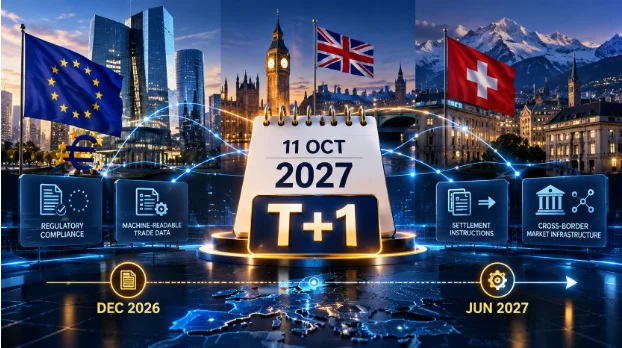
On October 16, 2026, the European Securities and Markets Authority confirmed that the EU’s regulatory framework was complete. The first major compliance milestone arrives on December 7, 2026, when applicable allocation and confirmation processes must use standardised electronic communication channels and machine-readable methods.
Settlement data is also receiving greater attention. The Place of Settlement (PSET) field identifies the intended location where a transaction should settle, helping counterparties detect potential routing and settlement-location discrepancies earlier.
PSET population became mandatory for applicable CTM transactions on October 3, 2026. During the first week, 99.98% of CTM allocations were enriched with PSET information. This is a result for allocations processed through the CTM platform, not a measure of adoption across all European market transactions.
Infrastructure providers are also moving toward testing. The European Central Bank has also outlined changes to the night-time settlement process on TARGET2-Securities (T2S), planned for June 2027. T2S already supports substantial T+1 and T+0 settlement activity, but the planned adjustments are intended to help the infrastructure operate more efficiently under the new timetable.
What Wall Street Needs to Fix Before the Next Settlement Shift
The transition to faster settlement requires more than changes to clearing systems. Firms need to address the operational processes that determine whether securities and cash are available when transactions reach settlement.
Four areas require particular attention:
- Automated trade matching: Reduce manual processing in allocations, confirmations and settlement-instruction management to identify discrepancies earlier.
- Securities availability: Improve coordination across securities lending, recalls and inventory management so firms can meet delivery obligations within tighter deadlines.
- Liquidity and FX funding: Align currency conversion, cash positioning and funding decisions with the shorter settlement window, particularly for cross-border transactions.
- Partial settlement and interoperability: Expand automated partial-delivery capabilities and improve coordination between trading, clearing, custodial and settlement systems.
These improvements will determine whether firms can capture the benefits of T+1 without transferring operational pressure into higher settlement-failure rates or unexpected liquidity requirements.
What Happens Next?
The U.S. transition established the financial case for T+1, with lower clearing fund requirements and improved trade affirmation providing measurable evidence of greater settlement efficiency. Europe now faces the more complex task of delivering that efficiency across markets with different operating practices, currencies and post-trade infrastructures.
The next milestones are approaching quickly. December 7, 2026, will bring new EU requirements for allocations and confirmations, while infrastructure providers and market participants move deeper into implementation and testing. In 2027, industry-wide testing will become central to validating whether firms can complete the full trade-to-settlement process within one business day.
The planned June 2027 T2S adjustments and DTC’s targeted Q3 2027 automated partial settlement launch will also test how effectively infrastructure changes support the new operating environment.
Ultimately, the success of T+1 will depend not just on how quickly trades settle, but on how efficiently the financial system moves securities and capital from execution to final delivery.
Was this writing helpful?

Trust with CoinPedia:
CoinPedia has been delivering accurate and timely cryptocurrency and blockchain updates since 2017. All content is created by our expert panel of analysts and journalists, following strict Editorial Guidelines based on E-E-A-T (Experience, Expertise, Authoritativeness, Trustworthiness). Every article is fact-checked against reputable sources to ensure accuracy, transparency, and reliability. Our review policy guarantees unbiased evaluations when recommending exchanges, platforms, or tools. We strive to provide timely updates about everything crypto & blockchain, right from startups to industry majors.
Investment Disclaimer:
All opinions and insights shared represent the author's own views on current market conditions. Please do your own research before making investment decisions. Neither the writer nor the publication assumes responsibility for your financial choices.
Sponsored and Advertisements:
Sponsored content and affiliate links may appear on our site. Advertisements are marked clearly, and our editorial content remains entirely independent from our ad partners.