



 Advertise



Bitcoin Uptober 2026 at Risk? Price Fights ETF Drain as Fed Odds Re-Price Ahead of Oct 28




Bitcoin entered October 2026 with three consecutive green months and a 6.33% September gain, the second-strongest September on record. The Uptober narrative arrived with statistical support. Then the Federal Reserve released its September meeting minutes on October 7. Bitcoin fell below $83,000 within hours. ETFs shed $484.9 million in a single session. The pattern is real. The variables that can override it are also real. This is the data-level audit of both.
The Statistical Record
Bitcoin has closed October higher in 10 of the 13 years from 2013 through 2025, producing a high monthly win rate. The average return across those 13 years is 18.52% and the median is 12.73%, according to Coinglass data.
The gap between the 18.52% average and the 12.73% median is structurally important. Three outsized years which are October 2013 (+60.79%), October 2021 (+39.9%), and October 2023 (+28.52%) typically pulls the average sharply above the typical outcome. The median is the more representative figure for any given October.
Only three Octobers produced losses across the full dataset: 2014 (−12.95%), 2018 (−4.72%), and 2025 (−3.92%). The three losing years share a macro context: 2014 followed Bitcoin’s first post-ATH correction, 2018 was the depths of a bear market, and 2025 was the first month in which US-China trade tensions and forced liquidations directly overrode a $4.7 billion ETF inflow.

Bitcoin October Returns (Full Historical Record on Coinglass)
Bitcoin’s price still has nearly 20 days before the monthly close, and whether it closes on a positive or negative note remains uncertain; however, historical data from 2013 to 2025 indicates that the odds lean toward a positive outcome.
| Year | Return | Context |
| 2013 | +60.79% | First major bull run ignition |
| 2014 | -12.95% | Post-ATH bear correction |
| 2015 | +27.44% | Recovery from 2014 lows |
| 2016 | +10.34% | Pre-halving accumulation |
| 2017 | +47.81% | ICO bull run acceleration |
| 2018 | -4.72% | Bear market (no catalyst) |
| 2019 | +10.78% | Macro uncertainty rally |
| 2020 | +27.70% | Institutional entry (MicroStrategy) |
| 2021 | +39.90% | ATH run ($69,000) |
| 2022 | +5.63% | Post-LUNA recovery |
| 2023 | +28.52% | Pre-ETF anticipation run |
| 2024 | +10.76% | Post-ETF approval base build |
| 2025 | -3.92% | Trade war liquidation despite $4.7B ETF inflow |
What October 2025 Actually Showed
October 2025 is the Uptober pattern’s most important data point, not because it was a loss, but because of the conditions under which it became one. Bitcoin traded from $103,856 to $126,080 intra-month, a 21% intra-month range, before closing down 3.92%. The month produced an all-time high of $126,198 on October 29 and then reversed.
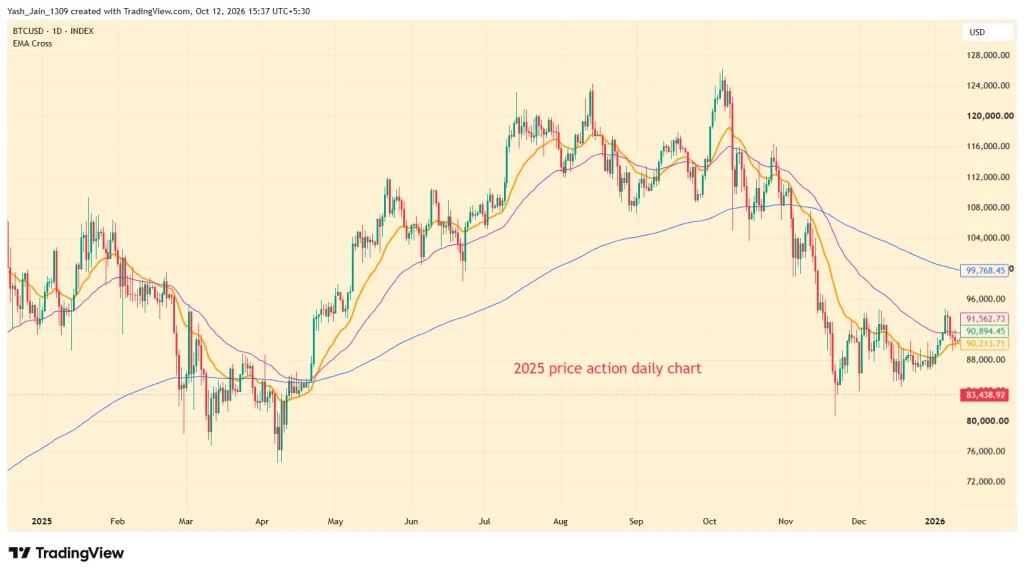
US spot Bitcoin ETFs absorbed approximately $4.7 billion in net inflows during October 2025. The inflows were the largest single-month ETF absorption since the January 2024 launch and did not prevent a negative monthly close. The negative month occurred despite record institutional buying because the selling pressure from US-China trade tensions and leveraged long liquidations exceeded it.
October 2025 was also the seventh consecutive October that Bitcoin had entered with either a post-halving tailwind or an ETF-driven demand floor. All six prior consecutive wins occurred in conditions where institutional selling was limited or absent. The 2025 break confirmed that seasonal patterns have a macro override threshold and that ETF inflows alone do not constitute an unconditional floor.
October 2026: The Current Setup
Price and Entry Point
Bitcoin entered October 2026 trading near $84,000, representing a 33.4% discount to October 2025’s intra-month high of $126,198. The three consecutive green months preceding October is August (+25%), September (+6.33%) has brought Bitcoin back above its 50-week and 200-day moving averages.
September 2026’s 6.33% return was the second-highest September return in Bitcoin’s history, behind only the 7.29% September 2024 return. Entering October on the second-best September on record has historically preceded positive Octobers, though the sample size for that specific setup is limited.
Citi raised its 12-month Bitcoin price target on October 1 from $82,000 to $113,000, citing renewed ETF demand, broader adviser and brokerage allocations, and improving macro conditions. The revision placed an institutional valuation above $100,000 into the public record on the first trading day of October.
ETF Flow Reversal
US spot Bitcoin ETFs opened October with $102.7 million on October 1 and $189.9 million on October 2. The Federal Reserve released September meeting minutes on October 7. Within one session, ETFs recorded $484.9 million in net outflows, which is the largest single-day withdrawal in more than three months, reversing all inflows accumulated across the first four October sessions.
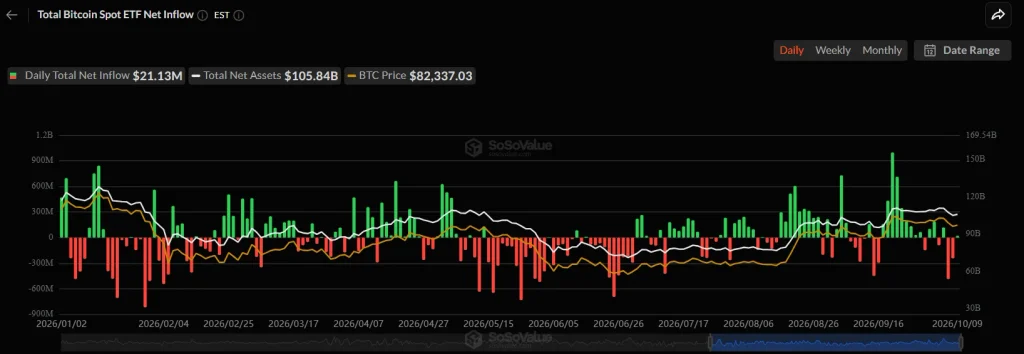
The fund-level breakdown from October 1 through October 8 shows the divergence inside the ETF complex. BlackRock’s IBIT took in +$332.5 million across the period. Fidelity’s FBTC lost $408.1 million. ARK 21Shares ARKB lost $214.9 million. Net across all US spot Bitcoin ETFs: minus $407.4 million. The aggregate turned negative despite IBIT’s continued inflows.
Bitcoin fell below $83,000 on October 8 after the Fed minutes signaled that most officials still viewed another hike this year as appropriate. The average ETF position sat marginally underwater at that price level, with the institutional cost basis estimated near the $82,000-$85,000 range.
The Fed Variable: October 28
The Federal Reserve’s October 27-28 FOMC meeting is the single highest-impact calendar event for Bitcoin in October 2026. The Fed hiked 25 basis points on September 16 to a 3.75-4.00% target range. The September minutes released October 7 stated most officials still viewed another hike this year as appropriate.
CME FedWatch placed the probability of a 25-basis-point October hike at 47.1% on October 1, down from 70.9% the prior week. By October 8, that probability had dropped further to approximately 18%. The September payrolls report were weaker than expected, which drove the revision lower.
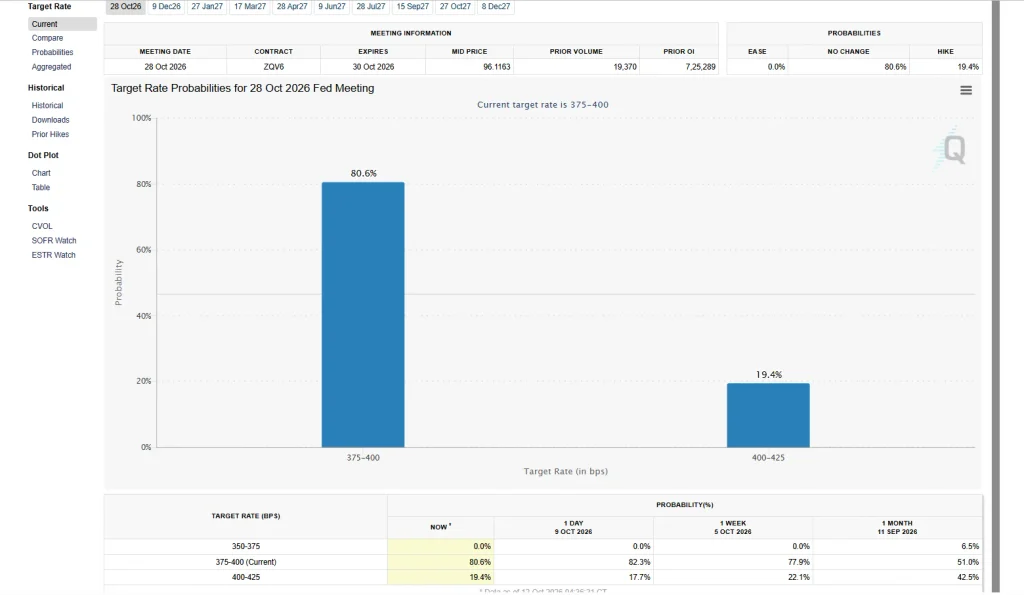
As shown in the latest CME FedWatch snapshot above, real-time rate expectations have solidified this downward shift. As of October 12, markets are pricing in an 80.6% probability of a pause (holding rates at 3.75%–4.00%), with the likelihood of a 25 bps hike hovering at 19.4%. This reflects a steady decline from 1-month prior levels of 42.5%.
The October 29 PCE inflation release, which is the Fed’s preferred inflation measure, arrives one day after the FOMC decision. A hot PCE reading the day after a hold decision would immediately reprice December hike expectations. This two-day sequence on October 28-29 is the most concentrated macro risk window Bitcoin has faced in a single month since the September 16 double event.
Statistical Verdict: Pattern vs Structure
The Halving Cycle Problem
Five of Bitcoin’s ten positive Octobers occurred in the 12 months following a halving event: 2013 (post-2012 halving), 2016 (post-2016 halving), 2020 (post-2020 halving), 2021, and 2024. The April 2024 halving cut block rewards from 6.25 to 3.125 BTC. October 2026 sits 30 months post-halving, outside the phase where halving-adjacent supply scarcity has historically amplified seasonal momentum.
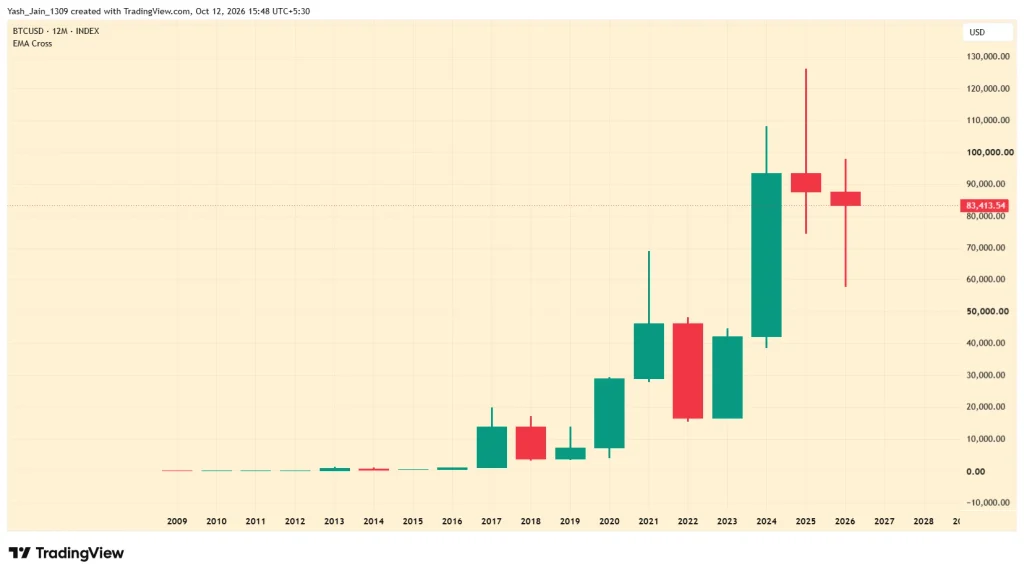
The pattern’s three negative years, which are 2014, 2018, 2025 are all that occurred outside the post-halving window. October 2026 shares that structural position. That does not make a negative October the base case. It removes the mechanical supply argument that underpinned multiple prior Uptober outcomes.
The ETF Structural Change
The US spot Bitcoin ETF market did not exist before January 2024. It now holds approximately $105 billion in assets across 12 funds. ETF holders and the institutional allocators behind them represent a buyer base with defined cost thresholds, quarterly reporting requirements, and drawdown limits that retail buyers do not have. October 2025 demonstrated that $4.7 billion in ETF inflows can be overcome by forced liquidation at scale.
The Octagonai prediction market data from early October shows the probability of Bitcoin exceeding $100,000 in October 2026 at 13%, down from 85% one week prior, which is nearly a 72-percentage-point repricing in seven days triggered by the Fed minutes. Seasonal patterns cannot price that kind of binary repricing. Prediction markets can, and they moved immediately.
The pattern’s 76.9% win rate over 13 years is historically robust. In no year from 2013 to 2024 did a Fed rate hike occur within the same calendar month as an October FOMC meeting while Bitcoin held a trailing 12-month gain of less than 5%. October 2026 is the first October in the dataset where all three conditions “post-halving cycle expiration, institutional ETF presence, and a live Fed rate decision within the month” are simultaneously present.
What the Data Supports as of October 12
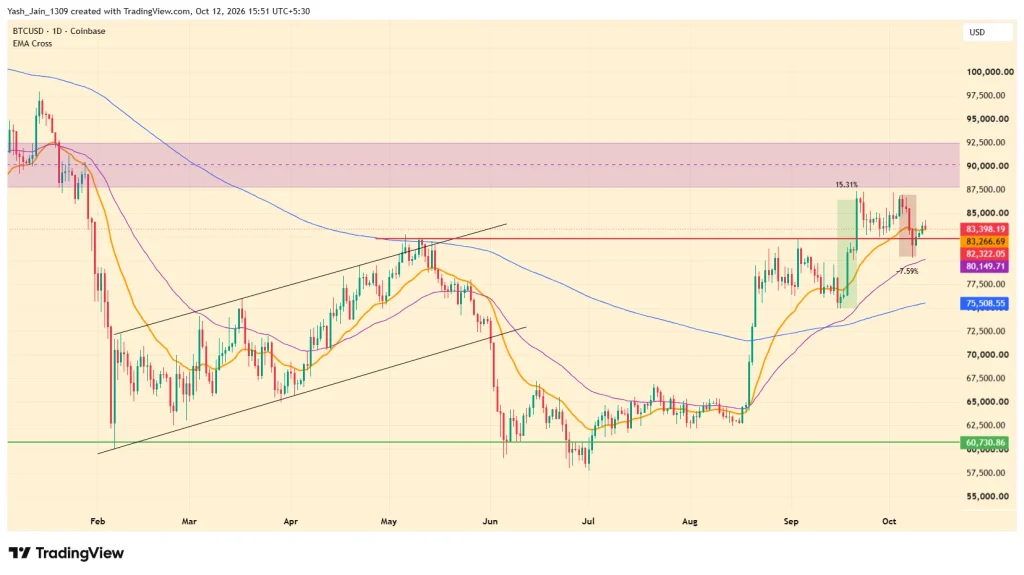
As of October 12, Bitcoin trades around $82,300-$84,500 range after the October 8 drop. ETFs are net negative for the month at minus $407.4 million. The FOMC meeting is 18 days away. The PCE release is 19 days away. The October 14 CPI print is the next immediate macro data point that will move October hike probability in either direction.
The Investing.com structural analysis, published October 9, notes that Bitcoin’s Q3 gain of approximately 45% has brought price to major technical resistance. Markets entering a historically bullish month at technical resistance with a live Fed binary event do not follow seasonal averages. They test support first.
Was this writing helpful?

Trust with CoinPedia:
CoinPedia has been delivering accurate and timely cryptocurrency and blockchain updates since 2017. All content is created by our expert panel of analysts and journalists, following strict Editorial Guidelines based on E-E-A-T (Experience, Expertise, Authoritativeness, Trustworthiness). Every article is fact-checked against reputable sources to ensure accuracy, transparency, and reliability. Our review policy guarantees unbiased evaluations when recommending exchanges, platforms, or tools. We strive to provide timely updates about everything crypto & blockchain, right from startups to industry majors.
Investment Disclaimer:
All opinions and insights shared represent the author's own views on current market conditions. Please do your own research before making investment decisions. Neither the writer nor the publication assumes responsibility for your financial choices.
Sponsored and Advertisements:
Sponsored content and affiliate links may appear on our site. Advertisements are marked clearly, and our editorial content remains entirely independent from our ad partners.