
 Advertise



Ethereum (ETH) Price Prediction 2026, 2027 – 2030: Can ETH Reach $10k?





Sohrab is a passionate cryptocurrency news writer with over five years of experience covering the industry. He keeps a keen interest in blockchain technology and its potential to revolutionize finance. Whether he's trading or writing, Sohrab always keeps his finger on the pulse of the crypto world, using his expertise to deliver informative and engaging articles that educate and inspire. When he's not analyzing the markets, Sohrab indulges in his hobbies of graphic design, minimal design or listening to his favorite hip-hop tunes.


Story Highlights
- The Ethereum price today is Loading live price .
- The asset could reach a high of $6100 by the end of 2026.
- The price of Ethereum could reach a high of $15,575 by 2030.
Since its launch in 2015, Loading profile preview has evolved from a pioneering smart-contract platform into the primary settlement layer for the global digital economy. What began as a space for experimental decentralized applications (dApps) has now transformed into a robust ecosystem attracting significant institutional interest. This shift is largely driven by Ethereum’s “Business Ready” infrastructure, which is designed to support high-assurance financial applications and large-scale tokenization initiatives.
The successful rollout of the Pectra and Fusaka upgrades has significantly improved Ethereum’s scalability and fee efficiency. These upgrades addressed long-standing network bottlenecks, making the platform more practical and cost-effective for enterprise adoption and high-volume blockchain activity.
As the ecosystem progresses through 2026, the narrative surrounding Ethereum has shifted from simple utility to institutional-grade resilience and infrastructure. With a well-defined roadmap emphasizing censorship resistance, modular scalability, and long-term sustainability, Ethereum is increasingly positioned to support the next generation of decentralized finance (DeFi) and global capital markets.
In this Ethereum price prediction for 2026–2030, we examine whether these structural improvements, combined with evolving macroeconomic conditions, could push ETH toward new valuation milestones over the coming years.

Ethereum Price Today
| Cryptocurrency | |
| Token | |
| Price | |
| Market Cap | |
| 24h Volume | |
| Circulating Supply | |
| Total Supply | |
| All-Time High | |
| All-Time Low |
Table of contents

Ethereum Price Prediction November 2026
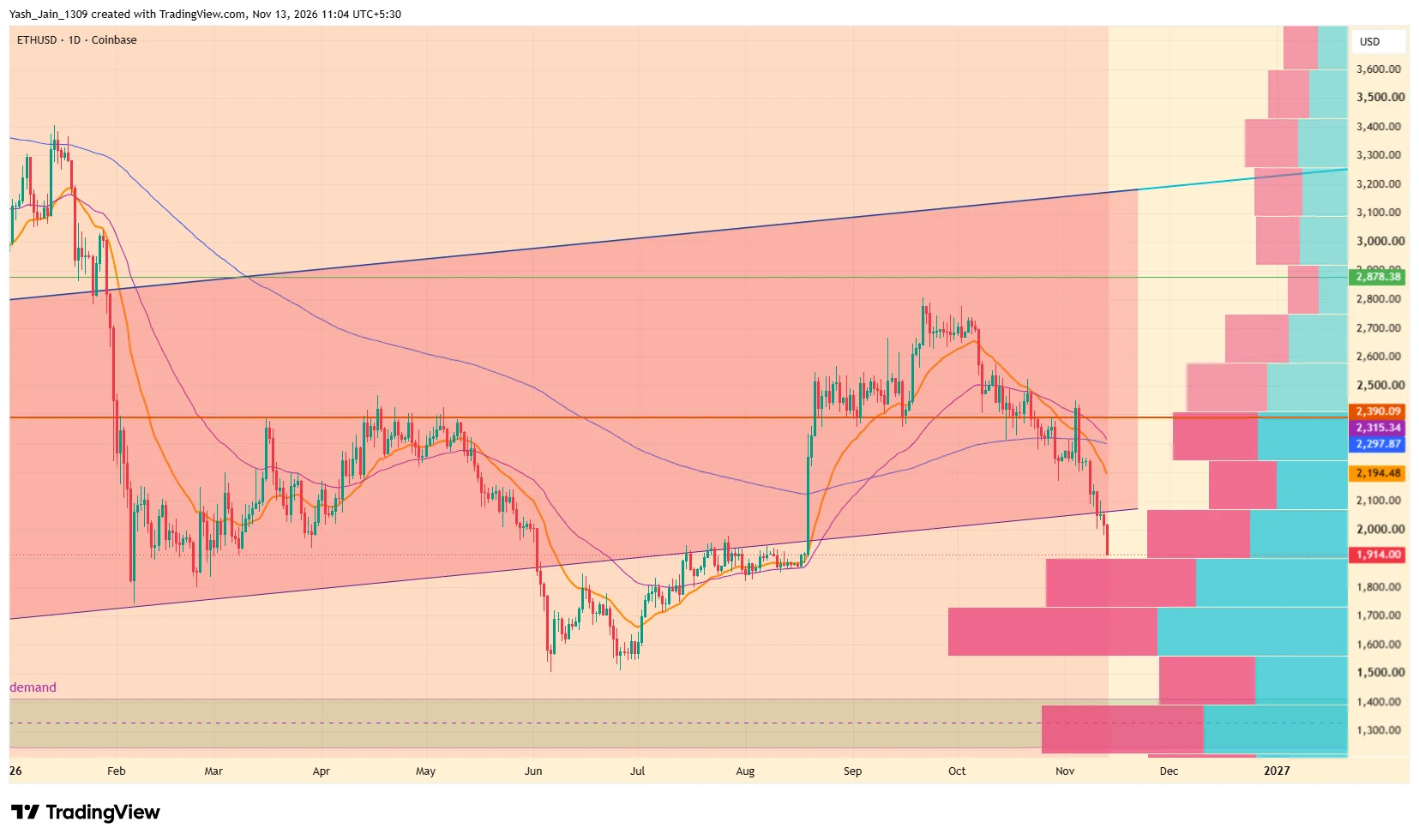
In the first quarter of 2026, Ethereum (ETH) faced significant challenges as its price dropped from a support level of $2,800 to a low of $1,750 in early February. Following this drop, the cryptocurrency began to stabilize and made multiple attempts to retest the $2,390 level, even reaching as high as $2,460 in mid-April. Despite these upward efforts, Ethereum was unable to break through this key resistance.
The market turned downward again in May, pushing the price back below the $2,000 mark. By June, Ethereum broke below its early February low to sit under $1,740, eventually retesting the critical $1,500 support level, a mark dating back to April 2025, by the end of the second quarter. This broader decline materialized after the price broke below the lower edge of a long-observed ascending channel.
However, a recovery began in July. By the end of the month, Ethereum formed a double bottom pattern and began hovering near its neckline between $1,800 and $2,000. This pattern stemmed from a swing low that printed a hammer candlestick formation, which also aligned with a high-volume anchored profile level.
In August, the price consolidated until the third week, when it spiked, broke above the 200-day EMA band, and successfully flipped $2,390 into support. This confirmed the completion of the double bottom pattern at that time.
In September, ETH sustained its rally above $2,390 by spiking to $2,800, only to reverse downward in October. By late October, it crashed back under $2,390, and conditions worsened in November as the sell-off extended below the psychological $2,000 support level.
If selling pressure continues to build, ETH may experience an extended decline toward $1,800 or even $1,600.
Conversely, if the asset sees rising demand around $1,800 and forms a reversal, it will first need to reclaim $2,000. Doing so could set up a retest of $2,390 or higher in the coming weeks.
Ethereum News or Opinions
On November 4, Digital asset exchange Bullish announced Ethereum as one of its core initial network partners (alongside Solana and Aptos) to support issuer-sponsored equity tokenization services. The architecture enables public companies to issue tokenized shares on public blockchains while maintaining official books and records with licensed transfer agents.
On August 26, global fintech leader Revolut announced the launch of its new Euro-backed stablecoin, EURR, on the Ethereum network. The move allows the company to offer native on-chain Euro transactions directly to its 80 million global customers.
On August 18, Securitize partnered with Neuberger Berman to launch the HINC on Ethereum, alongside multi-chain deployments. This marked Neubeger’s first engagement as a subadvisor to a tokenized vehicle, the fund leverages the firm’s $230 billion fixed-income platform to bring actively managed corporate credit directly on-chain.
On July 28, Morgan Stanley Investment Management (MISM) officially launched the Morgan Stanley Ethereum Trust (MSSE) on NYSE Arca. Managing roughly $2 trillion in assets, the firm has introduced a permanent, a rock-bottom 0.14% expense ratio, passing an anticipated 95% of the gross on-chain staking rewards directly back to investors.
On July 20, token terminal posted that the total market cap of tokenized RWAs surged to a historic high of $43.5 billion, anchored firmly by Ethereum’s 52.5% sector market share. This milestone caps a massive year of institutional expansion for the network, which alone captured an additional $7.2 billion in RWA allocations over the past 12 months.
On July 17, Japanese Financial giant SBI holdings chose Ethereum for the live production issuance of JPYSC, Japan’s first trust-based yen stablecoin built in partnership with Startale group. This bypasses standard experimental pilot phases; the institution deployed the regulated digital asset directly onto Ethereum to leverage its institutional-grade resilience and deep liquidity infrastructure.
On July 8, this day marked a highly successful first week for the newly Loading profile preview Chain, which is built on top of Ethereum and Arbitrum. This new chain is giving Ethereum a major boost as it is driving massive adoption by using ETH as its native gas token and sharing 10% of transaction fee profits with the ArbitrumDAO treasury.
On july 4th, Vitalik Buterin’s post outlined “Lean Ethereum”, framing it as the blockchain’s third fundamental epoch. The strawmap targets a 3 to 4 years horizon to rebuild nearly every core layer of the execution and consensus tack without breaking backward compatibility for existing applications.
On July 1, Ethereum announced the launch of an independent non-profit organization “Ethereum institutional” to serve as a neutral, dedicated front door for global banks and asset managers navigating onchain finance. Anchored by long-term funding from Joseph Lubin, BitMine, and SharpLink, the organization claims it will actively advocate for ecosystem-wide institutional adoption across tokenization, stablecoins, and L-2 infra.
On June 23, the Ethereum foundation officially completed a major internal restructuring to implement its update mandate and treasury management policy. As part of this reorganization, the non-profit eliminated 54 positions, representing roughly 20% of its total workforce.
On June 11, Loading profile preview spotlighted the ongoing development of building index-tracking assets on top of options instead of debt. To this, Vitalik urged for formal verification via Vyper or Verity before any mainnet launch, while focusing on the need for robustness-optimized oracles.
Ethereum Price Prediction 2026
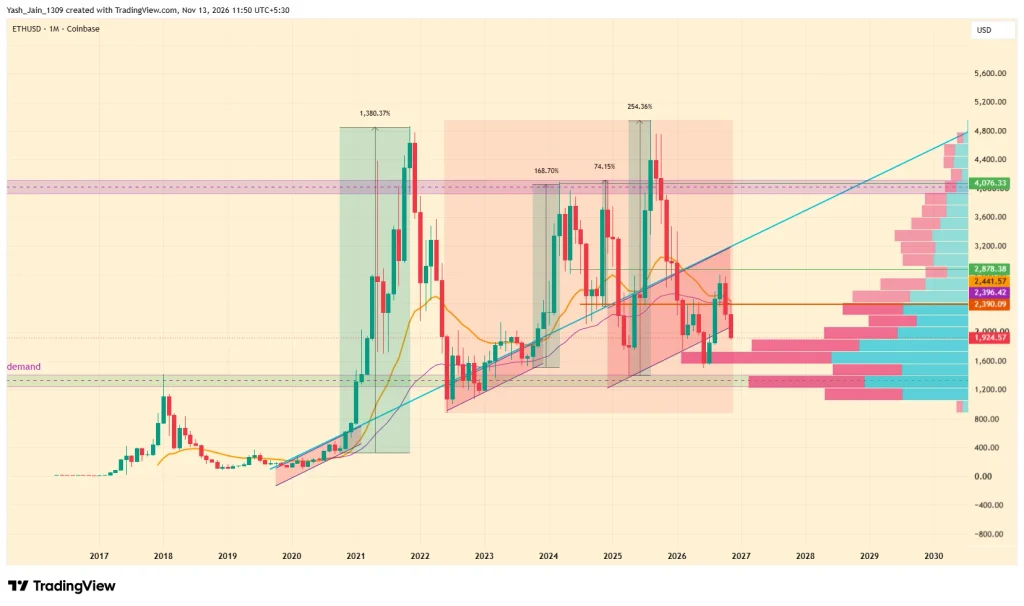
The Ethereum price currently exhibits a compelling long-term technical structure on the monthly timeframe, anchored by a multi-year 45-degree ascending trendline that has guided price action since 2020.
Historically, this trendline has served as a critical pivot point, with the market oscillating between periods of aggressive upward expansion above the line and phases of strategic consolidation below it.
Notably, when ETH trades beneath this trendline, it often forms a secondary short-term ascending channel lasting a few months. These channels have acted as accumulation zones, where price fluctuates until sufficient demand builds, eventually leading to a high-momentum breakout once bullish conditions are met.
In the current 2026 market environment, Ethereum initially appeared to follow a familiar structural pattern, albeit with increased volatility and a broader trading range. However, that did not play out this time.
In fact, the pattern was breached in May 2026, followed by another breakdown in November that has completely invalidated the historical setup.
Bears have remained firmly in control since September 2025, and as 2026 enters its final quarter, this downward trend continues, suggesting that losses could extend further. Key support levels capable of sparking a reversal lie at $1,800, $1,600, and $1,300.
Should ETH drop below $1,300, the price risks testing significantly lower levels and remaining dominated by bears for an extended period.
However, if ETH reverses from any of the key supports within the broader $1,800 to $1,300 range, the multi-year trend will remain structurally intact as long as the $1,300 level holds.
ETH On-Chain Analysis 2026
Ethereum’s supply distribution across address cohorts reflects a shifting accumulation dynamic behind recent price action. While the retail cohort (1–10,000 ETH) has steadily expanded, small holders are increasingly serving as exit liquidity for larger players. The 10,000–100,000 ETH cohort continues to distribute, whereas mid-tier whales (100,000–1,000,000 ETH) shifted from months of distribution to a noticeable accumulation spike in late August. However, overall upside momentum remains capped by mega-whales (1,000,000–10,000,000 ETH). After accumulating through June, this top tier began offloading holdings slowly, only to accelerate dumping more aggressively into August’s price rebound which is effectively suppressing further rallies.
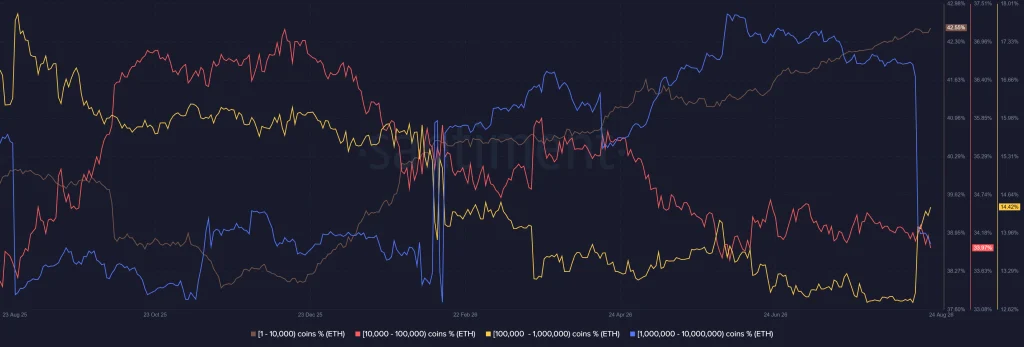
However, if the sentiment among these mega-whales shifts from selling back to buying, the removal of this bearish overhead could catalyze a powerful upward trend for the asset.
Despite the current price struggle, the network’s underlying fundamentals are strong, driven by massive institutional and ecosystem growth. Since January 2025, the value of real-world assets (RWAs) tokenized on the blockchain has surged to $18.6 billion, showcasing Ethereum’s dominance as a settlement layer for traditional finance. This expansion is further supported by a thriving scaling ecosystem that now features 105 active Layer 2 networks. These protocols collectively secure $31.1 billion in total value locked (TVL), demonstrating that the network is successfully migrating activity to more efficient layers without losing economic security.
Also, Distribution of stablecoin market cap on Ethereum shows 58.4% of the market share across the mainnet and Layer 2s, representing a staggering $172 billion in available capital.
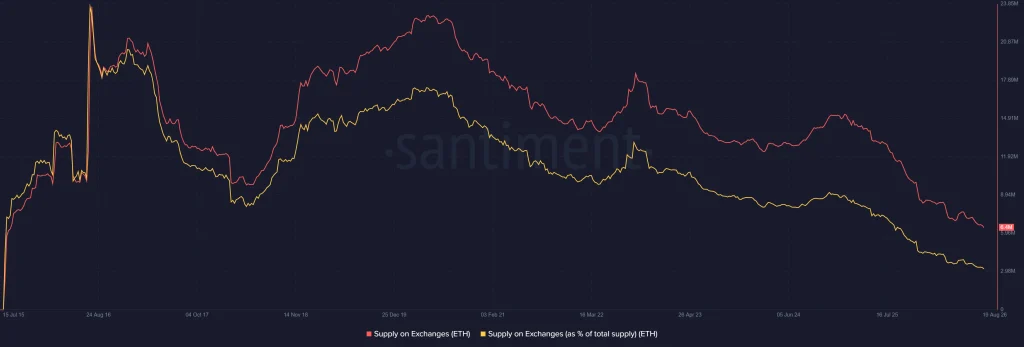
Moreover, the volume of ETH supply held on centralized exchanges continues to decline. As more tokens move into long-term storage or staking, the diminishing supply on trading platforms creates a supply shock environment where any sudden surge in demand could result in significant price appreciation.
Ethereum Price Prediction 2027-2030
| Year | Potential Low ($) | Potential Average ($) | Potential High ($) |
| 2027 | 7,071.08 | 14,142.16 | 21,213.24 |
| 2028 | 10,606.62 | 21,213.24 | 31,819.86 |
| 2029 | 15,909.93 | 31,819.86 | 47,729.79 |
| 2030 | 23,864.90 | 47,729.79 | 71,594.69 |
Ethereum (ETH) Price Prediction 2027
The Ethereum 2027 forecast expects the ETH coin price to make a new all-time high at $21,213.24. However, a correction based on market shortcomings may drive the ETH crypto to $7,071.08, with an average of $14,142.16.
ETH Price Prediction 2028
In 2028, the chances of Ethereum dominating the crypto market rise as the ETH price potentially makes a new high at $31,819.86. On the other hand, the altcoin might fall to $10,606.62, making an average of $21,213.24.
Ethereum Price Forecast 2029
Approaching its all-time high of $47,729.79 in 2029, the Ethereum price is expected to surpass the psychological barrier of $40,000. In case of a correction, $ETH may reach a low of $15,909.93, with an average price of $31,819.86.
Ethereum Price Prediction 2030
As per our Ethereum Price Prediction 2030, the ETH crypto price is projected to reach a new all-time high of $71,594.69 in 2030, with a potential low of $23,864.90 and an average price of $47,729.79.
Ethereum (ETH) Price Prediction: Market Analysis?
| Year | 2026 | 2027 | 2030 |
| Changelly | $5,800 | $7,500 | $25,000 |
| CoinCodex | $6,300 | $7,850 | $28,200 |
| WalletInvestor | $5,940 | $7,450 | $21,500 |
Never Miss a Beat in the Crypto World!
Stay ahead with breaking news, expert analysis, and real-time updates on the latest trends in Bitcoin, altcoins, DeFi, NFTs, and more.
FAQs
Ethereum could reach $6,200 in 2026 if accumulation strengthens and demand at key support levels increases.
ETH may hit around $21,200 in 2027, with potential lows near $7,071 depending on market conditions.
By 2030, 1 ETH could reach a new all-time high of $71,500 under strong adoption and network growth.
If adoption and blockchain integration continue rising, Ethereum could theoretically approach $100,000 by 2040.
Long‑term, Ethereum could exceed $150,000–$200,000 by 2050 with widespread global adoption, DeFi and tokenization.
Ethereum remains a strong long-term investment due to growing DeFi use, Layer 2 adoption, and rising institutional interest.
Was this writing helpful?

Disclaimer and Risk Warning
The price predictions in this article are based on the author's personal analysis and opinions. CoinPedia does not endorse or guarantee these views. Investors should conduct independent research before making any financial decisions.