


 Advertise



- Shubham Vishwakarma
 Shubham Vishwakarma
- Mar 09, 2026 09:36 UTC
-


Bitcoin Exchange Reserves Drop to 2019 Levels: Is a BTC Supply Shock Coming?

Bitcoin exchange reserves drop to around 2.7 million BTC, the lowest level recorded since 2019.
Growing accumulation by spot Bitcoin ETFs and corporate treasuries is gradually reducing the amount of BTC available on exchanges.
Bitcoin exchange reserves drop to their lowest levels in nearly six years, and the shift could quietly reshape the market’s supply dynamics. Recent on-chain data indicates that the amount of BTC held on centralized exchanges has fallen back to levels last seen in 2019, highlighting a significant structural change in how investors are choosing to hold the asset.
While price volatility often dominates market headlines, deeper indicators such as exchange reserves can reveal important changes in supply and liquidity. With institutional demand rising and more investors opting for self-custody, the pool of Bitcoin available for active trading may be shrinking. This development has now sparked a key question across the crypto market: could declining exchange reserves become the next bullish catalyst for Bitcoin price?
Bitcoin Exchange Reserves Drop to Multi-Year Lows
According to on-chain data, Bitcoin exchange reserves have declined to roughly 2.7 million BTC, marking the lowest level since 2019. The trend has been unfolding gradually over several years but accelerated significantly following the collapse of centralized platforms during the 2022 market crisis. After the FTX collapse, investors rushed to withdraw funds from exchanges and move their Bitcoin into private wallets. In November 2022 alone, more than 325,000 BTC left exchange reserves, marking one of the largest single-month outflows in Bitcoin’s history.
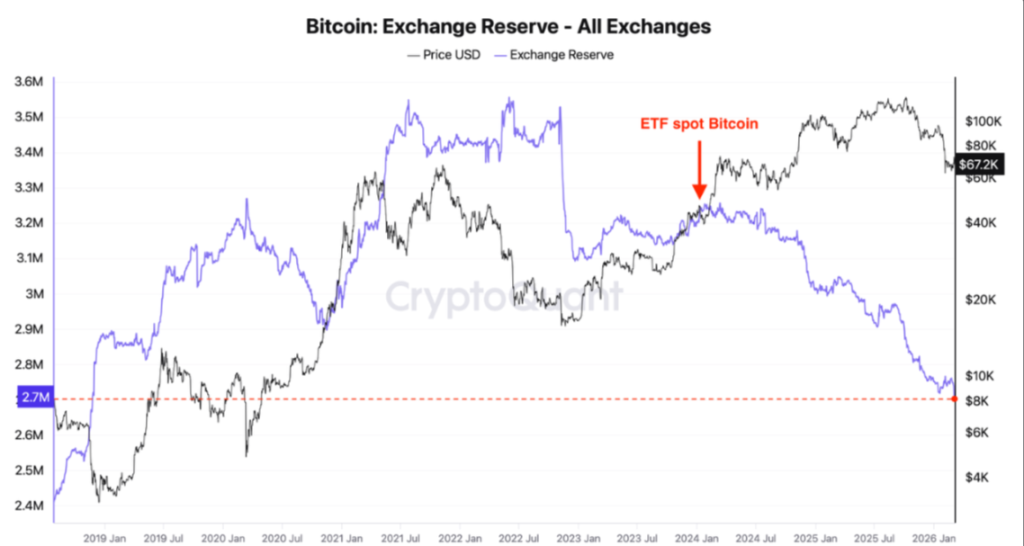
Even years after that event, the downward trend has continued, suggesting a long-term shift toward self-custody and long-term holding strategies.
Among centralized exchanges, Binance currently holds around 20% of all exchange-based BTC reserves, making it the largest retail liquidity hub. Meanwhile, Coinbase Advanced reportedly holds nearly 800,000 BTC, although this is roughly 200,000 BTC lower than levels seen in mid-2025.
Spot Bitcoin ETFs Are Absorbing Supply
Another key factor behind why Bitcoin exchange reserves drop is the rapid rise of spot Bitcoin ETFs. Since their launch in early 2024, institutional investors have been steadily accumulating Bitcoin through regulated investment products. At the time ETFs entered the market, exchange reserves were still above 3.2 million BTC. Today, these funds collectively hold roughly 1.3 million BTC, representing about 6–7% of Bitcoin’s circulating supply.
Because ETF holdings are typically stored with custodians rather than exchanges, this Bitcoin is effectively removed from the liquid trading supply.
As ETF inflows continue, the amount of Bitcoin available on exchanges may keep declining.
Corporate Bitcoin Treasuries Continue to Grow
Corporate treasury strategies are also contributing to the trend where Bitcoin exchange reserves drop. Over the past few years, several companies have adopted Bitcoin as a strategic reserve asset, allocating BTC to their balance sheets as a hedge against currency debasement and macroeconomic uncertainty. Collectively, corporate treasury entities now hold around 1.1 million BTC, which accounts for roughly 5% of the total circulating supply.
Unlike short-term traders, these organizations typically follow long-term accumulation strategies, meaning their Bitcoin is unlikely to return to exchanges anytime soon. This further reduces the liquid supply available for active market trading.
What This Means for Bitcoin Price
When Bitcoin exchange reserves drop, it often signals tightening supply conditions across the market. With more BTC moving into long-term storage, ETFs, and corporate treasuries, fewer coins remain available for immediate trading on exchanges.
Historically, declining exchange reserves have sometimes preceded supply-driven price expansions, particularly when demand simultaneously increases. While the impact may not appear immediately, analysts believe the ongoing reduction in exchange balances could play an important role in shaping Bitcoin’s next market cycle.
FAQs
Bitcoin reserves on exchanges are falling because investors are moving their coins to private wallets and ETFs. This shift toward self-custody and long-term holding reduces the supply available for immediate trading.
Yes, historically, declining exchange reserves can be bullish for Bitcoin price. When supply shrinks on trading platforms but demand stays strong or increases, it often creates upward pressure on the market value.
For traders, low reserves mean there are fewer coins available to buy instantly on exchanges. This can lead to higher volatility and potential price spikes if buying pressure suddenly increases with limited supply.
Yes, large outflows typically signal strong investor confidence. Moving Bitcoin off exchanges suggests holders are prioritizing long-term security over short-term selling, which indicates a belief in future price appreciation.
Trust with CoinPedia:
CoinPedia has been delivering accurate and timely cryptocurrency and blockchain updates since 2017. All content is created by our expert panel of analysts and journalists, following strict Editorial Guidelines based on E-E-A-T (Experience, Expertise, Authoritativeness, Trustworthiness). Every article is fact-checked against reputable sources to ensure accuracy, transparency, and reliability. Our review policy guarantees unbiased evaluations when recommending exchanges, platforms, or tools. We strive to provide timely updates about everything crypto & blockchain, right from startups to industry majors.
Investment Disclaimer:
All opinions and insights shared represent the author's own views on current market conditions. Please do your own research before making investment decisions. Neither the writer nor the publication assumes responsibility for your financial choices.
Sponsored and Advertisements:
Sponsored content and affiliate links may appear on our site. Advertisements are marked clearly, and our editorial content remains entirely independent from our ad partners.

 Yes
Yes  No
No 

![Bitcoin Price Today [LIVE] Updates, Why is Crypto Going Up 16th March](https://image.coinpedia.org/wp-content/uploads/2026/03/16140330/Bitcoin-Price-Today-LIVE-Updates-Why-is-Crypto-Going-Up-16th-March-390x220.webp)