



 Advertise



Binance USDT Liquidity Signals Consolidation, Not Bitcoin Recovery Yet



Binance holds about $41.2B in USDT, but reserves remain in a declining trend.
Combined 30-day USDT netflows on Binance total roughly -$1.27 billion.
Positive inflows briefly appeared in early June before returning to neutral levels.
Markets love to celebrate the first sign of stability. The data, however, isn’t always as enthusiastic. While Bitcoin continues trading in the low $60,000 range this June, Binance’s USDT liquidity suggests the market may be stabilizing rather than preparing for a full-fledged recovery, per an analyst.
The world’s largest crypto exchange currently holds approximately $41.2 billion in USDT across ERC-20 and TRC-20 networks. That’s a substantial reserve, sure, but the trend matters more than the headline number. The analyst points to Binance’s ERC-20 USDT reserve which has declined 2.3% over the last 30 days and now sits at just the 23.5th percentile of its monthly range. That’s hardly the profile of a market aggressively accumulating risk.
Capital Exits Slow But Haven’t Reversed
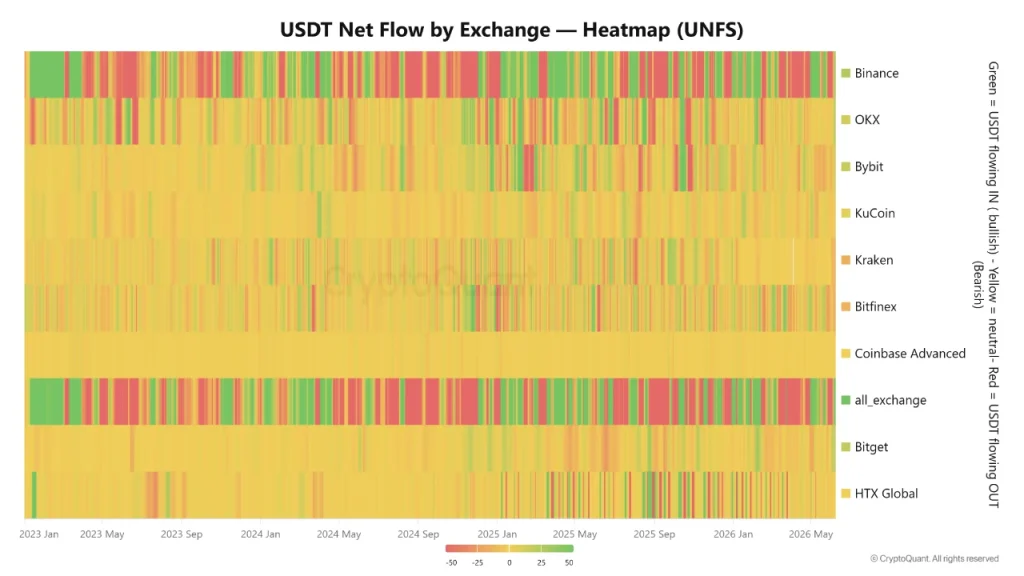
Late May delivered some of the strongest outflow pressure seen during the current cycle. The seven-day moving average of Binance ERC-20 netflows plunged to negative $215 million, reflecting intense capital distribution.
Then came early June. The same metric briefly flipped positive, reaching approximately $120 million on June 5 before cooling back to neutral territory by June 8. That’s encouraging if you’re looking for signs of stabilization. It’s less encouraging if you’re expecting a wave of fresh capital to fuel a sustained rally.

The CryptoQuant analyst Crazzyblockk highlights one major key detail that still remains unchanged that the money that left hasn’t fully returned, yet.
Binance Reserve Still Below Key Levels
Combined 30-day netflows across Binance’s ERC-20 and TRC-20 USDT reserves stand near negative $1.27 billion. Meanwhile, total reserves remain roughly 12.4% below their December 2025 peak of $43.9 billion.
In other words, distribution may be slowing, but accumulation hasn’t taken control.
Liquidity conditions that typically accompany strong market expansions remain absent from the data.
Broader Exchange Trends Tell Similar Story
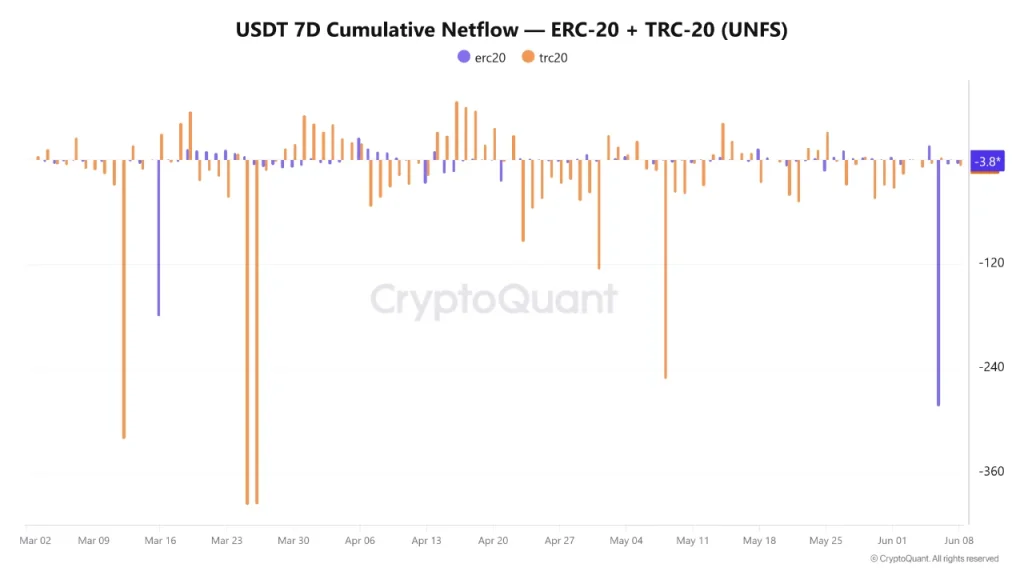
The pattern extends beyond Binance. OKX, Bybit, and Bitfinex continue showing mild distribution on a 30-day basis.
KuCoin and Bitget have posted accumulation signals through TRC-20 reserves, but their combined holdings of roughly $465 million limit their overall market influence.
For now, the message from USDT liquidity is fairly straightforward. Until Binance reserves reclaim their 30-day average alongside sustained positive inflows, the foundation for a stronger Bitcoin recovery remains incomplete. The market appears to be finding balance, but it doesn’t look fully reloaded yet.
Additionally, Bitcoin’s price hovers near the low $60,000 range, which may suggest the market has found a temporary footing. Yet the stablecoin data tells a more cautious story.
Was this writing helpful?

Trust with CoinPedia:
CoinPedia has been delivering accurate and timely cryptocurrency and blockchain updates since 2017. All content is created by our expert panel of analysts and journalists, following strict Editorial Guidelines based on E-E-A-T (Experience, Expertise, Authoritativeness, Trustworthiness). Every article is fact-checked against reputable sources to ensure accuracy, transparency, and reliability. Our review policy guarantees unbiased evaluations when recommending exchanges, platforms, or tools. We strive to provide timely updates about everything crypto & blockchain, right from startups to industry majors.
Investment Disclaimer:
All opinions and insights shared represent the author's own views on current market conditions. Please do your own research before making investment decisions. Neither the writer nor the publication assumes responsibility for your financial choices.
Sponsored and Advertisements:
Sponsored content and affiliate links may appear on our site. Advertisements are marked clearly, and our editorial content remains entirely independent from our ad partners.