



 Advertise



Bigger Is Losing: New ICODA Data Shows Crypto’s Largest Platforms Are Shrinking Fastest



Press release about recent ICOs, announcement from startups, new cryptocurrency launch by firms and unlike.



The largest platforms in crypto lost a median of 21% of their organic search traffic between 2024 and 2026, while the smallest sites in the same categories gained 13%, according to a new study tracking 124 crypto domains through Google’s core updates. The finding upends a common assumption in web3 marketing: that size and domain authority are protective assets in Google search.
The study tracked 31 months of organic traffic, from January 2024 to July 2026, across eight crypto niches: swaps, wallets, centralized exchanges, DeFi, trackers, on-ramps, earn/staking, and NFT platforms. After excluding domains with tracking artifacts like migrations, researchers cleanly classified 51 sites as winners, stable, or losers.
What the Data Shows
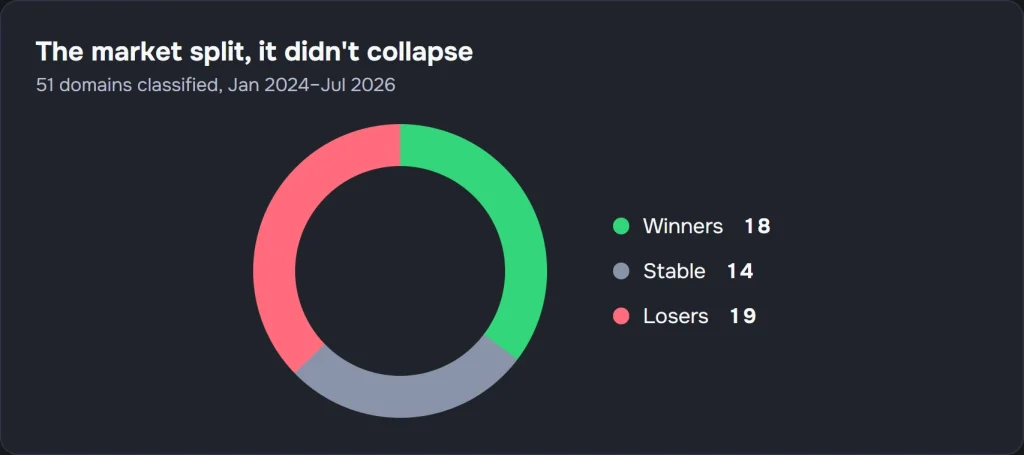
Crypto’s organic search traffic split rather than collapsed: 18 winners, 14 stable sites, and 19 losers among the 51 classified domains. Median change was −5%, mean +7%, close enough to flat that a casual read might call the sector unaffected. That read misses the story.
The real signal is the spread. Outcomes ranged from −87% to +190%, and all eight niches contained both winners and losers. The popular narrative that crypto broadly lost organic visibility after Google’s Helpful Content Update collapses two opposite populations into one false headline: some of the most authoritative brands in the space lost half their traffic while direct competitors in the same category doubled theirs over the same window.

Because winners and losers sat inside the same niches, facing the same token-price cycles and category demand, market conditions can’t explain the divergence.
The Size Inversion
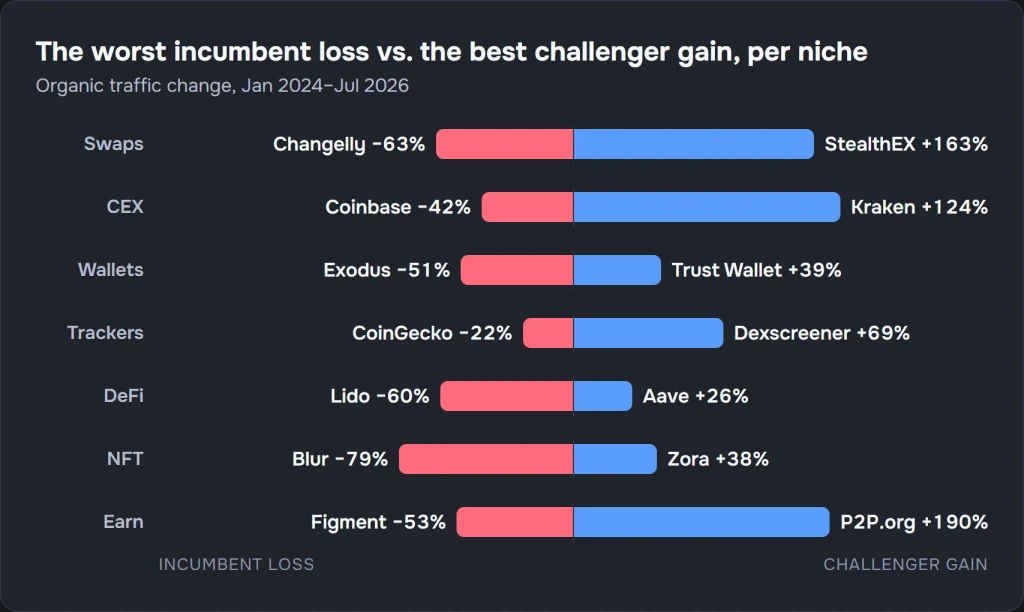
The largest platforms in each niche lost the most traffic while smaller, focused competitors gained. Split into thirds by starting size, the smallest third grew a median of +13% and the largest third fell a median of −21%, a pattern that held across categories:
| Niche | Incumbents that lost | Challengers that grew |
|---|---|---|
| Swaps | Uniswap −40%, Changelly −63% | StealthEX +163%, SimpleSwap +74% |
| Centralized exchanges | Coinbase −42%, Crypto.com −39%, Binance −17% | Kraken +124% |
| Wallets | Exodus −51% | MetaMask +38%, Trust Wallet +39% |
| Trackers | CoinGecko −22%, CoinMarketCap −19% | Dexscreener +69%, CoinTracker +61% |
| DeFi | Lido −60%, Compound −48% | Aave +26%, Jup +24% |
| NFT | OpenSea −55%, Blur −79% | Zora +38% |
| Earn/staking | Figment −53% | P2P.org +190%, Everstake +43% |
Outcome correlated at −0.23 with starting traffic size. That’s modest, but it’s consistent in direction across every category tested.
Why Authority Didn’t Help
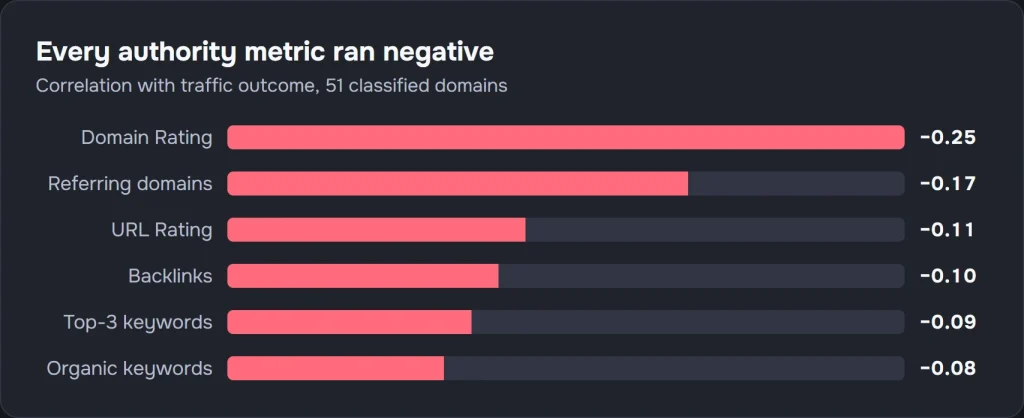
Domain authority showed no protective relationship with traffic outcomes. If anything, the correlation ran slightly negative: Domain Rating correlated at −0.25 with outcome, referring domains at −0.17, backlinks at −0.10, organic keywords at −0.08. Every classic authority metric tracked at or below zero.
| Metric | Correlation with outcome |
|---|---|
| Domain Rating | −0.25 |
| Referring domains | −0.17 |
| URL Rating | −0.11 |
| Backlinks | −0.10 |
| Organic keywords | −0.08 |
| Top-3 keywords | −0.09 |
For a sector where link-building is the default answer to a ranking problem, that’s a direct challenge. Web3 marketing strategies built on backlink volume and accumulated authority no longer track with which sites held or grew their traffic. Whatever drove outcomes through the 2024-to-2026 core updates operated at the level of individual page content, not off-site link signals.
What This Means for Web3 Marketing Teams
The data points to a specific shift in how crypto platforms should approach organic growth:
- Audit before you publish. Large content footprints built for broad keyword coverage are the pattern most tied to traffic loss. Pruning thin, redundant pages matters more than adding new ones, which is easier with a dedicated crypto SEO audit than with in-house guesswork.
- Depth beats breadth. The sites that grew were narrower and more intent-specific, not bigger or more authoritative.
- Don’t treat link-building as a growth lever on its own. It showed no measurable relationship to outcome here.
- Track AI-answer visibility separately. A May 2026 core update made AI Overviews citations a distinct, measurable signal, so organic rank and AI-answer presence now move independently.
Methodology
ICODA Research built the dataset from 124 crypto domains, pulling monthly organic-traffic estimates from Ahrefs for a stratified subset across eight niches. Baseline was the average for January and February 2024; current traffic was the average for May through July 2026. A net change above +15% classified a winner, below −15% a loser. Five domains were excluded as tracking artifacts, leaving 51 cleanly classified domains. Correlations are associational and do not establish causation.
Was this writing helpful?

Disclaimer and Risk Warning
The content featured on Coinpedia's press release page is provided for informational purposes only. Coinpedia does not endorse, verify, or take responsibility for the accuracy, completeness, or reliability of any press releases or associated materials. Any views, opinions, or statements expressed in these press releases are those of the respective issuers and do not reflect the opinions or positions of Coinpedia. Coinpedia is not liable for any content, products, services, or actions mentioned in the press releases. Readers should independently verify the information before taking any actions related to the subject matter of the releases.