

 Advertise



- Debashree Patra
 Debashree Patra
- Reviewed by:
 Nidhi Kolhapur
Nidhi is a Certified Digital Marketing Executive and Passionate crypto Journalist covering the world of alternative currencies. She shares the latest and trending news on Cryptocurrency and Blockchain.
- Feb 07, 2026 11:56 UTC
-


Vietnam Proposes 0.1% Tax on Crypto Transactions Under New Regulatory Framework
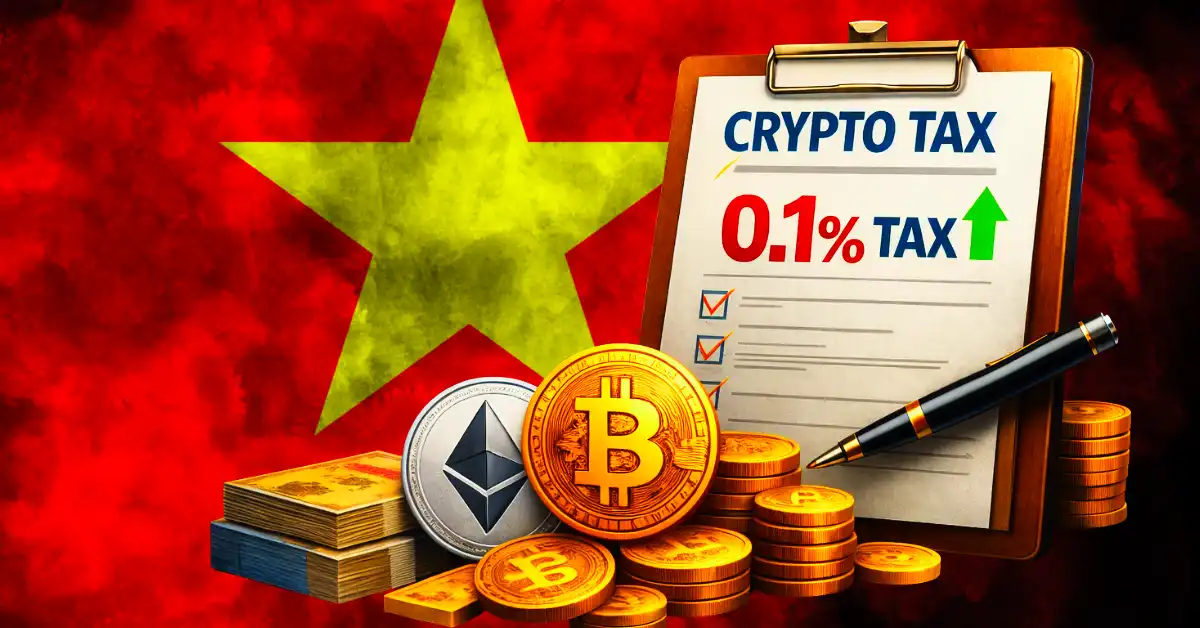
Vietnam plans to regulate crypto with a 0.1% transaction tax, VAT exemption, 20% corporate tax, and strict licensing rules for exchanges.
Vietnam moves closer to crypto regulation, proposing stock-style taxes, high capital requirements for exchanges, and a formal licensing framework.
Vietnam is moving closer to formally regulating cryptocurrency trading, with a new draft policy that treats digital assets similarly to traditional securities. The proposal, circulated by the Ministry of Finance for public feedback, introduces a transaction-based tax system while tightening oversight of crypto exchanges.
0.1% Levy on Crypto Transfers
Under the proposed framework, individuals trading or transferring cryptocurrencies through licensed service providers would be charged a 0.1% personal income tax on the value of each transaction. This mirrors the tax structure currently applied to stock trading in Vietnam. The levy would apply to all investors, regardless of residency, whenever a crypto transfer is executed within the regulated system.
At the same time, the draft clarifies that crypto transfers and trading would be exempt from value-added tax, signaling that the government views digital assets more as financial instruments than consumer goods.
Corporate Investors Face Profit-Based Taxation
Companies and institutional investors would be taxed differently. Profits generated from crypto trading would fall under the standard 20% corporate income tax regime. This tax would be calculated after deducting acquisition costs and related expenses, aligning crypto-related earnings with other business income.
Clear Definitions and High Entry Barriers
The proposal also formally defines crypto assets as digital assets that rely on cryptographic or similar technologies for issuance, storage, and transaction verification. Alongside this definition, the draft sets strict requirements for exchange operators. Firms seeking to run digital asset trading platforms would need at least 10 trillion Vietnamese dong, or about $408 million, in charter capital. Foreign ownership would be allowed but limited to 49%.
Pilot Program and Licensing Push
These rules come as Vietnam continues its five-year pilot program for a regulated crypto market, launched in September 2025. Despite the country ranking among the top globally for crypto adoption, no firms initially applied, largely due to high capital and compliance hurdles.
To push the framework forward, Vietnam began accepting license applications for crypto exchanges in January 2026, marking a concrete step toward bringing the fast-growing sector under full regulatory oversight.
Never Miss a Beat in the Crypto World!
Stay ahead with breaking news, expert analysis, and real-time updates on the latest trends in Bitcoin, altcoins, DeFi, NFTs, and more.
FAQs
Vietnam is implementing a formal regulatory pilot program for crypto trading, treating digital assets similarly to securities, with licensing for exchanges now open.
Individuals pay a 0.1% transaction tax per crypto transfer. Companies are taxed 20% on trading profits, aligning with standard corporate income tax rules.
Yes, but foreign ownership in licensed Vietnamese crypto exchanges is capped at 49%, with high capital requirements of approximately $408 million.
Yes. Individuals pay via the 0.1% transaction levy. Corporate investors pay a 20% tax on net profits from crypto trading, after deducting costs.
Trust with CoinPedia:
CoinPedia has been delivering accurate and timely cryptocurrency and blockchain updates since 2017. All content is created by our expert panel of analysts and journalists, following strict Editorial Guidelines based on E-E-A-T (Experience, Expertise, Authoritativeness, Trustworthiness). Every article is fact-checked against reputable sources to ensure accuracy, transparency, and reliability. Our review policy guarantees unbiased evaluations when recommending exchanges, platforms, or tools. We strive to provide timely updates about everything crypto & blockchain, right from startups to industry majors.
Investment Disclaimer:
All opinions and insights shared represent the author's own views on current market conditions. Please do your own research before making investment decisions. Neither the writer nor the publication assumes responsibility for your financial choices.
Sponsored and Advertisements:
Sponsored content and affiliate links may appear on our site. Advertisements are marked clearly, and our editorial content remains entirely independent from our ad partners.

 Yes
Yes  No
No