


 Advertise



- Zafar Naik
 Zafar Naik
- Reviewed by:
 Qadir AK
Qadir Ak is the founder of Coinpedia. He has over a decade of experience writing about technology and has been covering the blockchain and cryptocurrency space since 2010. He has also interviewed a few prominent experts within the cryptocurrency space.
- Dec 20, 2025 11:00 UTC
-


New Whale Buyers Now Drive 50% of Bitcoin’s Realized Cap – A Shift From Old Cycles?

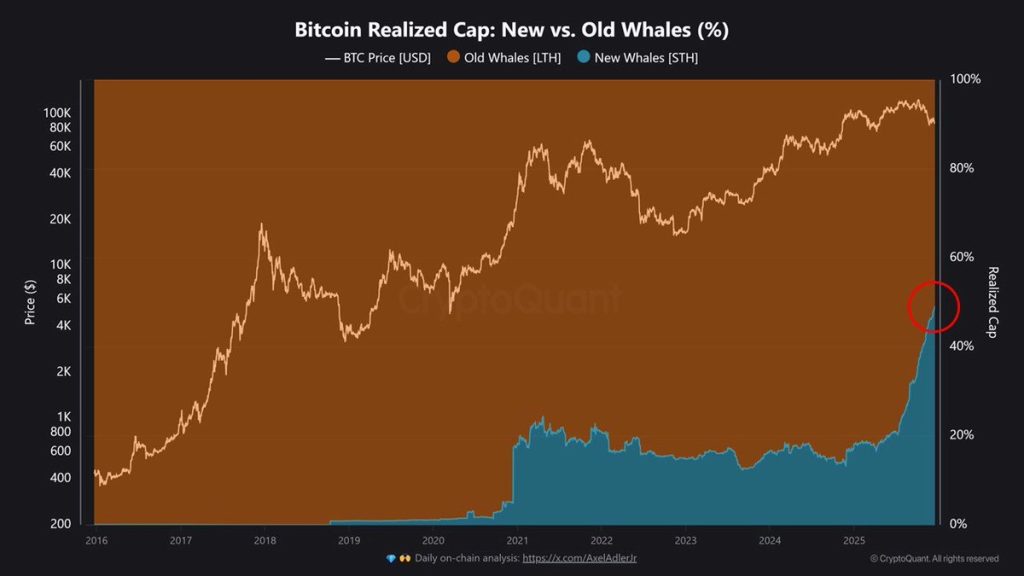
New Bitcoin whales now account for nearly half of the network’s realized cap.
On-chain data shows large buyers continue accumulating at higher prices, even during market pullbacks.
The trend suggests Bitcoin’s market structure is changing, challenging how past cycles typically played out.
Bitcoin’s price has been volatile, but the bigger story right now isn’t the chart. It’s who’s buying and at what levels.
New on-chain data shows that nearly 50% of Bitcoin’s realized cap now comes from new whale buyers, a sharp break from how past Bitcoin cycles played out.
Realized cap tracks the value of Bitcoin at the price each coin last moved on-chain. So when new whales approach a 50% share, it means half of the capital invested in Bitcoin was formed at recent price levels, not during early low-cost accumulation phases.
New Whales Are Playing a Different Game
According to the data, these new whales are mainly institutions and ETFs buying Bitcoin at higher prices and in larger volumes. That alone sets them apart from long-term holders who accumulated cheaply and sold into strength during previous bull runs.
More importantly, their behavior during pullbacks looks different.
“Even during corrections, the Realized Cap share of new whales has continued to rise,” the analysis notes.
This should not be interpreted as a short-term bullish or bearish signal, but as evidence that the structure of the Bitcoin market itself is changing, the report adds.
Demand Is Rising, Not Rotating
Short-term holder data backs this up. Supply held by coins younger than 155 days grew by roughly 100,000 BTC in 30 days, reaching an all-time high. That suggests fresh demand is still coming in, even as prices fluctuate.
At the same time, long-term holders remain mostly inactive. Exchange flows show that selling pressure came largely from smaller participants, while large wallets stepped in to absorb supply.
Cumulative volume delta data reinforces this split. Whale wallets posted a positive $135 million delta, while retail and mid-sized traders showed negative flows.
What This Shift Really Signals
This data points to something deeper.
Bitcoin is entering a transition toward a more mature asset shaped by sustained institutional accumulation.
For a market long defined by boom-and-bust cycles, that change matters. And it may explain why Bitcoin’s behavior is starting to look less familiar and more structural with each passing month.
Never Miss a Beat in the Crypto World!
Stay ahead with breaking news, expert analysis, and real-time updates on the latest trends in Bitcoin, altcoins, DeFi, NFTs, and more.
FAQs
Not necessarily. While institutional buyers can stabilize liquidity and reduce extreme volatility over time, they can also introduce new risks, such as synchronized reactions to macro events, regulatory changes, or ETF inflows/outflows. Retail investors may face sharper moves tied to traditional financial markets rather than purely crypto-native cycles.
The response may differ from past cycles. Instead of panic selling, institutions may hedge, rebalance, or add exposure at predefined levels. This could lead to faster stabilization—but if forced liquidations occur (for example, due to macro stress), downside moves could still be abrupt.
Long-term participants and infrastructure providers—such as custodians, derivatives platforms, and on-chain analytics firms—stand to benefit from a more capital-heavy, institutionally driven Bitcoin market. Short-term speculators, meanwhile, may find fewer momentum-driven opportunities than in earlier cycles.
Trust with CoinPedia:
CoinPedia has been delivering accurate and timely cryptocurrency and blockchain updates since 2017. All content is created by our expert panel of analysts and journalists, following strict Editorial Guidelines based on E-E-A-T (Experience, Expertise, Authoritativeness, Trustworthiness). Every article is fact-checked against reputable sources to ensure accuracy, transparency, and reliability. Our review policy guarantees unbiased evaluations when recommending exchanges, platforms, or tools. We strive to provide timely updates about everything crypto & blockchain, right from startups to industry majors.
Investment Disclaimer:
All opinions and insights shared represent the author's own views on current market conditions. Please do your own research before making investment decisions. Neither the writer nor the publication assumes responsibility for your financial choices.
Sponsored and Advertisements:
Sponsored content and affiliate links may appear on our site. Advertisements are marked clearly, and our editorial content remains entirely independent from our ad partners.

 Yes
Yes  No
No