


 Advertise



- Rizwan Ansari
 Rizwan Ansari
- Apr 08, 2026 08:33 UTC
-


Iran Loses Nearly 77% of Its Bitcoin Mining Power

Iran’s Bitcoin mining sector has taken a major hit amid the ongoing conflict involving the U.S., Israel, and Iran. The country has reportedly lost around 77% of its Bitcoin mining power, forcing thousands of miners offline.
The crisis has slowed global Bitcoin mining too, with the network dropping 5.8% QoQ, while falling Bitcoin prices continuously.
Iran Bitcoin Hashrate Drops Sharply
According to a Hashrate Index report, Iran’s Bitcoin hashrate has plunged from around 9 exahashes per second (EH/s) to just 2 EH/s, a drop of nearly 7 EH/s quarter-over-quarter.
The country, which once ran roughly 427,000 active Bitcoin miners, is now operating at a fraction of that capacity.
The trouble began in February 2026, when the US and Israel launched strikes against Iran. This led to rising conflict, infrastructure risks, and energy disruptions, which appear to be forcing miners offline.
Recently, Trump even threatened to strike power plants, energy facilities, and bridges, further worsening the situation.
Interestingly, the crisis remains contained within Iran. Neighboring countries like the UAE and Oman, each controlling about 3% of the global Bitcoin hashrate, have seen no disruptions and continue steady growth, supported by long-term government infrastructure plans.
Global Bitcoin Hashrate Declines By 5.8% QoQ
The impact isn’t just in Iran; global Bitcoin hashrate has also fallen. Data shows the network dropped to around 1,004 EH/s in Q2 2026, down from 1,066 EH/s in Q1 2026, a 5.8% decline quarter-over-quarter.
While the network remains strong near 1,000 EH/s, the drop signals slower mining activity and tougher conditions for miners.
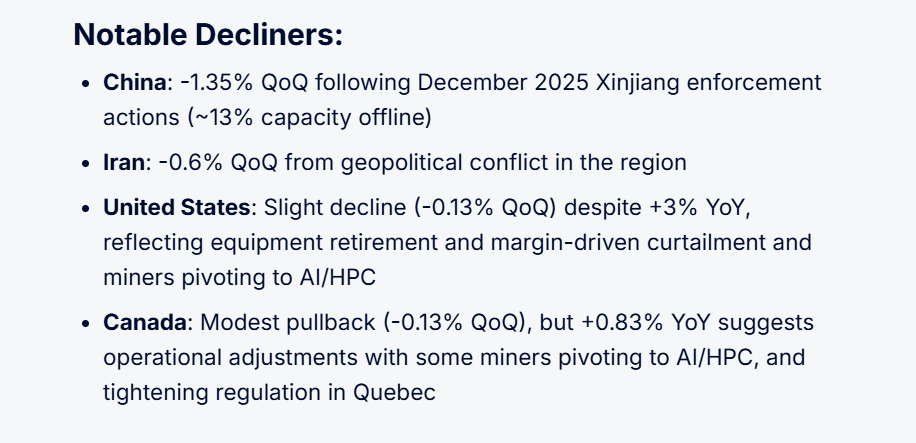
Looking at market share change, China has lost 1.35% QoQ after Xinjiang enforcement actions cut about 13% of its capacity. Meanwhile, Iran dropped 0.6% due to US-Israel conflicts, and the US fell by 0.13%.
Experts say the decline reflects broader pressure across the Bitcoin mining industry.
Bitcoin Price Drop Adds More Pressure
The mining slowdown also comes as the Bitcoin price remains below its previous highs. Bitcoin has fallen roughly 50% from its October 2025 peak near $126,000 and is now trading around $70,000.
Lower prices reduce mining profitability, pushing smaller operators offline. Hashprice has also dropped to around $27.89 per PH/s per day, marking historically low returns for miners.
Despite the decline, the Bitcoin network continues operating normally.
Trust with CoinPedia:
CoinPedia has been delivering accurate and timely cryptocurrency and blockchain updates since 2017. All content is created by our expert panel of analysts and journalists, following strict Editorial Guidelines based on E-E-A-T (Experience, Expertise, Authoritativeness, Trustworthiness). Every article is fact-checked against reputable sources to ensure accuracy, transparency, and reliability. Our review policy guarantees unbiased evaluations when recommending exchanges, platforms, or tools. We strive to provide timely updates about everything crypto & blockchain, right from startups to industry majors.
Investment Disclaimer:
All opinions and insights shared represent the author's own views on current market conditions. Please do your own research before making investment decisions. Neither the writer nor the publication assumes responsibility for your financial choices.
Sponsored and Advertisements:
Sponsored content and affiliate links may appear on our site. Advertisements are marked clearly, and our editorial content remains entirely independent from our ad partners.

 Yes
Yes  No
No