



 Advertise



Injective Whitepaper Recasts INJ Chain Around Tokenized Finance



Injective's new whitepaper is its first full rewrite since December 2018.
The protocol targets RWA issuance, onchain trading, derivatives, settlement, and AI-agent finance.
Injective uses BFT consensus with roughly 600ms blocks and deterministic finality.
The new Injective whitepaper marks the first full rewrite since December 2018, when the project described a front-running-resistant exchange protocol on Ethereum. Eight years later, the protocol is pitching something considerably broader: a layer-1 blockchain built around institutional-grade finance and tokenization.
The premise is straightforward. Every layer is designed around issuing real-world assets and giving them utility across markets, applications, and AI agents.
Injective Whitepaper Puts Asset Issuance First
Native RWA tokenization sits at the center of the new architecture. Assets can use role-based permissions covering minting, sending, receiving, and burning, alongside programmable receive hooks and sealable namespaces.
Then comes iAssets, which provide stablecoin-margined, oracle-priced derivatives tracking external assets without wrapping or pre-funding them. That’s a fairly ambitious stack.

Onchain Trading Gets A Different Structure
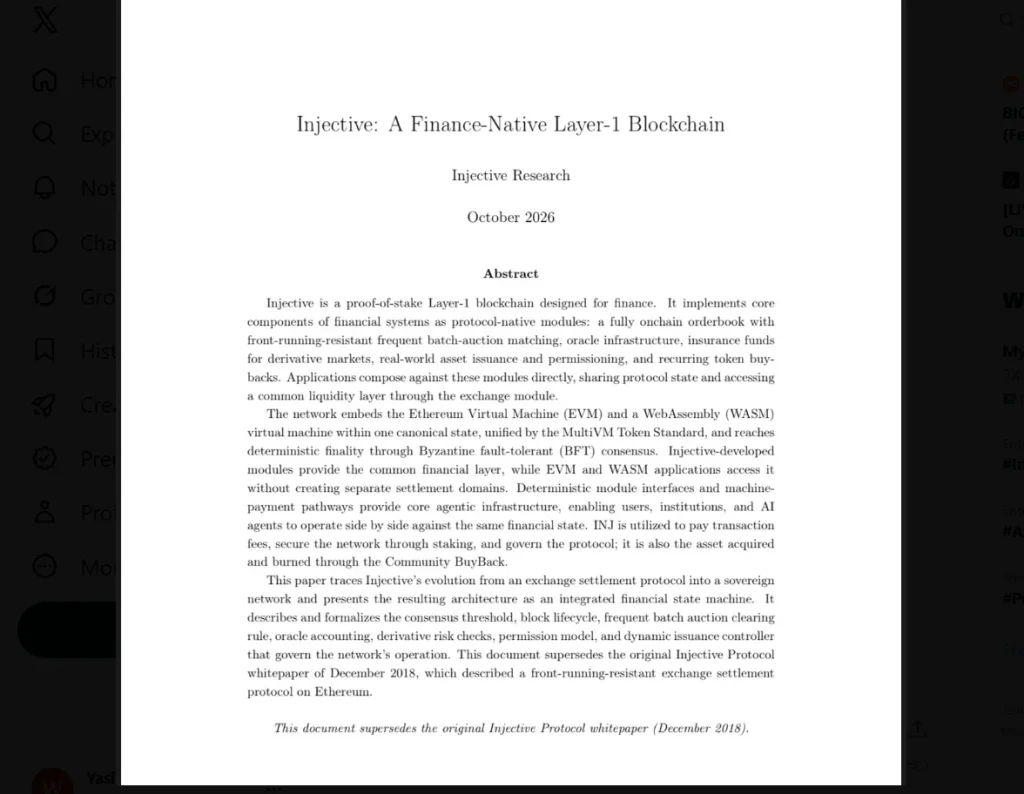
Tokenized assets can trade through a fully onchain CLOB, with each block running a sealed frequent batch auction at a uniform clearing price. The design is intended to resist front-running and ordering MEV.
Settlement runs through BFT consensus with a greater-than-two-thirds commit threshold, delivering deterministic finality with approximately 600ms blocks.
Meanwhile, native EVM and WASM operate within one canonical state. The MultiVM Token Standard keeps a single balance per asset across the bank module while exposing that balance to Solidity through precompiles.
AI Agents And Derivatives Join The Same Stack
The architecture also includes perpetuals with time-weighted premium funding, margin checks, reduce-only liquidations, and insurance funds.
Then there’s agentic finance. AI agents can interact with tokenized assets through MCP servers, policy-bounded signing, and x402 machine payments using USDC.
Finally, onchain protocol revenue flows into the recurring Community BuyBack for INJ. The Injective whitepaper therefore lays out a chain covering issuance, trading, derivatives, settlement, composability, and agentic finance under one protocol.
Was this writing helpful?

Trust with CoinPedia:
CoinPedia has been delivering accurate and timely cryptocurrency and blockchain updates since 2017. All content is created by our expert panel of analysts and journalists, following strict Editorial Guidelines based on E-E-A-T (Experience, Expertise, Authoritativeness, Trustworthiness). Every article is fact-checked against reputable sources to ensure accuracy, transparency, and reliability. Our review policy guarantees unbiased evaluations when recommending exchanges, platforms, or tools. We strive to provide timely updates about everything crypto & blockchain, right from startups to industry majors.
Investment Disclaimer:
All opinions and insights shared represent the author's own views on current market conditions. Please do your own research before making investment decisions. Neither the writer nor the publication assumes responsibility for your financial choices.
Sponsored and Advertisements:
Sponsored content and affiliate links may appear on our site. Advertisements are marked clearly, and our editorial content remains entirely independent from our ad partners.
![Why is Bitcoin Price Down Today? [October 27th]](https://image.coinpedia.org/wp-content/uploads/2026/10/24153109/btc-price-tumbles-to-80k-why-is-bitcoin-falling-and-whats-next-1-390x220.webp)