


 Advertise



- Rizwan Ansari
 Rizwan Ansari
- Reviewed by:
 Sohrab Khawas
Sohrab is a passionate cryptocurrency news writer with over five years of experience covering the industry. He keeps a keen interest in blockchain technology and its potential to revolutionize finance. Whether he's trading or writing, Sohrab always keeps his finger on the pulse of the crypto world, using his expertise to deliver informative and engaging articles that educate and inspire. When he's not analyzing the markets, Sohrab indulges in his hobbies of graphic design, minimal design or listening to his favorite hip-hop tunes.
- Jan 20, 2026 08:20 UTC
-


India’s RBI Proposes Digital Currency for BRICS Nations
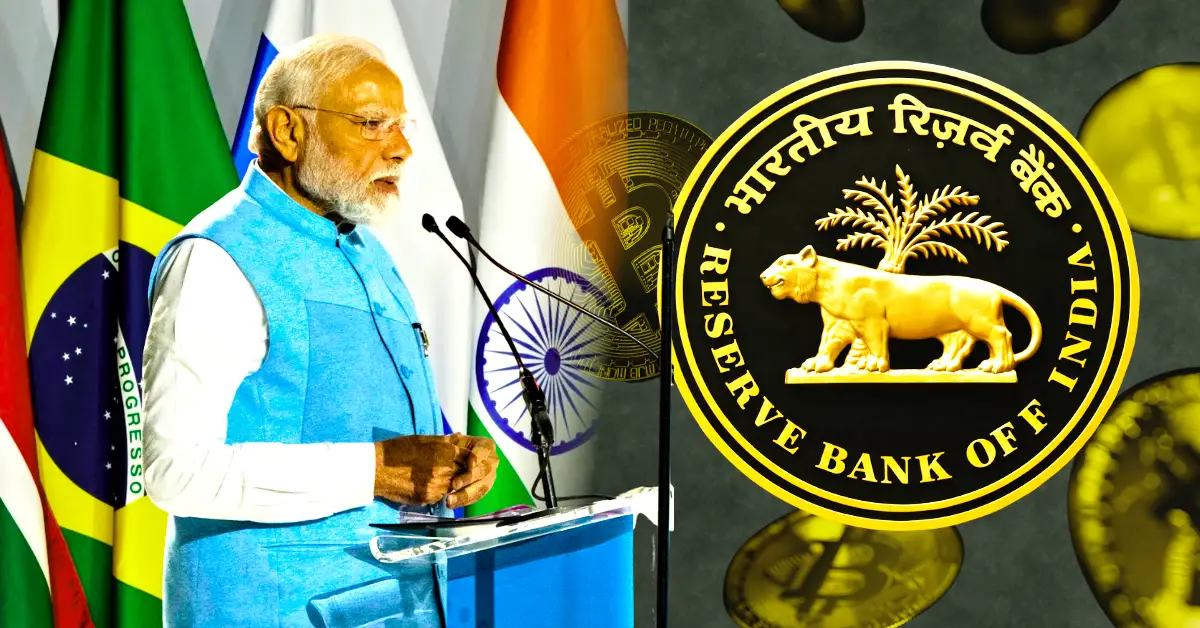
RBI proposes linking BRICS digital currencies to improve cross-border payments and reduce costs.
However, plan may be discussed at 2026 BRICS summit hosted by India later year.
RBI says digital currency linkage aims efficiency, not replacing US dollar dominance.
India’s central bank, the Reserve Bank of India (RBI), has put forward a bold plan to connect the digital currencies of BRICS nations to make international transactions smoother, faster, and less costly.
This proposal may become a major talking point at the 2026 BRICS summit, to be hosted by India later this year.
RBI Proposes Digital Currency for BRICS
According to reports, the RBI has suggested that BRICS countries, such as Brazil, Russia, India, China, and South Africa, work on linking their central bank digital currencies (CBDCs).
The goal is to make cross-border payments faster, cheaper, and more efficient, which could help trade, tourism, remittances, and daily business payments by cutting costs and saving time.
The proposal comes at a time when global tensions are rising, and U.S. President Donald Trump has threatened to impose 500% tariffs on imports from countries like Brazil, India, and China over their trade with Russia.
On top of it, this move could also help BRICS nations reduce their dependence on the U.S. dollar for international transactions.
CBDC Readiness Across BRICS
While none of the BRICS countries have fully launched their digital currencies yet, all of them are testing them. For example, India’s e-rupee has already reached about 7 million users since it launched in December 2022.
China is expanding its digital yuan, while Russia, Brazil, and South Africa are also running pilot programs.
The proposed plan builds on a 2025 BRICS agreement that aimed to connect national payment systems to make cross-border payments easier.
If accepted, the idea could be formally discussed at the 2026 BRICS summit, which India is scheduled to host later this year.
Challenges Ahead for Digital Currency Integration
While the idea is ambitious, experts note that technology and governance will be critical. Market observers point out that digital currency systems must balance efficiency with privacy, security, and regulatory oversight.
One suggested solution is using bilateral foreign exchange swap arrangements between central banks to balance payment differences over time.
Meanwhile, the RBI has also clarified that this plan is not about replacing the US dollar, but about making global payments cheaper and more efficient.
Never Miss a Beat in the Crypto World!
Stay ahead with breaking news, expert analysis, and real-time updates on the latest trends in Bitcoin, altcoins, DeFi, NFTs, and more.
FAQs
In the early stages, access is likely to be limited to banks, payment providers, and regulated institutions rather than the general public. Consumer-facing use would depend on domestic rules in each country and how the systems are eventually rolled out.
Exporters, importers, and firms handling frequent international settlements could benefit from faster clearing times and lower FX-related friction. However, businesses would still need to comply with local tax, reporting, and capital control rules.
Banks, remittance companies, and payment intermediaries could see changes to how cross-border flows are processed. Migrant workers and small traders may benefit indirectly if costs fall, but outcomes will vary by country.
Trust with CoinPedia:
CoinPedia has been delivering accurate and timely cryptocurrency and blockchain updates since 2017. All content is created by our expert panel of analysts and journalists, following strict Editorial Guidelines based on E-E-A-T (Experience, Expertise, Authoritativeness, Trustworthiness). Every article is fact-checked against reputable sources to ensure accuracy, transparency, and reliability. Our review policy guarantees unbiased evaluations when recommending exchanges, platforms, or tools. We strive to provide timely updates about everything crypto & blockchain, right from startups to industry majors.
Investment Disclaimer:
All opinions and insights shared represent the author's own views on current market conditions. Please do your own research before making investment decisions. Neither the writer nor the publication assumes responsibility for your financial choices.
Sponsored and Advertisements:
Sponsored content and affiliate links may appear on our site. Advertisements are marked clearly, and our editorial content remains entirely independent from our ad partners.

 Yes
Yes  No
No