 Advertise



Core Scientific to Wind Down Bitcoin Mining By Q4 2026 as AI Takes Over



Core Scientific plans to fully exit Bitcoin mining operations by the end of Q4 2026.
AI data-center workloads can generate far more value from the same power capacity than Bitcoin mining.
Riot Platforms, MARA, HIVE and Hut 8 are also shifting toward AI and HPC infrastructure.
Core Scientific, one of the biggest names in Bitcoin mining, plans to wind down its mining operations by Q4 2026. It is not alone. Other major mining firms, including MARA Holdings, Riot Platforms, and HIVE Digital, have already begun shifting away from traditional Bitcoin mining.
But what is driving these major companies to shift their mining businesses? The reasons may surprise you.
Core Scientific Is Leaving Bitcoin Mining Behind
During its Q3 2026 earnings call, Core Scientific confirmed that it expects to wind down its self-mining operations by 2026. From 2027, the company will focus on providing data center space for AI and high-performance computing.
The shift is already visible in its financial results.

Core Scientific generated $215.4 million in colocation revenue during Q3, up nearly 60% from the previous quarter. Colocation accounted for 93% of total revenue, while Bitcoin self-mining generated just $12.3 million. Adjusted EBITDA also jumped to $133.6 million, pushing the margin to 57%.
The company has already reduced its active mining fleet by nearly 50% from the end of 2025.
It even paid $41.9 million to end its Bitcoin mining equipment agreement with Block and Proto, ending future equipment deliveries.
Why Are Bitcoin Miners Moving Away From Mining?
The economics of Bitcoin mining have become increasingly difficult for large public miners.
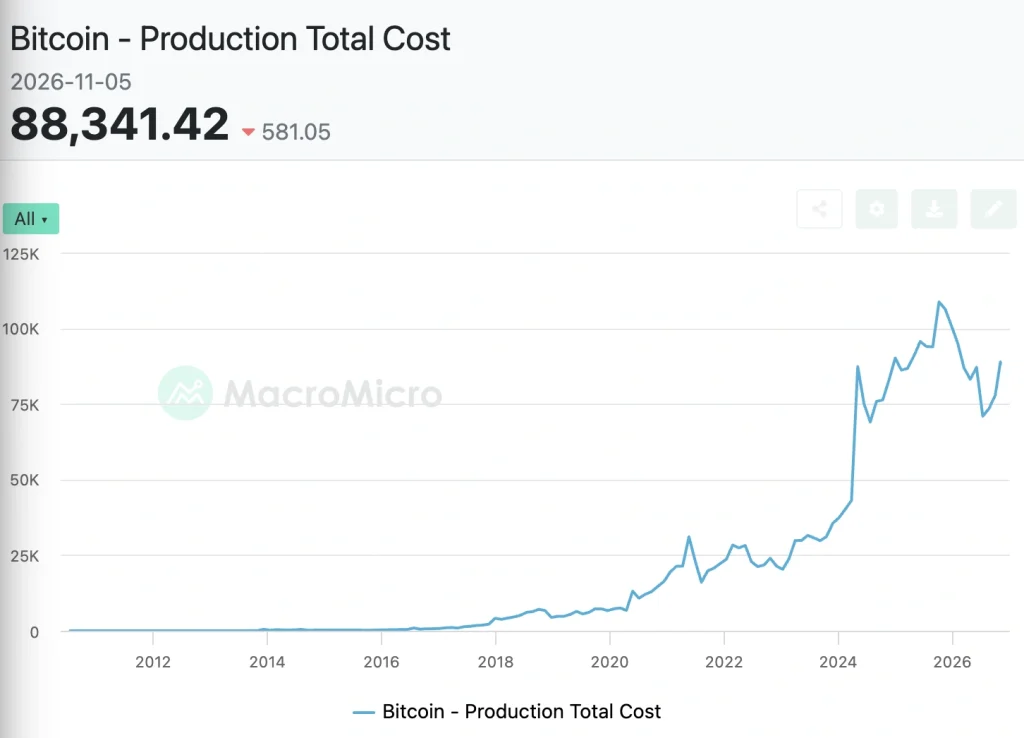
Following the April 2024 halving, the block reward was cut from 6.25 BTC to 3.125 BTC. For public mining companies, the average cost of producing one Bitcoin has climbed to around $88.341. When Bitcoin trades at or below $80,000, miners can lose money on every coin they produce. Even when Bitcoin briefly rises above $80,000, profit margins remain very thin.
These changes have put pressure on mining profits. Core Scientific said weaker mining conditions contributed to a $266.5 million loss in value on its mining-related assets earlier this year.
Electricity costs are also pushing miners to consider other businesses. According to an energy infrastructure analyst, one megawatt of power can generate roughly $1.9 million over five years from Bitcoin mining, compared with about $7.9 million from AI data-center workloads.
This makes AI data centers a more profitable option for companies that already have large power facilities. Instead of using that electricity to mine Bitcoin, they can rent their facilities to AI companies through long-term contracts.
Core Scientific is already doing that. Its AMD and Neocloud agreement covers about 530 MW, while AMD also has reservation rights for another 1,925 MW of potential capacity.
Core Scientific Is Not the Only Miner Making the Switch
Several other major miners are following a similar path. MARA Holdings sold about 15,133 BTC for roughly $1.1 billion in March and cut its workforce by 15% as it redirected capital toward balance-sheet strengthening and other opportunities.
Riot Platforms is taking the AI route even further. It signed a 20-year lease for 191 MW of critical IT capacity with a major AI lab, with an estimated $9.1 billion in contract revenue over the initial term.
HIVE is winding down its Bitcoin mining operations in Sweden while expanding its AI and HPC infrastructure in Canada.
The shift is becoming significant across the sector. At least 35 EH/s of computing power is scheduled to leave publicly listed Bitcoin miners as companies redirect capacity toward AI and high-performance computing.
Was this writing helpful?

Trust with CoinPedia:
CoinPedia has been delivering accurate and timely cryptocurrency and blockchain updates since 2017. All content is created by our expert panel of analysts and journalists, following strict Editorial Guidelines based on E-E-A-T (Experience, Expertise, Authoritativeness, Trustworthiness). Every article is fact-checked against reputable sources to ensure accuracy, transparency, and reliability. Our review policy guarantees unbiased evaluations when recommending exchanges, platforms, or tools. We strive to provide timely updates about everything crypto & blockchain, right from startups to industry majors.
Investment Disclaimer:
All opinions and insights shared represent the author's own views on current market conditions. Please do your own research before making investment decisions. Neither the writer nor the publication assumes responsibility for your financial choices.
Sponsored and Advertisements:
Sponsored content and affiliate links may appear on our site. Advertisements are marked clearly, and our editorial content remains entirely independent from our ad partners.