

 Advertise



- Debashree Patra
 Debashree Patra
- Reviewed by:
 Anjali Belgaumkar
Writer by choice, CryptoCurrency Writer, and Researcher by chance. Currently, focusing on financial news and analysis, as well as cryptocurrency news and data. One may not call me a crypto “Enthusiast” but trust me I'm getting there.
- Mar 30, 2026 08:28 UTC
-


CLARITY Act News: Senate Markup Set for April As Coinbase Fights to Save $1.35 Billion in Revenue
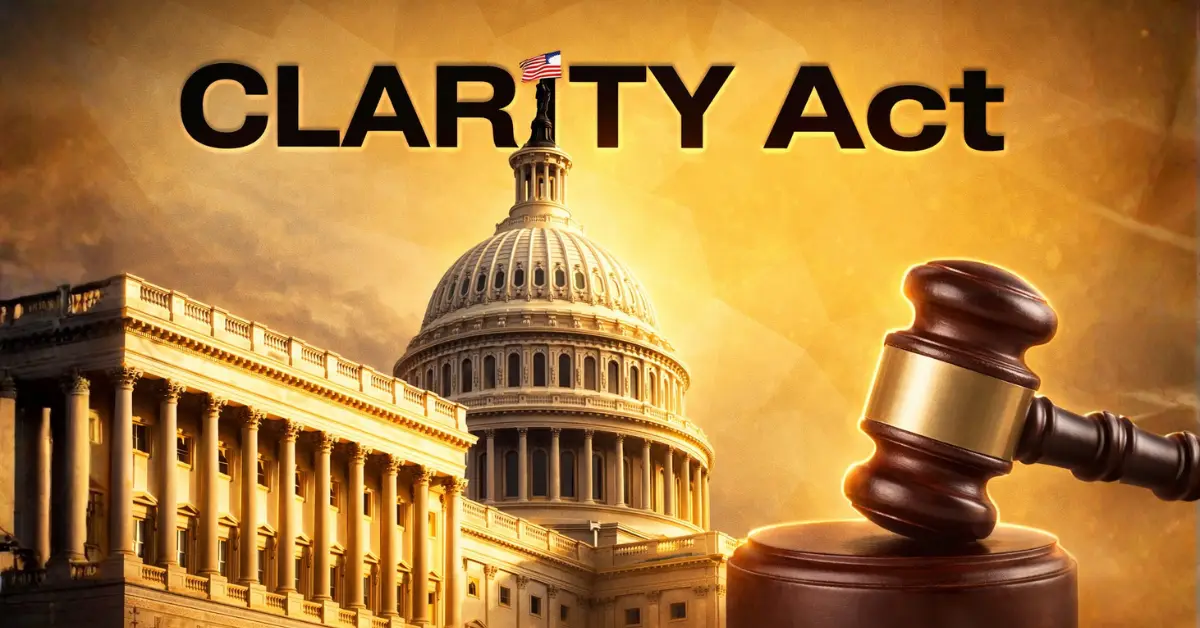
CLARITY Act may pass by May, banning passive stablecoin yield but allowing usage rewards. Coinbase warns it could hit billions in revenue.
New CLARITY Act draft targets stablecoin yield limits. Passive rewards may end, impacting Coinbase earnings and reshaping crypto incentives.
The CLARITY Act is moving again, and this time the timeline looks real. A recent update reveals that the CLARITY Act is all set to make headlines again, with Coinbase hinting at a possible Senate markup in the second half of April and potential passage by May.
According to Coinbase’s internal market view, lawmakers had already reached an agreement in principle on March 20, followed by a new compromise on March 24 that proposes banning passive stablecoin yield while still allowing limited, activity-based rewards.
The Stablecoin Flashpoint
The biggest sticking point is stablecoin yield. The latest proposal aims to ban passive rewards, meaning users won’t earn just by holding stablecoins. However, it still allows limited incentives tied to actual usage, like payments.
This isn’t a small tweak. In 2025, Coinbase and Circle generated around $2.75 billion from reserves backing USDC. Coinbase’s share alone was roughly $1.35 billion, close to one-fifth of its total revenue.
If passive yield disappears, that revenue stream takes a direct hit.
Coinbase’s Stand
Moreover, Coinbase isn’t opposing the entire bill. It supports clearer rules for DeFi, developer protections, and a defined split between regulators. The issue is the wording around yield.
Chief Legal Officer Paul Grewal has warned that vague language today could give future regulators too much power to reinterpret rules. The company is now working on a coordinated counterproposal to keep reward models viable while still aligning with regulation.
“My memory is a little better than to trust future rogue regulators to faithfully apply the law.” Grewal
This also ties into Coinbase’s broader model. The platform takes a sizable cut from staking rewards, around 35% on major assets, showing how central yield-based income is to its business.
- Also Read :
- Ripple CEO Traces Crypto From Rat Poison to Pet Rock, Says CLARITY Act Will Decide if Wall Street Goes All In
- ,
Power Struggle Behind the Scenes
Tensions are not just regulatory; they’re also institutional. Jamie Dimon and Brian Armstrong have reportedly clashed over stablecoin economics, even as both firms maintain a working partnership.
On the policy side, White House adviser Patrick Witt has made the urgency clear: move now or risk losing the window entirely.
What This Means for the Market
The outcome directly affects users. If broader reward structures remain, stablecoins could continue offering 4–5% returns, keeping liquidity strong. If restrictions tighten, incentives shrink, and capital could shift back toward traditional systems.
Overall, the full draft is expected soon, and the next few weeks will decide everything. This isn’t just another bill; it’s a turning point that will shape how crypto operates in the U.S., from user rewards to billion-dollar revenue models.
Never Miss a Beat in the Crypto World!
Stay ahead with breaking news, expert analysis, and real-time updates on the latest trends in Bitcoin, altcoins, DeFi, NFTs, and more.
FAQs
The CLARITY Act is a proposed U.S. bill that defines crypto regulations, clarifies agency roles, and sets rules for stablecoins and DeFi.
The CLARITY Act could move to Senate markup in April, with a potential final vote by May if lawmakers maintain current momentum.
On Polymarket, traders are speculating on CLARITY Act timelines, reflecting market expectations around approval chances and regulatory impact.
It may reduce passive earnings but bring clearer rules, helping platforms operate legally while improving trust and safety for users.
Trust with CoinPedia:
CoinPedia has been delivering accurate and timely cryptocurrency and blockchain updates since 2017. All content is created by our expert panel of analysts and journalists, following strict Editorial Guidelines based on E-E-A-T (Experience, Expertise, Authoritativeness, Trustworthiness). Every article is fact-checked against reputable sources to ensure accuracy, transparency, and reliability. Our review policy guarantees unbiased evaluations when recommending exchanges, platforms, or tools. We strive to provide timely updates about everything crypto & blockchain, right from startups to industry majors.
Investment Disclaimer:
All opinions and insights shared represent the author's own views on current market conditions. Please do your own research before making investment decisions. Neither the writer nor the publication assumes responsibility for your financial choices.
Sponsored and Advertisements:
Sponsored content and affiliate links may appear on our site. Advertisements are marked clearly, and our editorial content remains entirely independent from our ad partners.

 Yes
Yes  No
No