


 Advertise



- Rizwan Ansari
 Rizwan Ansari
- Reviewed by:
 Sohrab Khawas
Sohrab is a passionate cryptocurrency news writer with over five years of experience covering the industry. He keeps a keen interest in blockchain technology and its potential to revolutionize finance. Whether he's trading or writing, Sohrab always keeps his finger on the pulse of the crypto world, using his expertise to deliver informative and engaging articles that educate and inspire. When he's not analyzing the markets, Sohrab indulges in his hobbies of graphic design, minimal design or listening to his favorite hip-hop tunes.
- Dec 24, 2025 09:10 UTC
-


Bitcoin vs. Gold: Can BTC Surpass Gold? Experts Weigh In

Gold hits record new all time highs while Bitcoin lags, renewing debate over which asset stores value.
Analysts argue Bitcoin halvings enforce rising production costs, unlike gold mining responding to prices.
Conservative models suggest Bitcoin could match gold’s market value within eighteen years from now and btc will hit $1.5 million.
Gold has jumped more than 70% this year and is now trading near a new record high of $4,406. The rally is being driven by expected interest rate cuts and rising global tensions. At the same time, Bitcoin has been falling compared to gold. Bitcoin is now trading below $87,000, almost 29% down from its recent peak.
This growing gap has left many traders wondering whether Bitcoin can recover and eventually move ahead of gold again.
Gold Still Dominates Safe-Haven Status
For centuries, gold has been the top choice to store value. Recently, many countries and large institutions have rushed to buy gold as global tensions rise, inflation fears grow, and investors expect interest rate cuts.
Gold is widely seen as a safe place to park money during uncertain times. Because of this strong demand, gold prices have surged more than 70% this year, reaching new record levels above $4,400 per ounce.
In contrast, Bitcoin has faced more selling pressure, with its value down roughly 29% from its peak and trading range-bound for weeks.
Why Bitcoin’s Supply Works Differently Than Gold
Gold supply increases slowly each year. When gold prices rise, miners are encouraged to dig deeper, use more machines, and extract more gold. This extra supply slowly enters the market and helps cool prices over time.
Bitcoin works in a completely different way.
Bitcoin has a fixed supply of only 21 million coins. No matter how high the price goes, no new Bitcoin can be created beyond this limit. Every four years, Bitcoin goes through a halving event that cuts the number of new coins entering the market in half. This makes Bitcoin harder to obtain as time passes.
Because of this design, rising demand does not increase Bitcoin’s supply.
Bitcoin could hit $1.5 million in 18 years
Meanwhile, a crypto researcher, David, offers a mathematical calculator using very conservative assumptions:
- Gold grows about 2% per year
- Bitcoin’s market value doubles every four years
Under these slow estimates, Bitcoin could match gold’s total value in about 18 years. That would place Bitcoin near a $30 trillion market cap, or roughly $1.5 million per coin.
This is not hype. It is basic math based on supply rules.
Bitcoin vs Gold: What the Chart Is Showing
The Bitcoin-to-gold ratio chart shows how Bitcoin performs compared to gold over time. Right now, this ratio is moving inside a falling wedge pattern, which is often seen before a trend reversal.
Even more important, momentum indicators like RSI and MACD are showing bullish divergence. This means selling pressure is slowing, even though prices remain low. In simple terms, Bitcoin is losing strength less quickly against gold, which often happens before a rebound.
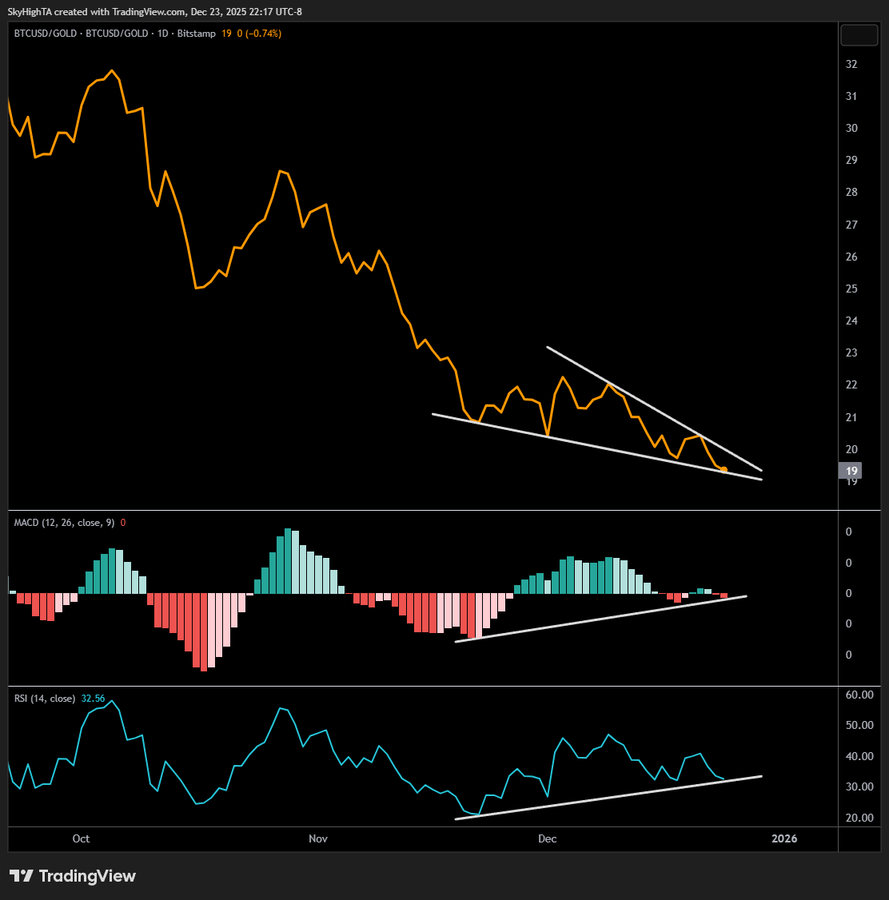
This setup suggests Bitcoin may be forming a base rather than collapsing further.
Never Miss a Beat in the Crypto World!
Stay ahead with breaking news, expert analysis, and real-time updates on the latest trends in Bitcoin, altcoins, DeFi, NFTs, and more.
FAQs
Gold benefits from rate-cut expectations and geopolitical risk, while Bitcoin faces short-term selling pressure and weaker demand from risk-averse investors.
Yes. Bitcoin’s fixed 21 million supply and halving cycles mean long-term demand growth could eventually push its value beyond gold’s market cap.
The ratio shows Bitcoin’s performance versus gold. Current chart patterns suggest Bitcoin may be stabilizing and preparing for a potential rebound.
Trust with CoinPedia:
CoinPedia has been delivering accurate and timely cryptocurrency and blockchain updates since 2017. All content is created by our expert panel of analysts and journalists, following strict Editorial Guidelines based on E-E-A-T (Experience, Expertise, Authoritativeness, Trustworthiness). Every article is fact-checked against reputable sources to ensure accuracy, transparency, and reliability. Our review policy guarantees unbiased evaluations when recommending exchanges, platforms, or tools. We strive to provide timely updates about everything crypto & blockchain, right from startups to industry majors.
Investment Disclaimer:
All opinions and insights shared represent the author's own views on current market conditions. Please do your own research before making investment decisions. Neither the writer nor the publication assumes responsibility for your financial choices.
Sponsored and Advertisements:
Sponsored content and affiliate links may appear on our site. Advertisements are marked clearly, and our editorial content remains entirely independent from our ad partners.

 Yes
Yes  No
No