 Advertise



Bitcoin Retail Traders Start Giving Up as BTC Loses 109K Wallets




Bitcoin has lost 108,700 non-empty wallets since reaching 59.99 million in October.
Coinbase Premium remains negative, pointing to weaker Bitcoin demand from US-based investors.
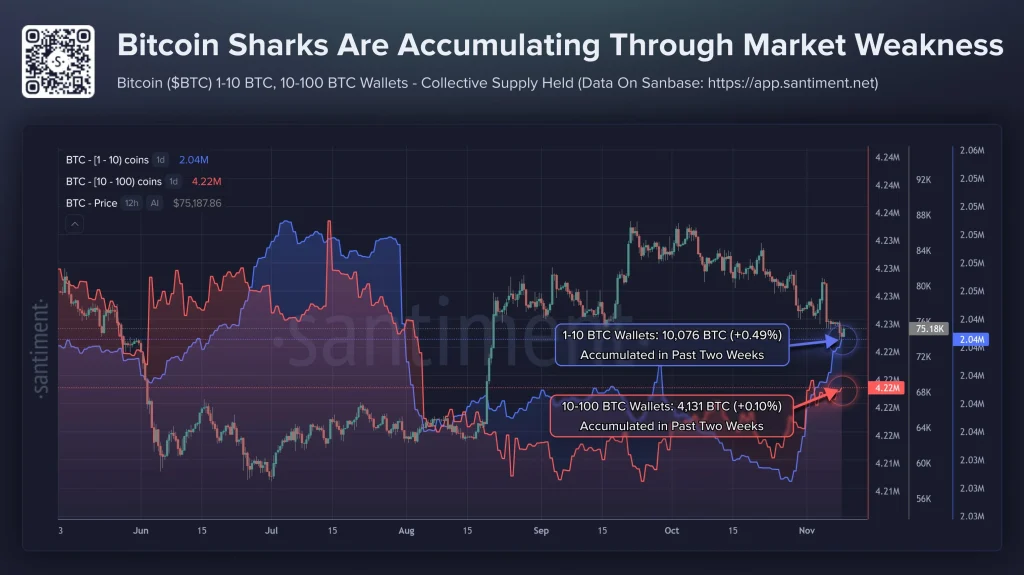
Santiment data also shows larger Bitcoin wallets accumulated more than 14,200 BTC recently.
Bitcoin retail traders are starting to give up as on-chain analytics firm Santiment reports that the number of non-empty BTC wallets has fallen by about 108,700 since October 16.
The big question is whether falling retail confidence will push Bitcoin lower, especially as BTC struggles to reclaim $80,000.
Bitcoin Loses 109K Wallets as Retail Confidence Drops
Bitcoin’s number of non-empty wallets reached nearly 60 million last month. Since then, the count has fallen by around 108,700 to 59.88 million. During the same period, Bitcoin’s price has also dropped from $84,890 to around $74,547, showing how much the market has weakened.
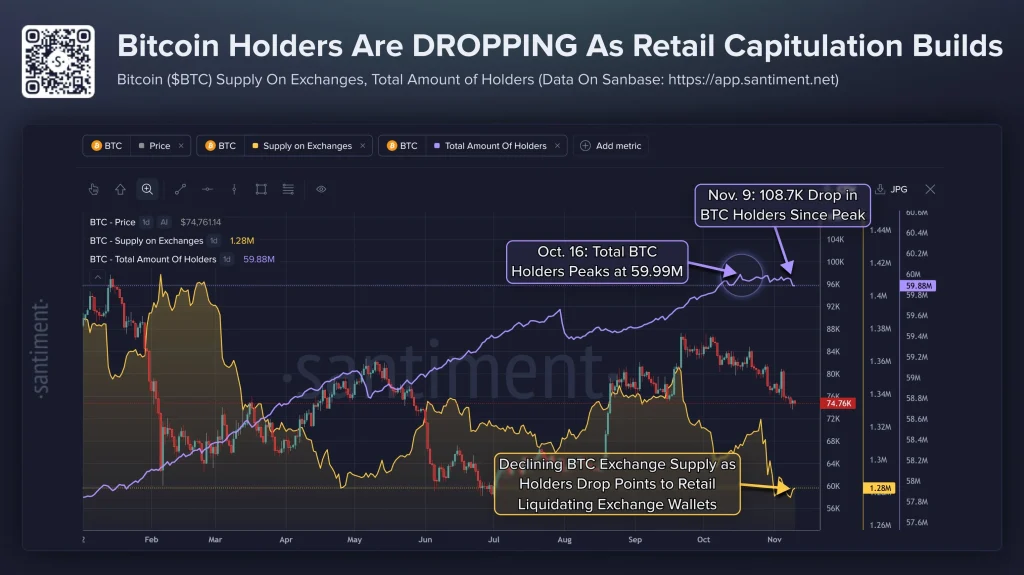
Santiment says the decline in wallet numbers shows that some retail holders are losing patience after weeks of falling prices.

This matters because smaller wallets holding less than 0.1 BTC account for around 5% to 7% of Bitcoin’s total circulating supply.
The weakness is also showing up in Bitcoin demand.
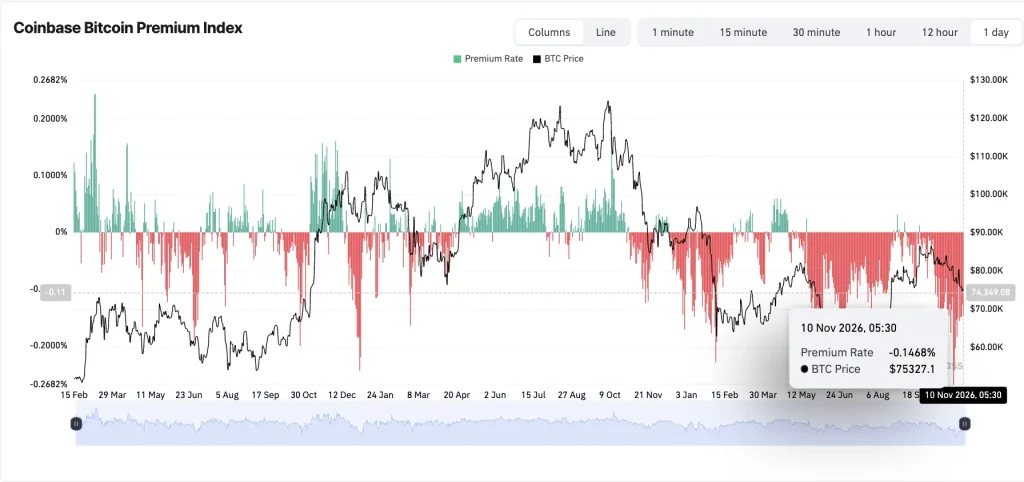
The Coinbase Premium Index remained negative, with the supplied chart showing a reading of -0.1468% on November 10, pointing to weak relative demand on the US exchange.
Why Retail Traders Are Giving Up on BTC
As of now, Bitcoin is facing pressure from several sides. Since late October, the drop in AI stocks has added to market worries, while Bitcoin ETFs have seen millions of dollars in outflows.
At the same time, rising US Treasury yields are making safer investments more attractive. This leaves less money flowing into risky assets like Bitcoin. When market fears grow, retail investors often pull back instead of buying the dip.
In fact, Santiment’s data shows that Bitcoin held on exchanges has also fallen to around 1.28 million BTC. This suggests the drop in wallet numbers isn’t simply because investors are moving coins to exchanges to sell. Some may have emptied their wallets.
Bitcoin Sharks Are Buying the Dip
While retail holders are pulling back, wallets holding between 1 and 100 BTC have been adding Bitcoin.
Santiment data shows 1–10 BTC wallets accumulated 10,076 BTC over the past two weeks, while 10–100 BTC wallets added another 4,131 BTC. Together, these groups accumulated more than 14,200 BTC while Bitcoin moved toward $75,000.
Meanwhile, Strategy, the largest corporate holder of Bitcoin, has acquired another 1,036 BTC and repurchased $188 million worth of STRC shares. With these latest purchases, the company now holds 850,364 BTC and $4.9 billion in cash and other USD assets as of November 8, 2026.
Bitcoin Now Needs Buyers to Stop the Slide
The problem is that sharks accumulation has not yet been enough to turn Bitcoin higher. BTC is still trading around the $74537 area, while retail wallets continue to disappear and US demand remains weak.
This makes the $72,000-$75,000 area the key test. If BTC loses that zone, the retail exit could continue.
If Bitcoin finally holds there despite more wallets disappearing, it would show that sellers are struggling to push the price lower.
Was this writing helpful?

Trust with CoinPedia:
CoinPedia has been delivering accurate and timely cryptocurrency and blockchain updates since 2017. All content is created by our expert panel of analysts and journalists, following strict Editorial Guidelines based on E-E-A-T (Experience, Expertise, Authoritativeness, Trustworthiness). Every article is fact-checked against reputable sources to ensure accuracy, transparency, and reliability. Our review policy guarantees unbiased evaluations when recommending exchanges, platforms, or tools. We strive to provide timely updates about everything crypto & blockchain, right from startups to industry majors.
Investment Disclaimer:
All opinions and insights shared represent the author's own views on current market conditions. Please do your own research before making investment decisions. Neither the writer nor the publication assumes responsibility for your financial choices.
Sponsored and Advertisements:
Sponsored content and affiliate links may appear on our site. Advertisements are marked clearly, and our editorial content remains entirely independent from our ad partners.