
 Advertise



Bitcoin Miners Just Hit Capitulation as BTC Falls $26K Below Production Cost




Bitcoin’s production cost has climbed to roughly $86,000, far above its current market price.
U.S. spot Bitcoin ETFs recorded $5.39 billion in net outflows through November 25.
Glassnode identified $58,500 as a key closing level, with $53,200 as the next major downside area.
Bitcoin miners are running into one of their toughest stretches in years as BTC trades near $60,000, roughly $26,000 below JPMorgan’s estimated production cost. Network hash rate has also fallen 8% year over year, marking its first annual decline since 2021.
This is forcing miners to rethink whether producing Bitcoin still makes economic sense.
Miners Are Now Producing Bitcoin at a Loss
JPMorgan estimates Bitcoin’s average production cost at about $86,000 in late November. With BTC briefly falling to $57,300 before recovering near $60,400, the gap has become too large for high-cost miners to ignore.
Luxor’s Hashrate Index puts daily mining revenue at only $29.36 per petahash per second as of November 23. At the same time, Glassnode recorded an 8% year-over-year decline in Bitcoin’s hash rate, marking the first annual drop since the 2021 China mining ban.

The change is visible against Bitcoin’s previous cycles in the Bitco chart. Mining difficulty and price historically rose together through major bull phases, but the current cycle has moved sharply lower from its 2025 peak.
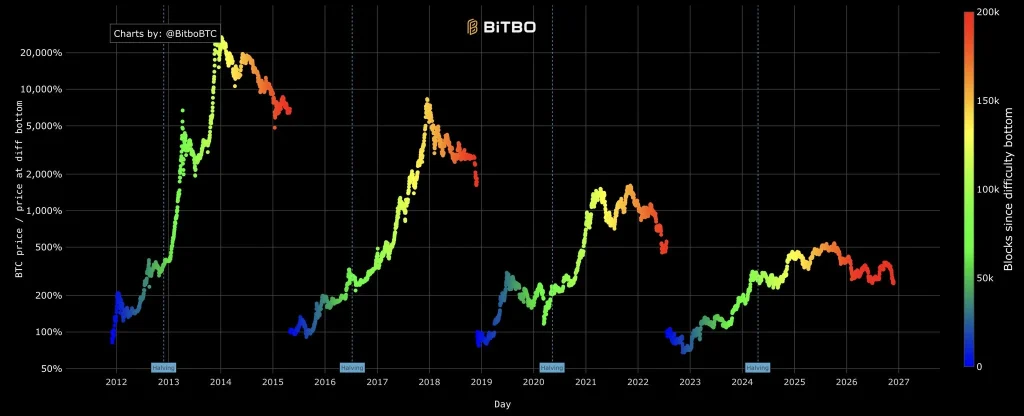
For miners, the problem is not simply a weaker Bitcoin price. Electricity, equipment, debt, and operating costs continue while each unit of computing power generates less revenue.
Miners Are Selling, Cutting Exposure and Moving Into AI
The pressure is already forcing mining companies and corporate treasuries to sell their Bitcoin reserves. In 2026, 14 tracked public companies have sold a combined 108,247 BTC, worth around $8.08 billion, to cover expenses, reduce debt, and fund operations.
Some are also shifting power capacity toward artificial intelligence and data centers, where electricity contracts can generate better returns than Bitcoin mining when mining revenue is compressed.
The wider market is showing similar stress. U.S. spot Bitcoin ETFs have recorded $5.39 billion in net outflows through November 25.
Long Block Gap Adds to the Mining Stress
According to Galaxy Research’s Alex Thorn, Bitcoin also recently went 98 minutes and 19 seconds between blocks 977,967 and 977,968, the longest gap since July. It was the 69th-longest interval since 2011.
However, that event does not mean the network is failing. Bitcoin targets a 10-minute average block time, so longer gaps naturally occur.
Meanwhile, Glassnode identifies $58,500 as a key closing level and $53,200 as the next major downside area for Bitcoin.
Was this writing helpful?

Trust with CoinPedia:
CoinPedia has been delivering accurate and timely cryptocurrency and blockchain updates since 2017. All content is created by our expert panel of analysts and journalists, following strict Editorial Guidelines based on E-E-A-T (Experience, Expertise, Authoritativeness, Trustworthiness). Every article is fact-checked against reputable sources to ensure accuracy, transparency, and reliability. Our review policy guarantees unbiased evaluations when recommending exchanges, platforms, or tools. We strive to provide timely updates about everything crypto & blockchain, right from startups to industry majors.
Investment Disclaimer:
All opinions and insights shared represent the author's own views on current market conditions. Please do your own research before making investment decisions. Neither the writer nor the publication assumes responsibility for your financial choices.
Sponsored and Advertisements:
Sponsored content and affiliate links may appear on our site. Advertisements are marked clearly, and our editorial content remains entirely independent from our ad partners.