


 Advertise



- Rizwan Ansari
 Rizwan Ansari
- Reviewed by:
 Sohrab Khawas
Sohrab is a passionate cryptocurrency news writer with over five years of experience covering the industry. He keeps a keen interest in blockchain technology and its potential to revolutionize finance. Whether he's trading or writing, Sohrab always keeps his finger on the pulse of the crypto world, using his expertise to deliver informative and engaging articles that educate and inspire. When he's not analyzing the markets, Sohrab indulges in his hobbies of graphic design, minimal design or listening to his favorite hip-hop tunes.
- Feb 14, 2026 06:49 UTC
-


Bank of Japan Rate Hike to 1% in April 2026 Could Crash Bitcoin Price
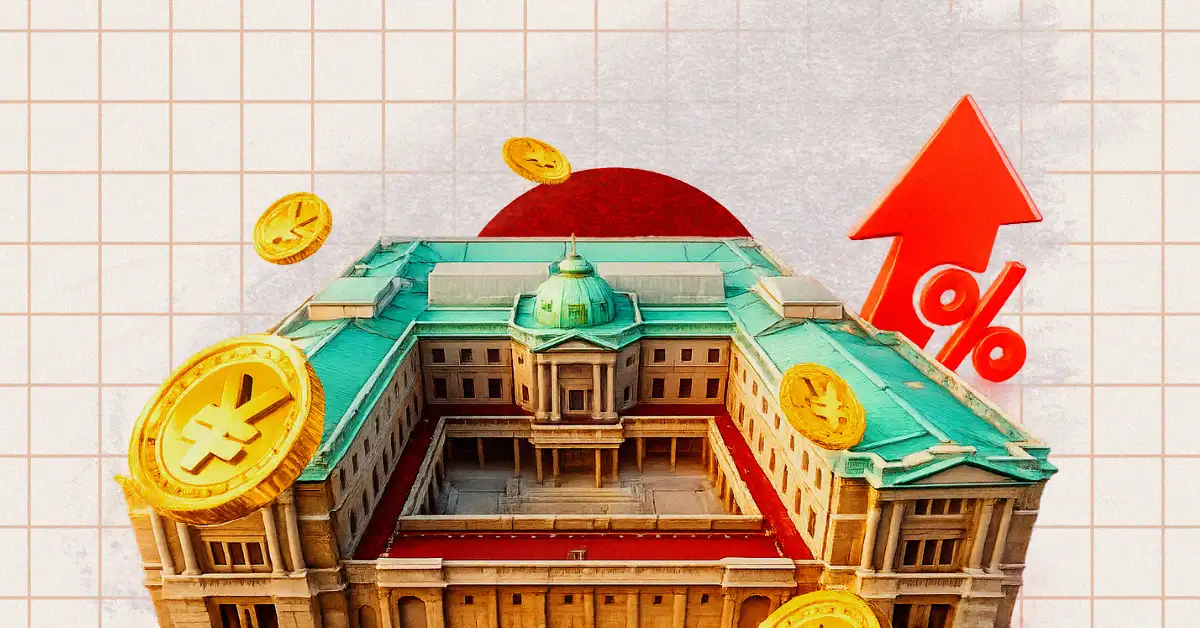
BOJ may raise rates to 1% in April 2026, tightening global liquidity and risking a 4–5% Bitcoin drop toward $60K.
Bank of America warns Japan’s rate hike could strengthen the yen, curb leverage, and trigger another Bitcoin sell-off.
The global crypto market is back under pressure as expectations grow that the Bank of Japan could raise interest rates to 1% in April 2026. Bank of America warns that tighter policy in Japan may reduce global liquidity and trigger another sharp Bitcoin sell-off, similar to the 3% drop seen after January’s hike.
Bank of Japan Rate Hike to 1% in April 2026
According to Bank of America Global Research, the Bank of Japan (BOJ) is expected to increase interest rates by 25 basis points, which could push the interest rate to 1% in April 2026.
The Bank of Japan is expected to implement a 25 basis point interest rate increase, which will bring interest rates to 1% in April 2026, according to Bank of America Global Research
This would mean that interest rates in Japan would reach their highest interest rate level since the 1990s because Japan maintained its interest rates close to zero for an extended period.
Japan has always been the primary force behind the yen carry trade because it maintains interest rates between zero and near-zero for multiple years now.
The Bank of Japan already raised rates to 0.75% in January 2026, as rising inflation, stronger wage growth, and pressure on the weak yen continue to push policymakers toward further tightening.
Why Japan’s Monetary Policy Matters for Bitcoin Price
Japan holds the title of the largest creditor nation worldwide because it possesses approximately $1.2 trillion worth of U.S. Treasuries. Japanese banks and institutions also invest heavily in global bonds, stocks, and other risk assets, making Japan a key source of global liquidity.
If the Bank of Japan proceeds with another rate hike in April 2026, analysts warn that risk appetite could weaken further. A stronger yen and falling USD/JPY would signal reduced global leverage, which often pressures Bitcoin and altcoins.
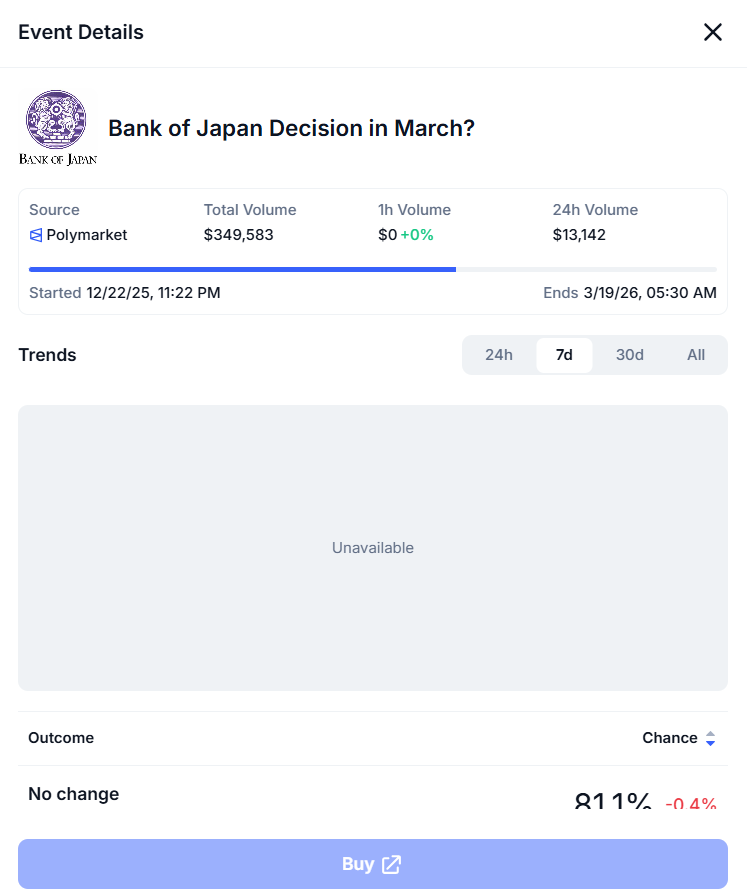
Current predictions on the Polymarket prediction platform show 81% likelihood that no rate hikes will occur in March, suggesting the next move could depend on future economic data.
Bitcoin Price After BOJ Rate Hike
Looking at the earlier BOJ rate hike data shows strong sensitivity to Japan’s interest rate changes. The Bitcoin price after BOJ rate hike in January 2026 reflected this clearly, as Bitcoin fell nearly 3% shortly after the Bank of Japan raised rates to 0.75%. This showed how quickly crypto markets react when global liquidity conditions change.
When interest rates increase, borrowing becomes more expensive, which reduces the flow of capital into risk assets like Bitcoin.
If the Bank of Japan raises rates again toward 1%, analysts warn Bitcoin could face more downside pressure. Some estimates suggest a possible 4% to 5% decline, which may push the Bitcoin price closer to the $60,000 level.
Never Miss a Beat in the Crypto World!
Stay ahead with breaking news, expert analysis, and real-time updates on the latest trends in Bitcoin, altcoins, DeFi, NFTs, and more.
FAQs
Japan is a major source of global liquidity due to its large holdings of foreign assets. When the BOJ raises rates, it strengthens the yen and unwinds yen carry trades, reducing the flow of capital into risk assets like Bitcoin and causing market pressure.
Japan has kept rates near zero for years, making it the primary source of the yen carry trade. When the BOJ hikes rates, the yen strengthens, making these trades more expensive to maintain and forcing investors to sell off risk assets like crypto.
Current predictions on Polymarket show an 81% likelihood that no rate hikes will occur in March. This suggests the central bank is waiting for more economic data, with the next potential move being an increase to 1% in April 2026.
Trust with CoinPedia:
CoinPedia has been delivering accurate and timely cryptocurrency and blockchain updates since 2017. All content is created by our expert panel of analysts and journalists, following strict Editorial Guidelines based on E-E-A-T (Experience, Expertise, Authoritativeness, Trustworthiness). Every article is fact-checked against reputable sources to ensure accuracy, transparency, and reliability. Our review policy guarantees unbiased evaluations when recommending exchanges, platforms, or tools. We strive to provide timely updates about everything crypto & blockchain, right from startups to industry majors.
Investment Disclaimer:
All opinions and insights shared represent the author's own views on current market conditions. Please do your own research before making investment decisions. Neither the writer nor the publication assumes responsibility for your financial choices.
Sponsored and Advertisements:
Sponsored content and affiliate links may appear on our site. Advertisements are marked clearly, and our editorial content remains entirely independent from our ad partners.

 Yes
Yes  No
No