


 Advertise



Bank Groups Say CLARITY Act’s Stablecoin Circuit Breaker Is ‘Not a Safeguard at All’



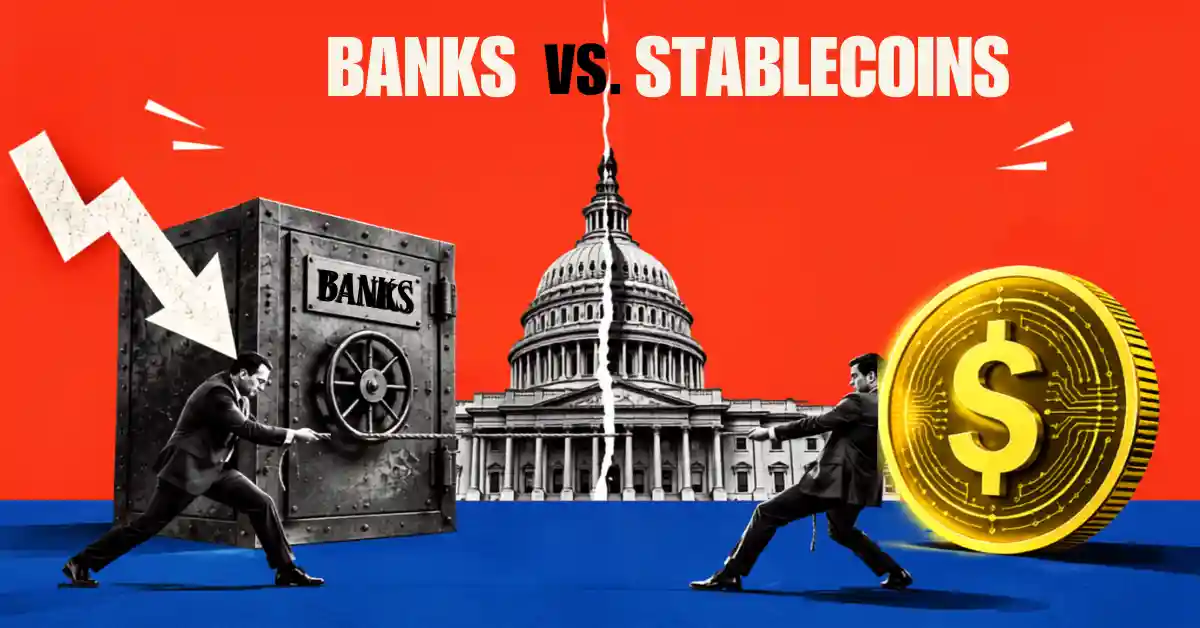
Eight banking groups warn stablecoin rewards could trigger deposit flight and reduce community bank lending.
Banking groups want “solely” removed from Section 10404(c)(1)(A) to strengthen stablecoin yield restrictions.
Patrick Witt rejects the deposit-flight argument, saying bank deposits are increasing despite stablecoin rewards.
Eight major banking groups are warning that the revised CLARITY Act could create this risk if stablecoin rewards work like bank interest. The banks say the bill’s “circuit breaker” may come too late to stop deposit losses and lending problems.
The letter comes ahead of a key Senate procedural vote scheduled for 15 September.
Eight Bank Groups Challenge the Circuit Breaker
In a letter to Senate leaders John Thune and Charles Schumer, eight major banking groups, including the American Bankers Association, Bank Policy Institute, Independent Community Bankers of America (ICBA), and National Bankers Association, warned that stablecoins offering rewards similar to bank interest could lead to deposit flight.
They said payment stablecoins were mainly created for payments, not as a place to store money. If users move deposits into stablecoins, banks could have less money to provide mortgages, small-business loans, farm loans, and other community credit.

The groups also criticized the bill’s deposit-flight circuit breaker. They said it would act only after major deposit losses had already happened.
Instead, banking groups want the Clarity Act to prevent this risk before it affects banks and lending.
Banks Want Specific Words Removed From Section 10404
To address this risk, the banking groups are asking lawmakers to make specific changes to Section 10404(c)(1), which covers interest and yield on payment stablecoins.
They want the word “solely” removed from Section 10404(c)(1)(A). They also want the phrases “on a payment stablecoin balance” and “on an interest bearing bank deposit” removed from Section 10404(c)(1)(B).
The groups also want to replace the bill’s “economically or functionally equivalent” test with a “substantially similar” test. They say this would make the rules clearer and make it harder for crypto companies to create rewards that work like interest.
They also want the “substantially similar” test used throughout Section 10404.
Banks Seek Removal of Section 10404(3)(B)
The banking groups have another concern with Section 10404(3)(B). It says the section allows some rewards to be based on a customer’s balance, duration, or tenure.
Banks argue that this could weaken the stablecoin yield ban because these same factors are often used to calculate interest on bank deposits.
Therefore, the groups want Section 10404(3)(B) removed entirely.
Bessent Defends the Circuit Breaker
Treasury Secretary Scott Bessent defended the circuit breaker, saying it gives the Treasury more power to protect community banks if stablecoins cause deposit losses.
He said,
“If stablecoins cause harm to community banks, I will not hesitate to use these tools to ensure they remain fully protected.”
As community banks are essential to U.S. economic performance and Main Street growth. Economic security is national security, and community banks play a major role in this principle
Crypto Supporters Push Back on Banks
White House crypto adviser Patrick Witt rejected the deposit-flight argument. Witt said crypto companies have offered stablecoin rewards for years and argued that if deposit flight were already a major problem, bank deposits would not be increasing.
Columbia Business School professor Omid Malekan also compared the debate with banks’ earlier opposition to money market funds, saying similar warnings about deposit losses and reduced lending were made decades ago.
U.S. attorney John Deaton criticized the group, saying,
“The banking industry strikes again. Banks have caused more damage to Americans than most other industries.”
As of now, Banks support crypto regulation but want CLARITY to impose tighter stablecoin reward rules upfront.
Was this writing helpful?

Trust with CoinPedia:
CoinPedia has been delivering accurate and timely cryptocurrency and blockchain updates since 2017. All content is created by our expert panel of analysts and journalists, following strict Editorial Guidelines based on E-E-A-T (Experience, Expertise, Authoritativeness, Trustworthiness). Every article is fact-checked against reputable sources to ensure accuracy, transparency, and reliability. Our review policy guarantees unbiased evaluations when recommending exchanges, platforms, or tools. We strive to provide timely updates about everything crypto & blockchain, right from startups to industry majors.
Investment Disclaimer:
All opinions and insights shared represent the author's own views on current market conditions. Please do your own research before making investment decisions. Neither the writer nor the publication assumes responsibility for your financial choices.
Sponsored and Advertisements:
Sponsored content and affiliate links may appear on our site. Advertisements are marked clearly, and our editorial content remains entirely independent from our ad partners.