


 Advertise



Linkmate Analysis on AI Trading in 2026 — What Actually Works and What’s Just Hype



Sara is steadily working on cryptocurrency evaluations, news, and fluctuations in digital currency prices. She is guest author associated with many cryptocurrencies admin and contributes as an active guide to readers about recent updates on virtual currencies.



Market Analysis by Linkmate (formerly Linkomo), an AI software company focused on fintech, banking, and blockchain.
By 2026, “AI-powered” on a trading page tells you about as much as “digital” did twenty years ago. The same label is now used for a news summarizer, a copy-trader ranking engine and an agent that can place a leveraged order.
The useful distinction is operational — what data does the system read, what decision is it allowed to make, and who carries the risk when it gets that decision wrong?
That leaves three fairly different businesses hiding under one term.

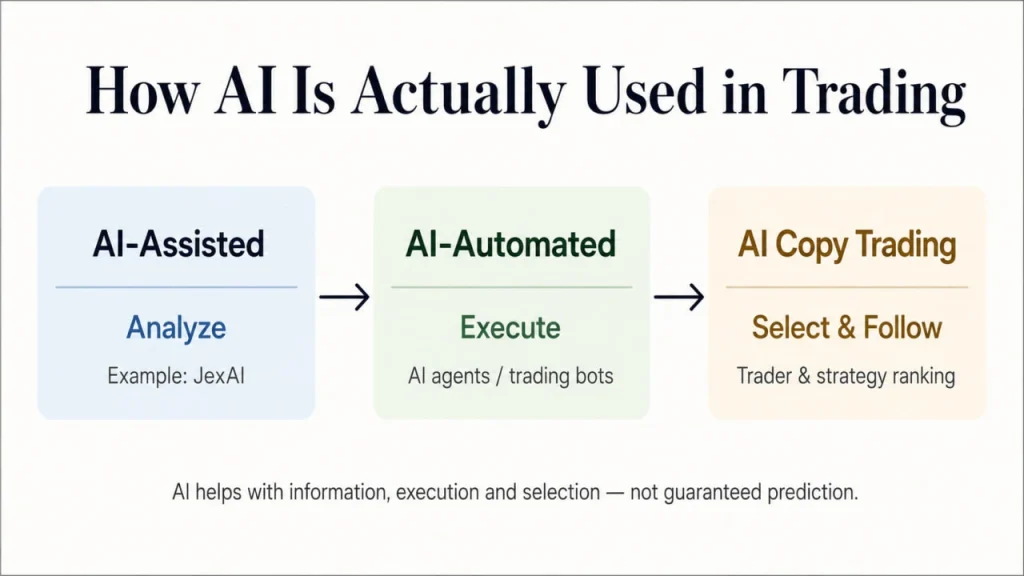
AI-assisted trading: filtering before forecasting
Crypto traders rarely lack data. A single BTC position can involve funding rates, liquidations, open interest, order-book liquidity, news, flows and half a dozen charts. The bottleneck is deciding which of those inputs matters now.
That is a good fit for AI. Summarization, anomaly detection and cross-checking are much easier problems than predicting the next candle. Even outside crypto, FINRA’s 2026 regulatory report says “summarization and information extraction” has become the top GenAI use case it observes among member firms. Finance is finding value in compression before prediction.
LocalTrade’s JexAI sits in that camp. In a recent LocalTrade post, the company describes JexAI as a tool for faster market-data processing, real-time analysis, risk assessment before entry, copy-trader selection and conversational execution. Inside the exchange, JexAI can also check balances, prepare orders and set alerts. For copy trading, LocalTrade says it looks beyond headline ROI to drawdown, consistency across market phases and volatility. The order flow keeps a human confirmation step: JexAI prepares the action, the trader approves it.
That last detail matters more than the AI branding. A system that reduces ten tabs to one useful summary can improve a decision without pretending to know where Bitcoin will trade tomorrow.
The caveat is obvious: these capability claims come from LocalTrade, not an independent performance audit. JexAI should be judged by whether its summaries, rankings and risk context help users make better decisions — not by whether the word AI appears next to the trade button.
AI-automated trading: the dangerous part is permission
Automation is a different proposition because the model can act.
Bybit’s AI Hub shows how quickly this layer has expanded. Bybit says compatible AI assistants can query markets, manage positions and execute trades through 274 API endpoints. Pre-built “skills” can also run specific strategies inside isolated AI subaccounts.
This removes a lot of technical friction. It does not create an edge.
If the trading logic is poor, AI simply gives the poor logic faster execution and longer working hours. The useful features here are the boring ones: position limits, restricted permissions, isolated balances, confirmation screens and a clean audit trail.
Regulators are already focused on the same problem. FINRA’s 2026 oversight report warns that autonomous agents can act outside their intended authority, become difficult to audit and make bad decisions when they lack sufficient domain knowledge. In trading, the question is not whether an agent can place an order. It is how hard it is to stop the agent from placing the wrong one.
AI-powered copy trading: a leaderboard is not due diligence
Copy trading has always rewarded a seductive metric — recent return. It is also one of the easiest metrics to misread.
A trader who makes 180% with huge leverage and a 55% drawdown may rank above someone who makes 60% with far less risk. For a copier, those are completely different products.
AI is useful here because ranking is a multivariable problem. It can compare drawdown, volatility, consistency, leverage, trade frequency and risk-adjusted returns instead of sorting everyone by one green percentage.
BingX has pushed the idea further with AI Arena, where several LLM-based agents trade real-money crypto perpetual accounts under comparable starting conditions and users can copy them. Each model begins with $10,000, while entries, exits and PnL are visible on the platform.
The experiment is interesting because the trades can actually be observed. It still does not prove that the winning model has found a durable edge. A live leaderboard is evidence of what happened, not what happens next.
What actually works in 2026
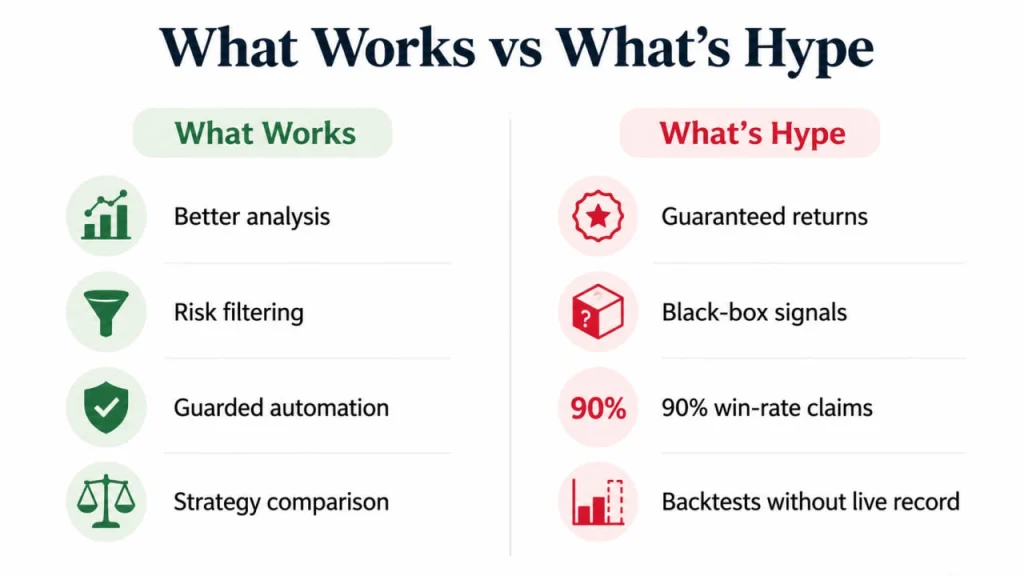
The useful part is fairly mundane: AI can read more information than a trader reasonably can, rank alternatives, enforce rules, monitor positions and turn a clear instruction into an executable action.
What works is using AI to solve data-dense problems, to find patterns in places where it’s hard to look for humans. Market data, on-chain behaviour, transaction hashes in the blockchain, long and short deals, everything’s a data stream now. Using AI allows you to extract patterns out of that information, and act on them better and with more control over your own strategy.
The same goes for ranking copytraders: selecting one item in a multivariable set is hard for most people, JexAI makes it as easy as chatting. Users can ask the agent about copytrading, find relevant copytraders and have them compared by multiple variables.
Problems start when those capabilities are sold as certainty: guaranteed returns, unexplained “self-learning” systems, spectacular backtests with no comparable live history, or an AI label attached to ordinary automation.
The SEC has already penalized investment advisers for false and misleading claims about how they used AI — a useful reminder that “AI-powered” is a marketing claim until somebody explains what the machine actually does.
There is no model exemption from market structure. Slippage still exists. Liquidity disappears. Leverage still liquidates accounts.Popular signals tend to decay as more traders exploit them.
The best AI trading tools in 2026 are doing something less cinematic than replacing the trader. They are making the trader faster at understanding what is in front of them.
LLMs, ML and AI can democratize access to data, but acting on that is entirely on humans.
Was this writing helpful?

Trust with CoinPedia:
CoinPedia has been delivering accurate and timely cryptocurrency and blockchain updates since 2017. All content is created by our expert panel of analysts and journalists, following strict Editorial Guidelines based on E-E-A-T (Experience, Expertise, Authoritativeness, Trustworthiness). Every article is fact-checked against reputable sources to ensure accuracy, transparency, and reliability. Our review policy guarantees unbiased evaluations when recommending exchanges, platforms, or tools. We strive to provide timely updates about everything crypto & blockchain, right from startups to industry majors.
Investment Disclaimer:
All opinions and insights shared represent the author's own views on current market conditions. Please do your own research before making investment decisions. Neither the writer nor the publication assumes responsibility for your financial choices.
Sponsored and Advertisements:
Sponsored content and affiliate links may appear on our site. Advertisements are marked clearly, and our editorial content remains entirely independent from our ad partners.