



 Advertise



Robinhood Markets Inc. (HOOD) Stock Price Prediction 2026, 2027, 2030 – 2040



Robinhood Markets Inc. (NASDAQ: HOOD) has established itself as one of the fastest-growing names in financial technology, steadily expanding beyond retail brokerage into a diversified platform spanning digital assets, wealth management, and banking services. While HOOD stock price has pulled back to nearly $100 after touching its 52-week high of $153 in October 2025, the company’s robust execution and expanding product portfolio continue to support a compelling long-term investment thesis.
So, can Robinhood evolve into the next fintech giant? Here’s our latest HOOD stock price prediction for 2026-2040.
HOOD Stock Price Today
| Metric | Value |
| HOOD Current Price | $101.49 |
| Market Cap | $90.09 Billion |
| 24H Change | +1.70% |
| 52-Week High | 153.86 |
| 52- Week Low | 63.52 |
| Volume | 27.61M |
| Shares Outstanding | 760.78M |
| Industry | Fintech & Financial Services |
| Exchange | NASDAQ |
| Sentiment | Bullish Long-Term |
Robinhood (HOOD) at a Glance
Robinhood has rapidly evolved into one of the fastest-growing fintech platforms, driven by strong customer growth, record platform assets, and an expanding suite of digital financial services. Here’s a quick snapshot of the company’s business and growth metrics.
| Metric | Value |
| Founded | 2013 |
| Funded Customers | 27M+ |
| Assets Under Custody | $300B+ |
| Robinhood Gold Subscribers | 4M+ |
| Global Expansions | U.S & International Markets |
| Revenue Model | Transactional & Subscription Based |
| Growth Strategy | AI, Tokenization & Global Expansion |
CoinPedia’s HOOD Price Prediction for 2026
Fundamental Analysis
Robinhood has steadily transformed into a broader financial ecosystem, expanding beyond retail brokerage through crypto trading, wealth management, banking, and subscription-based services. Backed by strong customer growth, rising platform assets, and continuous product innovation, the company is building a more diversified and resilient business model.

Over the long term, Robinhood’s investment case will hinge on continued ecosystem expansion, deeper customer monetization, and broader adoption of digital financial services. As fintech and digital assets continue to converge, Robinhood remains well-positioned to capitalize on structural industry growth, although execution, regulation, and market conditions will remain critical drivers of HOOD stock’s future performance.
Technical Analysis:
Robinhood’s long-term price action continues to favor the bulls after the stock invalidated its multi-month downtrend and reclaimed a key breakout level around $92-$95. Although profit-taking has capped the recent rally below $120, the broader trend remains characterized by higher highs and higher lows, an indication that buyers continue to control the larger market structure.
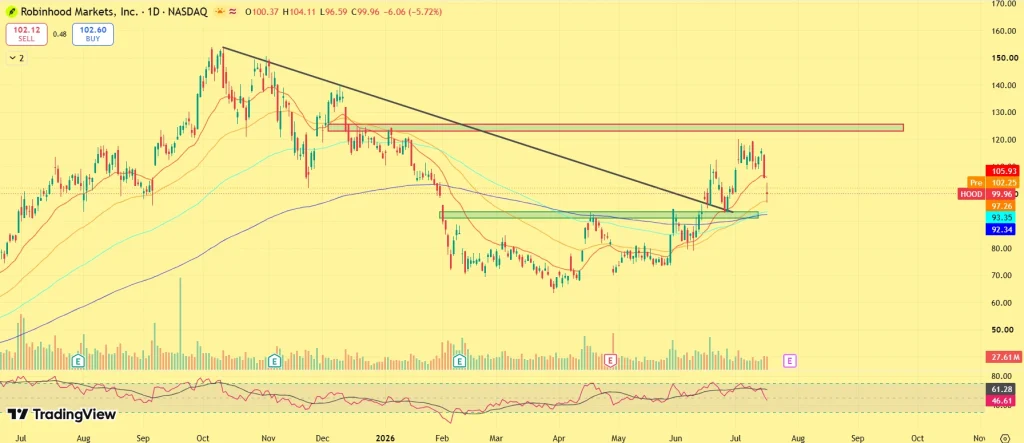
From here, $92-$95 serves as the first major demand zone, while the $125-$130 region represents the final resistance before HOOD stock can challenge its previous peak around $153. A successful breakout above this supply zone would likely confirm the continuation of the broader uptrend, whereas a sustained move below support could shift momentum in favor of the bears.
CoinPedia believes the current pullback is best viewed as a consolidation within an established uptrend rather than a structural reversal. As long as HOOD stock price maintains support above $92, the long-term technical outlook remains tilted to the upside, with a breakout above $130 likely setting the stage for a retest of all-time high near $156 and the potential for further price discovery.
Robinhood Markets (HOOD) Monthly Price Prediction 2026
| Month | Min. Price | Average Price | Max Price |
| July | $92 | $102 | $112 |
| August | $97 | $106 | $120 |
| September | $100 | $115 | $130 |
| October | $102 | $118 | $140 |
| November | $120 | $133 | $152 |
| December | $127 | $147 | $160 |
HOOD Price Prediction 2027-2030
| Year | Min. Price | Average Price | Max Price |
| 2027 | $130 | $166 | $190 |
| 2028 | $150 | $200 | $230 |
| 2029 | $160 | $240 | $280 |
| 2030 | $200 | $260 | $330 |
Long-Term HOOD Price Prediction
| Year | Min. Price | Average Price | Max Price |
| 2035 | $400 | $550 | $700 |
| 2040 | $670 | $900 | $120 |
Expert & Analyst Predictions
| Analyst/ Firm | Rating | Price Target | Outlook |
| Goldman Sachs | Buy | $150 | Bullish |
| Morgan Stanley | Overweight | $130 | Bullish |
| JPMorgan | Neutral | $115 | Neutral |
| Barclays | Overweight | $140 | Bullish |
| KeyBanc Capital Markets | Overweight | $135 | Positive |
What Does HOOD Stock Price Depend On?
Robinhood’s long-term valuation will be shaped by its ability to scale beyond its commission-free brokerage roots and build a diversified financial ecosystem. While broader market sentiment may influence short-term price action, the following factors are expected to play a key role in determining HOOD stock’s long-term trajectory.
- User & Asset Growth: Robinhood’s valuation largely depends on its ability to expand funded accounts, attract higher net deposits, and increase assets under custody, which directly support long-term revenue growth.
- Trading Activity Across Markets: Equity, options, and cryptocurrency trading volumes remain key earnings drivers. Higher market participation typically translates into stronger transaction revenue and improved investor sentiment.
- Expansion of Financial Services: Continued growth in Robinhood Gold, wealth management, retirement accounts, banking products, and other subscription-based services could accelerate recurring revenue and improve profitability.
- Innovation & Product Execution: The successful rollout of AI-powered investing tools, tokenized assets, prediction markets, and other digital finance offerings will be critical to sustaining user engagement and long-term growth.
- Financial Performance: Revenue growth, expanding profit margins, positive earnings, and disciplined capital allocation will remain essential for supporting a higher valuation over the long run.
- Macroeconomic & Regulatory Trends: Interest rate decisions, financial market conditions, cryptocurrency regulations, and broader investor risk appetite will continue to influence Robinhood’s business performance and share price.
How CoinPedia Generated HOOD Stock Price Predictions
CoinPedia’s HOOD stock price prediction is based on a proprietary multi-factor forecasting framework that evaluates Robinhood’s business fundamentals, financial performance, market position, and long-term growth potential. Rather than relying solely on historical price action, our methodology combines fundamental research, technical analysis, Wall Street sentiment, and macroeconomic trends to estimate Robinhood’s future valuation across different market cycles.
Business Growth Analysis
Robinhood’s long-term outlook is closely tied to the expansion of its financial ecosystem. Our forecasts assess customer growth, assets under custody, revenue diversification, Robinhood Gold adoption, and the company’s ability to scale wealth management, banking, crypto, and other financial services to estimate future earnings potential.
Company Fundamentals
We evaluate Robinhood’s revenue growth, profitability, operating margins, free cash flow generation, balance sheet strength, capital allocation strategy, and product innovation. We also analyze management’s execution across AI-powered investing, tokenization, and international expansion to determine the company’s long-term competitive position.
Market & Technical Indicators
Our projections incorporate long-term chart structure, trend strength, trading volume, moving averages, momentum indicators, and major support and resistance levels to identify probable price ranges across multiple investment horizons.
Industry & Macroeconomic Factors
Finally, our valuation framework considers broader market drivers, including interest rate expectations, retail investor participation, digital asset adoption, financial regulations, and overall equity market sentiment. These factors help ensure our forecasts reflect both Robinhood’s business execution and the external economic environment.
Conclusion
Robinhood’s long-term outlook reflects a business that is transitioning from a high-growth brokerage into a diversified financial services platform. While short-term fluctuations are inevitable, the company’s expanding product portfolio and improving financial profile suggest that its investment thesis is becoming increasingly driven by fundamentals rather than market speculation.
As fintech adoption accelerates and digital finance continues to evolve, Robinhood’s ability to execute on innovation, improve operating leverage, and expand its customer ecosystem will ultimately determine whether HOOD stock can deliver sustained long-term shareholder returns.
Frequently Asked Questions (FAQs)
Is HOOD stock a good investment?
Robinhood remains one of the fastest-growing fintech companies, with expanding businesses across investing, banking, wealth management, and digital assets. While short-term volatility is expected, its diversified business model and long-term growth strategy make HOOD an attractive stock for investors with a long-term horizon.
What will Robinhood (HOOD) stock be worth in 2026?
According to CoinPedia’s forecast, HOOD stock could trade between $115 and $150 by the end of 2026, depending on earnings growth, market conditions, and the company’s execution of its expansion strategy.
Can HOOD stock reach $200?
Yes. If Robinhood continues delivering strong financial performance, expands its higher-margin financial services, and benefits from favorable market conditions, HOOD could potentially surpass the $200 mark over the coming years.
What factors could drive HOOD stock higher?
The biggest catalysts include growth in funded customers, assets under custody, Robinhood Gold subscriptions, wealth management and banking adoption, AI-driven product innovation, profitability improvements, and favorable macroeconomic conditions.
Does Robinhood benefit from the cryptocurrency market?
Yes. Robinhood generates a meaningful portion of its transaction revenue from cryptocurrency trading. Higher digital asset adoption and increased crypto trading activity can positively impact the company’s financial performance and investor sentiment.
Was this writing helpful?

Trust with CoinPedia:
CoinPedia has been delivering accurate and timely cryptocurrency and blockchain updates since 2017. All content is created by our expert panel of analysts and journalists, following strict Editorial Guidelines based on E-E-A-T (Experience, Expertise, Authoritativeness, Trustworthiness). Every article is fact-checked against reputable sources to ensure accuracy, transparency, and reliability. Our review policy guarantees unbiased evaluations when recommending exchanges, platforms, or tools. We strive to provide timely updates about everything crypto & blockchain, right from startups to industry majors.
Investment Disclaimer:
All opinions and insights shared represent the author's own views on current market conditions. Please do your own research before making investment decisions. Neither the writer nor the publication assumes responsibility for your financial choices.
Sponsored and Advertisements:
Sponsored content and affiliate links may appear on our site. Advertisements are marked clearly, and our editorial content remains entirely independent from our ad partners.