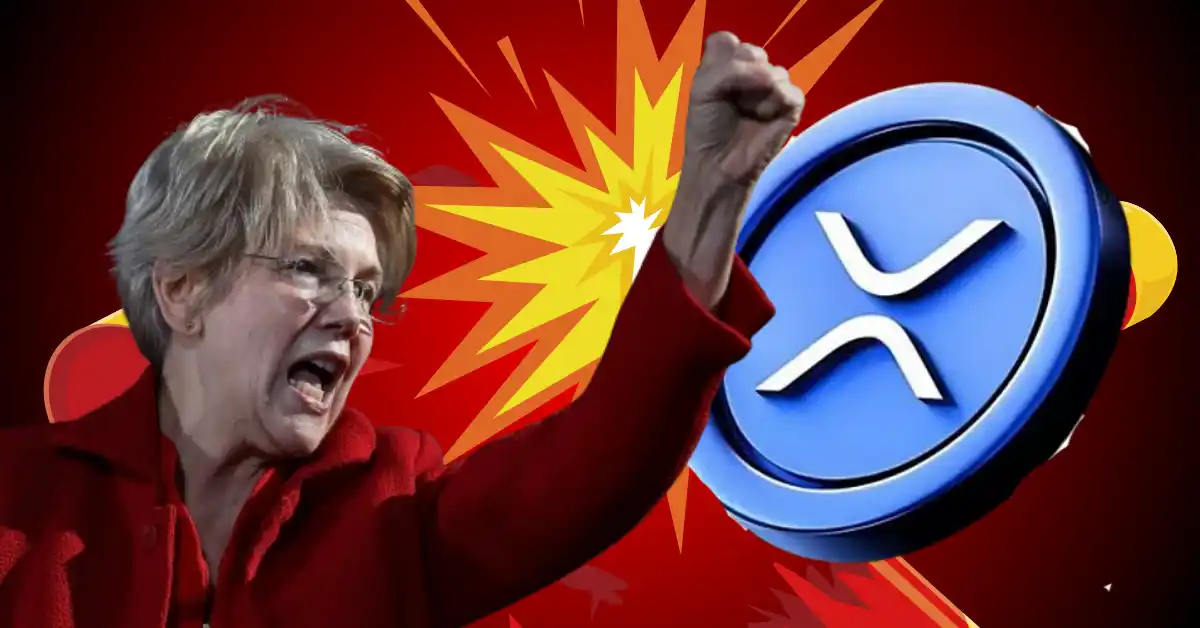
Senator Elizabeth Warren sent a letter to the Office of the Comptroller of the Currency questioning nine bank charter applications. The names on that list included Coinbase, Ripple, and Paxos. But analysts tracking the letter noticed something specific about how it was structured.
For those watching the CLARITY Act negotiations closely, the positioning was not subtle. Warren was not conducting a routine regulatory inquiry. She was sending a signal about which company she considers the biggest threat to the existing banking order.
Experts like Paul Barron said that Warren is not attacking Ripple because of what Ripple has done. She is attacking Ripple because of what Ripple is about to do.
The CLARITY Act, if passed, would give crypto platforms the legal framework to offer activity-based rewards on digital asset holdings. Banks have spent months lobbying against this provision, warning that money would flow out of traditional bank accounts and into crypto platforms. Warren has been their most vocal ally in Congress throughout that fight.
Ripple, with its combination of institutional payment infrastructure, RLUSD stablecoin, Ripple Prime brokerage, and the XRP Ledger, is positioned to capture more of that potential deposit migration than almost any other company in the space. If the CLARITY Act passes and the banking sector’s worst-case scenario materialises, Ripple is likely near the top of the list of beneficiaries.
Adding another layer to the pressure on Warren and the banking lobby is a quiet but significant shift at the SEC. The commission officially ended its 1972 policy that prevented settling defendants from denying wrongdoing in enforcement cases.
Under the old policy, companies that settled with the SEC could not publicly state they had done nothing wrong. Under the new policy they can. For Ripple, which settled its SEC lawsuit and has consistently maintained it did nothing wrong, this change could allow the company to formally and publicly state its position in a way that was previously prohibited.
That kind of public vindication, combined with the CLARITY Act potentially codifying XRP’s non-security status into federal law, would remove the last remaining regulatory cloud over the company at exactly the moment institutional adoption is accelerating.
CoinPedia has been delivering accurate and timely cryptocurrency and blockchain updates since 2017. All content is created by our expert panel of analysts and journalists, following strict Editorial Guidelines based on E-E-A-T (Experience, Expertise, Authoritativeness, Trustworthiness). Every article is fact-checked against reputable sources to ensure accuracy, transparency, and reliability. Our review policy guarantees unbiased evaluations when recommending exchanges, platforms, or tools. We strive to provide timely updates about everything crypto & blockchain, right from startups to industry majors.
All opinions and insights shared represent the author's own views on current market conditions. Please do your own research before making investment decisions. Neither the writer nor the publication assumes responsibility for your financial choices.
Sponsored content and affiliate links may appear on our site. Advertisements are marked clearly, and our editorial content remains entirely independent from our ad partners.
VeChain (VET) is approaching a critical technical test as investors look for blockchain projects that…
Render Token (RENDER) is approaching a crucial test on the weekly chart, with price action…
The Federal Reserve may hold interest rates steady in October, with markets putting the odds…
Netflix (NFLX) stock is facing renewed selling pressure ahead of its upcoming earnings report, as…
Former Ripple CBDC adviser Anthony Welfare says the XRP Ledger (XRPL) has the technology to…
Bitcoin price today has fallen below $81,000, touching a low near $80,250. Meanwhile, U.S. spot…