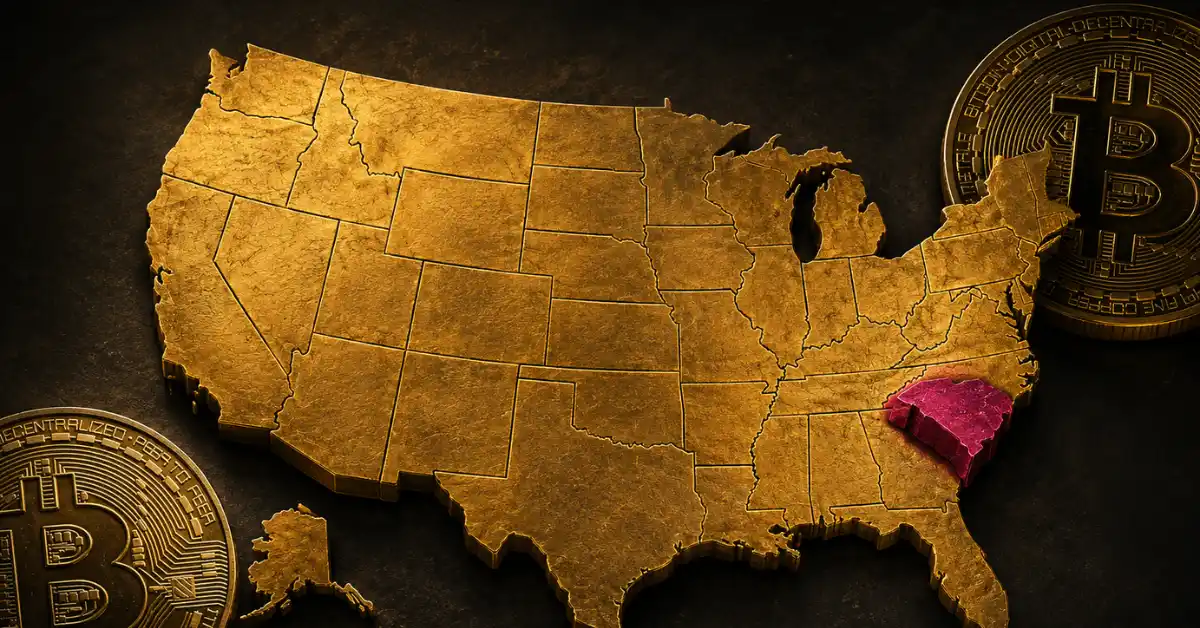
South Carolina has officially signed one of America’s strongest pro-crypto laws after Governor Henry McMaster approved legislation banning state-level CBDC participation while expanding legal protections for Bitcoin users, crypto miners, blockchain developers, and self-custody rights.
The new law, Senate Bill 163, was signed on May 19 after previously clearing the state legislature with strong bipartisan support.
The legislation creates a new legal framework protecting digital asset ownership, blockchain operations, staking services, mining businesses, and crypto payments inside the state.
One of the biggest sections of the law prohibits South Carolina government agencies from accepting, testing, or participating in any central bank digital currency (CBDC) program tied to the U.S. Federal Reserve or federal government.
The bill defines CBDCs specifically as digital currencies issued directly by government agencies or the Federal Reserve.
However, the legislation makes an important distinction by excluding privately issued stablecoins backed by government treasuries or legal tender. That means stablecoins like USD Coin remain fully allowed under the law despite the broader CBDC restrictions.
The law also strengthens protections for individuals and businesses using digital assets for legal payments and transactions.
Under the new rules, people cannot be restricted from accepting crypto payments for lawful goods and services. The legislation additionally protects self-custody rights, allowing users to independently hold and manage their digital assets without unnecessary restrictions.
Supporters say the bill is designed to prevent future targeted taxes or regulations specifically aimed at Bitcoin users or blockchain participants.
Apart from this, South Carolina’s law also gives legal clarity to crypto mining and staking businesses operating inside the state.
Local governments are now restricted from imposing discriminatory zoning rules, excessive sound restrictions, or unfair regulations targeting mining facilities specifically.
The bill further clarifies that blockchain node operations, staking services, mining activity, and blockchain software development generally do not require money transmitter licenses under certain conditions.
Importantly, the legislation still preserves the state attorney general’s authority to prosecute fraud tied to fake staking or mining investment schemes.
With this South Carolina now joins a growing number of U.S. states including Oklahoma, Florida, Kentucky, Wyoming, Arizona, and Montana that have passed “Bitcoin Rights” legislation in recent years.
For now, South Carolina’s new law signals that state governments are becoming increasingly willing to openly support Bitcoin.
CoinPedia has been delivering accurate and timely cryptocurrency and blockchain updates since 2017. All content is created by our expert panel of analysts and journalists, following strict Editorial Guidelines based on E-E-A-T (Experience, Expertise, Authoritativeness, Trustworthiness). Every article is fact-checked against reputable sources to ensure accuracy, transparency, and reliability. Our review policy guarantees unbiased evaluations when recommending exchanges, platforms, or tools. We strive to provide timely updates about everything crypto & blockchain, right from startups to industry majors.
All opinions and insights shared represent the author's own views on current market conditions. Please do your own research before making investment decisions. Neither the writer nor the publication assumes responsibility for your financial choices.
Sponsored content and affiliate links may appear on our site. Advertisements are marked clearly, and our editorial content remains entirely independent from our ad partners.
SEI’s price prediction comes with a tempting target of $1. But the weekly chart remains…
U.S. President Donald Trump is set to announce a federal crackdown on crypto scams as…
Zcash is gaining momentum and is trading around $1,275, with a subsequent increase in buying…
Strategy Inc (NASDAQ: MSTR) has witnessed one of its biggest corrections in recent years. After…
Meta Platforms is scheduled to release its third-quarter results after the US market closes on…
SUI's $10 price target is back on the table, but the weekly chart still has…
