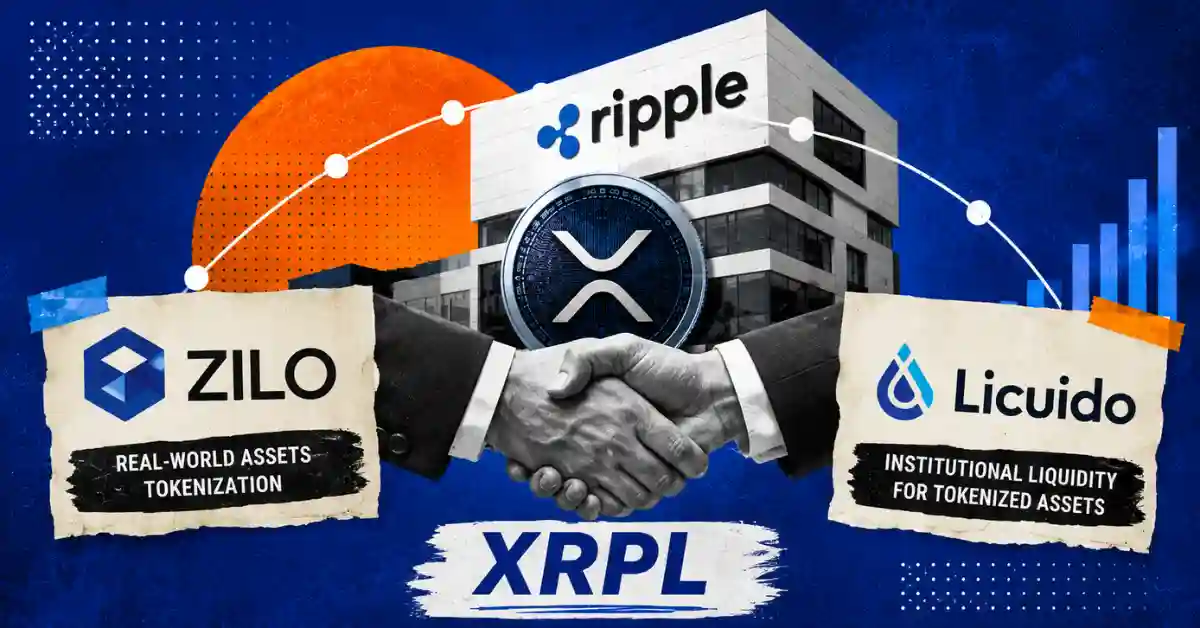
Ripple has announced strategic investments in two UK-based fintech firms, ZILO and Licuido, to strengthen the XRP Ledger (XRPL) with regulated financial infrastructure.
The move comes as financial firms are starting to use XRPL for real investment fund products, showing that tokenized assets are moving beyond testing and into real-world use.
Ripple is positioning the XRPL to act as a complete capital markets ecosystem where banks and asset managers can issue, manage, trade, and use tokenized assets.
To support this, Ripple has invested in two companies that provide compliant data infrastructure, identity solutions, and liquidity tools
ZILO (Transfer Agency Software): It builds the AI-driven software that keeps official records of fund ownership. Large financial firms, including Fidelity International and State Street, already use its technology to manage investment funds.
Traditional banks can only use blockchain if asset ownership is properly recorded. ZILO helps Ripple manage those records.
Licuido (FCA-Regulated Tokenisation & Collateral Platform): Being an FCA-regulated company, it helps institutions use tokenized fund shares via Licuido, which allows institutions to instantly borrow against their assets, turning “dead” balance sheet capital into moving liquidity.
Meanwhile, the platform is focused on the nearly $10 trillion money market repo market.
Also Read : How High Will XRP Price Go if the CLARITY Act Passes in 2026?
Ripple says tokenization alone is not enough. The company believes tokenized assets must also be easy to trade, settle, borrow against, and use across financial markets.
Senior vice president of Trading and Markets at Ripple, Nigel Khakoo, said
“Tokenization of assets is only the starting point: the real value lies in what can be done with a token, including buying, selling, and settling trades instantly, or using it as collateral to borrow, lend, or post margin.”
Meanwhile, Brian Lynch, CEO and co-founder of Licuido, said tokenization solves only part of the problem, while regulated lending and collateral tools unlock the real value of digital assets.
Ripple’s recent investment comes shortly after Aviva Investors launched the first tokenized share class of its USD Liquidity Fund on the XRP Ledger. This shows that major financial firms are moving beyond pilot projects.
Ripple is also working with Franklin Templeton and DBS Bank to expand XRPL’s tokenization ecosystem.
Today, XRPL supports around $4 billion in tokenized assets, has over seven million active wallets, and is secured by 120 independent validators.
CoinPedia has been delivering accurate and timely cryptocurrency and blockchain updates since 2017. All content is created by our expert panel of analysts and journalists, following strict Editorial Guidelines based on E-E-A-T (Experience, Expertise, Authoritativeness, Trustworthiness). Every article is fact-checked against reputable sources to ensure accuracy, transparency, and reliability. Our review policy guarantees unbiased evaluations when recommending exchanges, platforms, or tools. We strive to provide timely updates about everything crypto & blockchain, right from startups to industry majors.
All opinions and insights shared represent the author's own views on current market conditions. Please do your own research before making investment decisions. Neither the writer nor the publication assumes responsibility for your financial choices.
Sponsored content and affiliate links may appear on our site. Advertisements are marked clearly, and our editorial content remains entirely independent from our ad partners.
Crypto trader kimchi removed Pump.fun from his social media bio just two days after promoting…
The XRP price is trying to recover, but the rebound may not be enough to…
Fundstrat’s Tom Lee said the latest tech selloff is close to bottoming and that he…
HSBC is bringing its Hong Kong dollar-backed RedCoin stablecoin to more than 3.3 million PayMe…
SK Hynix has abandoned plans to list its U.S. storage-chip subsidiary, Solidigm, on Nasdaq, ending…
Story Highlights The live price of Notcoin (NOT) is . Notcoin may possibly hit $0.200…
