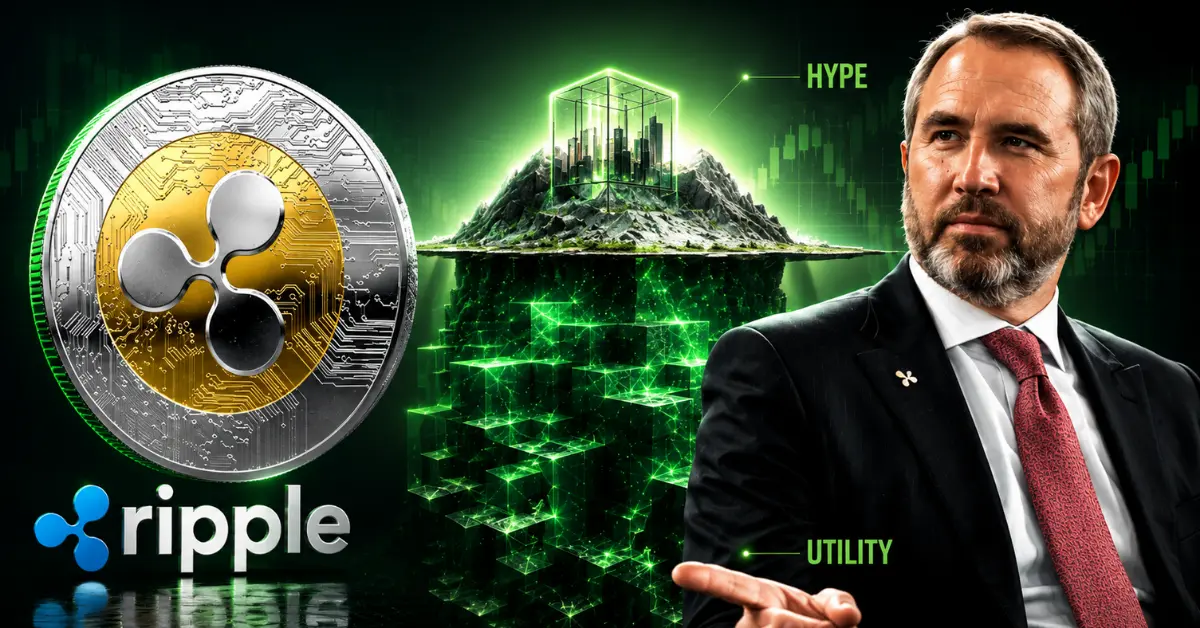
Ripple CEO Brad Garlinghouse has renewed his criticism of leverage-driven crypto strategies, saying long-term value in digital assets comes from real-world utility rather than financial engineering.
In a post on X, Garlinghouse wrote, “Financial engineering doesn’t drive long-term value. Utility does,” while reacting to a clip from his recent CNBC interview in which he criticised Strategy’s approach to Bitcoin accumulation.
The comment comes as crypto markets remain under pressure following Bitcoin’s recent correction and concerns around leveraged exposure across the industry.
During the CNBC interview, Garlinghouse argued that Strategy’s aggressive use of leverage has contributed to recent market volatility.
“I think team Michael Saylor wasn’t focused on the right stuff, and that has hurt the overall market,” he said.
According to Garlinghouse, borrowing heavily to acquire Bitcoin boosted prices during the bull market but has amplified downside risks as market conditions weakened. He also pointed to Strategy’s preferred stock, STRC, which has fallen well below its issue price, as evidence that leverage can quickly become a liability.
Despite the criticism, Garlinghouse stressed that his comments were directed at Strategy’s capital allocation strategy rather than Bitcoin itself.
Garlinghouse reiterated that cryptocurrencies derive lasting value only when they solve real-world problems.
He said assets with genuine use cases create sustainable demand, liquidity and long-term adoption, whereas financial engineering simply increases risk without improving the underlying value proposition.
The Ripple chief added that he has maintained the same view for years, arguing that speculation alone cannot support long-term growth in the digital asset market.
While remaining bullish on Bitcoin, Garlinghouse described it as evolving into “digital gold,” highlighting how blockchain enables large-value transfers far more efficiently than moving physical gold.
He also pointed to Ripple’s payments business as an example of blockchain utility. The company processed around $16 trillion in payments last year, though Garlinghouse acknowledged that only a small portion currently settles using digital assets.
He said the long-term opportunity lies in bringing traditional financial infrastructure onto blockchain networks rather than relying on leveraged investment strategies to lift crypto prices.
US Crude oil is at risk of falling below $90 as President Donald Trump’s proposed…
The XRP Ledger (XRPL) disclosed two software vulnerabilities on October 9, 2026, including a critical…
Ethereum is taking a beating, but investors aren’t necessarily heading for the exits. Ethereum exchange…
When the Bitcoin realized profit data tells a different story from the market panic, it’s…
U.S. Treasury Secretary Scott Bessent says the government will “probably” seize another $1 billion in…
Former New York Governor Andrew Cuomo said the CLARITY Act collapsed mainly because of election-year…
