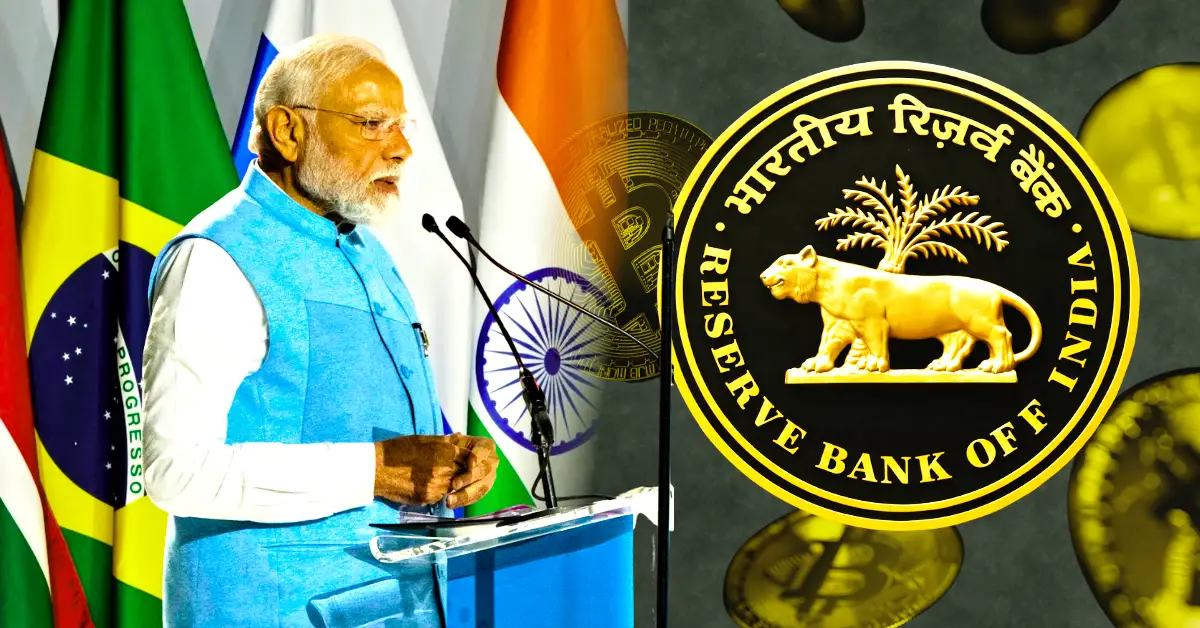
India’s central bank, the Reserve Bank of India (RBI), has put forward a bold plan to connect the digital currencies of BRICS nations to make international transactions smoother, faster, and less costly.
This proposal may become a major talking point at the 2026 BRICS summit, to be hosted by India later this year.
According to reports, the RBI has suggested that BRICS countries, such as Brazil, Russia, India, China, and South Africa, work on linking their central bank digital currencies (CBDCs).
The goal is to make cross-border payments faster, cheaper, and more efficient, which could help trade, tourism, remittances, and daily business payments by cutting costs and saving time.
The proposal comes at a time when global tensions are rising, and U.S. President Donald Trump has threatened to impose 500% tariffs on imports from countries like Brazil, India, and China over their trade with Russia.
On top of it, this move could also help BRICS nations reduce their dependence on the U.S. dollar for international transactions.
While none of the BRICS countries have fully launched their digital currencies yet, all of them are testing them. For example, India’s e-rupee has already reached about 7 million users since it launched in December 2022.
China is expanding its digital yuan, while Russia, Brazil, and South Africa are also running pilot programs.
The proposed plan builds on a 2025 BRICS agreement that aimed to connect national payment systems to make cross-border payments easier.
If accepted, the idea could be formally discussed at the 2026 BRICS summit, which India is scheduled to host later this year.
While the idea is ambitious, experts note that technology and governance will be critical. Market observers point out that digital currency systems must balance efficiency with privacy, security, and regulatory oversight.
One suggested solution is using bilateral foreign exchange swap arrangements between central banks to balance payment differences over time.
Meanwhile, the RBI has also clarified that this plan is not about replacing the US dollar, but about making global payments cheaper and more efficient.
In the early stages, access is likely to be limited to banks, payment providers, and regulated institutions rather than the general public. Consumer-facing use would depend on domestic rules in each country and how the systems are eventually rolled out.
Exporters, importers, and firms handling frequent international settlements could benefit from faster clearing times and lower FX-related friction. However, businesses would still need to comply with local tax, reporting, and capital control rules.
Banks, remittance companies, and payment intermediaries could see changes to how cross-border flows are processed. Migrant workers and small traders may benefit indirectly if costs fall, but outcomes will vary by country.
The final days of March and the first week of April are shaping up to…
Pi Network has officially announced that its Mainnet is upgrading to Protocol 21, with a…
Story Highlights The live price of the Cosmos token is . Cosmos’s price could move…
Story Highlights Litecoin price today Price predictions for 2026 range from $100 to $150.00. Long-term…
The crypto market faces a wholesome decline in price this week, with Bitcoin dropping to…
ETH is trading at $2,000 today, sitting 59% below its August 2025 all-time high. Most…
