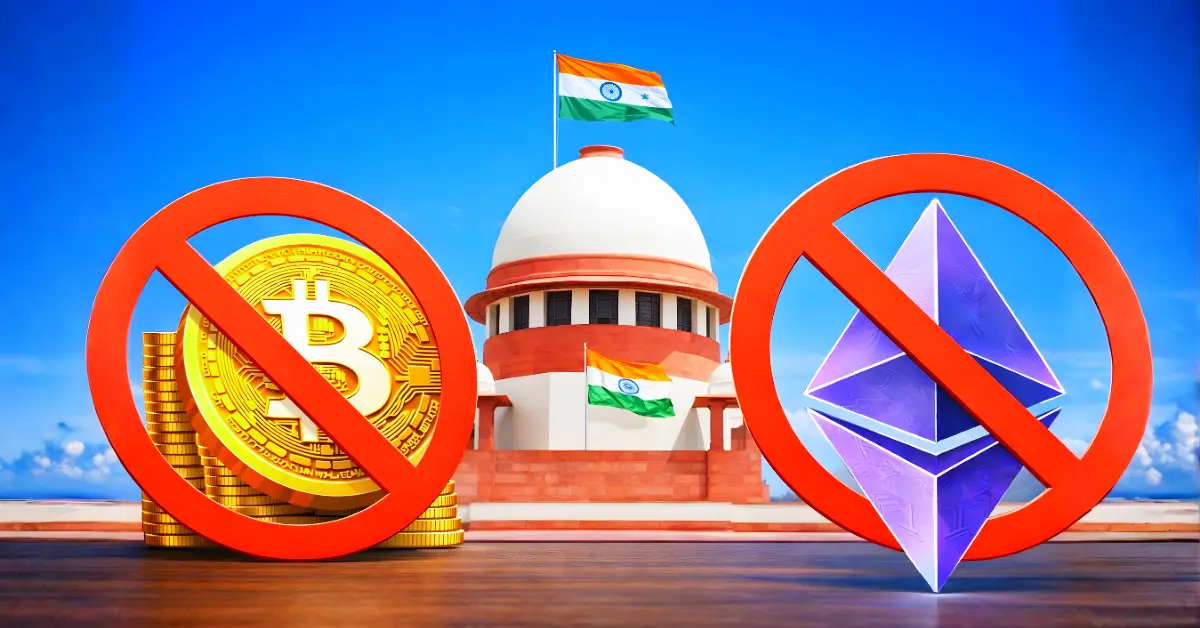
India’s Delhi High Court has refused to regulate cryptocurrency exchanges in India, making it clear that creating crypto laws is the government’s responsibility. The decision came after a crypto investor filed a case against Indian exchange Bitbns, asking the court to introduce regulations and order an investigation into withdrawal issues.
This ruling shows that India still does not have clear crypto laws, leaving investors to depend on existing legal systems.
The case was filed by investor Rana Handa, who accused Bitbns of restricting withdrawals and manipulating asset values. Handa claimed he invested ₹14.22 lakh ($15,637) in 2021 and faced withdrawal limits, and later the platform showed the incorrect value of his Bitcoin holdings in 2025.
After filing a cybercrime complaint and receiving no response, he approached the Delhi High Court seeking regulatory action and a Central Bureau of Investigation (CBI) probe.
He accused Bitbns of financial mismanagement and asked the court to order a probe and introduce stricter crypto rules.
However, Justice Purushaindrakumar Kaurav dismissed the petition, stating that cryptocurrency exchanges are private entities and do not qualify as “State” under constitutional law.
Because of this, the court cannot create new regulations or order investigations without proper legal authority. Thus, the court advised the investor to use normal legal channels, such as police complaints or civil courts.
The Delhi High Court clarified that courts interpret and enforce laws but do not create new regulations. Crypto regulation falls under the authority of Parliament and government regulators, not the judiciary.
This means courts cannot regulate crypto exchanges unless the government first creates clear crypto laws.
The ruling shows the current legal gap in India’s crypto sector.
The decision highlights the risks faced by crypto investors in India’s largely unregulated market. Without dedicated crypto laws, investors cannot rely on courts to enforce special protections specific to digital assets.
Instead, users must depend on general financial, civil, and criminal laws when disputes arise with crypto platforms.
India remains one of the largest crypto markets globally, with 123.35 million active users investing in digital assets. Despite such a strong user base, the country still lacks clear regulatory guidelines governing crypto exchanges.
While the government has introduced crypto taxation, including a 30% tax on gains and 1% TDS, a comprehensive regulatory framework has not yet been implemented.
This regulatory gap creates uncertainty for both users and crypto companies operating in India.
No. India taxes crypto at 30% with 1% TDS but has no comprehensive law governing exchanges, investor protection, or licensing.
Crypto regulation falls under the central government and Parliament. Agencies like RBI and SEBI may play roles once formal laws are enacted.
Investors must rely on existing civil, criminal, and financial laws. There are no crypto-specific consumer protection regulations yet.
It reinforces that only the government can introduce crypto laws, highlighting the urgent need for a clear regulatory framework for investors.
CoinPedia has been delivering accurate and timely cryptocurrency and blockchain updates since 2017. All content is created by our expert panel of analysts and journalists, following strict Editorial Guidelines based on E-E-A-T (Experience, Expertise, Authoritativeness, Trustworthiness). Every article is fact-checked against reputable sources to ensure accuracy, transparency, and reliability. Our review policy guarantees unbiased evaluations when recommending exchanges, platforms, or tools. We strive to provide timely updates about everything crypto & blockchain, right from startups to industry majors.
All opinions and insights shared represent the author's own views on current market conditions. Please do your own research before making investment decisions. Neither the writer nor the publication assumes responsibility for your financial choices.
Sponsored content and affiliate links may appear on our site. Advertisements are marked clearly, and our editorial content remains entirely independent from our ad partners.
Polymarket prediction markets are showing a cautious outlook for Bitcoin in 2026, with traders assigning…
SUI is beginning to show signs of a potential breakout as price stabilizes near key…
Hong Kong Monetary Authority has issued its first stablecoin issuer licences under the new Stablecoins…
Hong Kong just wrote itself into crypto history. This morning, the Hong Kong Monetary Authority…
XRP Ledger validator Vet says XRP appears less exposed to quantum computing risks compared to…
Pi Network just unlocked 18.16 million tokens on April 9, the largest single day release…
