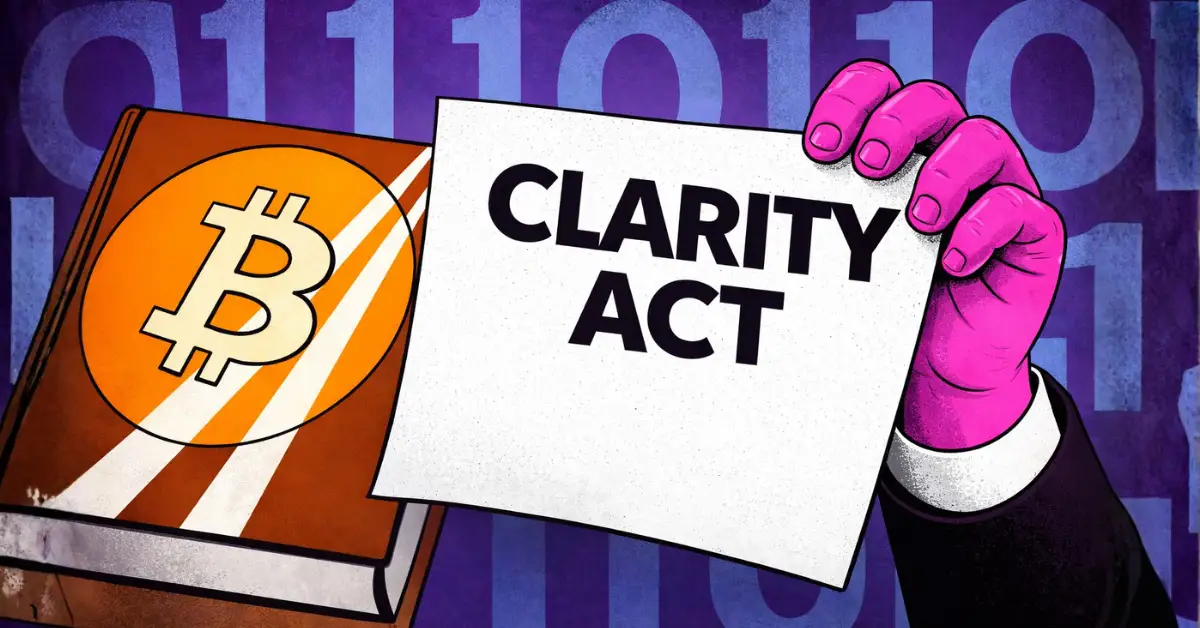
In a recent interview, Chainlink’s Adam Minehardt laid out the reason behind delay for the passage of the much-awaited CLARITY Act. According to him, traditional institutions have pushed “extremely hard” to block any crypto features that offer yield, especially on stablecoins like USDC.
“Definitely, the banks have pushed extremely hard to prevent anything that looks like yield or rewards from being paid by any exchange on platform,” he said.
He added, “It very much is a competitive issue for them, particularly for smaller banks that really chase deposits with interest rates and frankly don’t want to pay higher rates. It really would undercut their profitability.”
Minehardt says that this is ultimately a competitive issue. Smaller banks rely on attracting deposits through low interest payouts and don’t want to raise rates. If crypto exchanges begin offering higher yields on stablecoin balances, it would directly undercut bank profitability.
The pushback doesn’t stop there. Critics across the crypto space argue the CLARITY Act may be leaning too heavily in favor of banking institutions.
Some claim it could block non-bank players from offering competitive yields, keeping traditional finance in control of stablecoin rails and liquidity flows. There’s also frustration that “safety” is being used as justification, despite crypto’s transparent and fully collateralized systems.
The latest update around the CLARITY Act shows things picking up again as Senator Cynthia Lummis pushes for it to move forward, saying the U.S. needs to bring the digital asset industry back with clear rules in place. U.S. Senator Bill Hagerty confirms the CLARITY Act heads to the Senate Banking Committee next week.
After weeks of back-and-forth discussions around market structure and stablecoin policies, Congress is now back from its break, and talks have officially resumed.
On the top, Crypto Twitter is hinting that the bill is basically ready, suggesting it could move ahead with support from both sides. There’s also growing chatter that it might be positioned as part of a broader national security push, which could help move things along faster.
CoinPedia has been delivering accurate and timely cryptocurrency and blockchain updates since 2017. All content is created by our expert panel of analysts and journalists, following strict Editorial Guidelines based on E-E-A-T (Experience, Expertise, Authoritativeness, Trustworthiness). Every article is fact-checked against reputable sources to ensure accuracy, transparency, and reliability. Our review policy guarantees unbiased evaluations when recommending exchanges, platforms, or tools. We strive to provide timely updates about everything crypto & blockchain, right from startups to industry majors.
All opinions and insights shared represent the author's own views on current market conditions. Please do your own research before making investment decisions. Neither the writer nor the publication assumes responsibility for your financial choices.
Sponsored content and affiliate links may appear on our site. Advertisements are marked clearly, and our editorial content remains entirely independent from our ad partners.
Crypto exchange spot volume came roaring back in September, climbing 36.5% month over month to…
XRP ETF demand is holding up, but on-chain activity tells a less encouraging story. By…
Solana has had a volatile run this year, with periods of recovery followed by renewed…
Apple (AAPL) set a new all-time high of about $348 on Tuesday, its 22nd record…
Anthropic has warned that self-replicating AI agents, or “AI worms,” could soon hijack connected devices…
XRP is at one of the most extreme readings in its 13-year history. Its monthly…