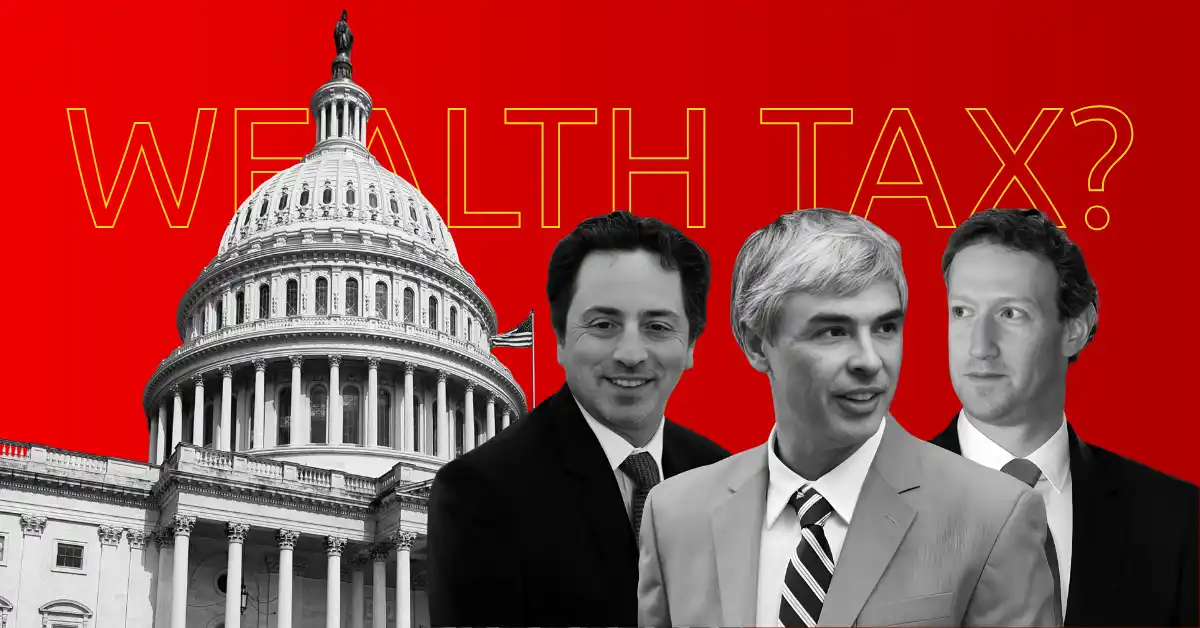
California’s proposed billionaire wealth tax is quickly becoming a major flashpoint for the cryptocurrency and technology sectors. While state leaders say the policy will help fund public services, critics argue it could weaken the startup and innovation economy that helped make California a global powerhouse.
The core issue, according to industry leaders, is that the tax misunderstands how modern wealth is created, particularly in crypto companies, startups, and venture-backed businesses, where most wealth exists on paper rather than in cash.
The proposal, officially titled the 2026 Billionaire Tax Act, would introduce a 5% tax on net wealth above $1 billion. The revenue would be directed toward healthcare and social programs.
What sets this plan apart is its inclusion of unrealized gains, meaning individuals could be taxed on assets they have not sold. This includes private company equity, startup shares, and long-term crypto holdings, assets that are often illiquid and difficult to convert into cash.
Supporters say the tax ensures the ultra-wealthy contribute more. Critics say it creates financial pressure for founders whose wealth is tied to business ownership rather than income.
The unrealized gains tax has drawn the strongest criticism from founders and crypto leaders. Many startup founders take modest salaries and rely on equity for long-term value. When a company’s valuation increases, a founder can suddenly be classified as a billionaire without receiving any actual money.
This situation, critics argue, forces founders to make difficult choices, including selling equity early or taking on personal debt just to meet tax obligations. Over time, this uncertainty may discourage long-term innovation and risk-taking, especially in emerging sectors like blockchain and crypto.
Several industry leaders, including Hunter Horsley, Nic Carter, and Jesse Powell, have warned that the tax could accelerate capital flight from California. Their concern goes beyond individual relocation.
They argue that startups, venture capital firms, skilled workers, and philanthropic investment could gradually shift to regions with more predictable tax environments. In a digital-first economy, capital and talent are highly mobile, and policy signals play a major role in where innovation settles.
Chamath Palihapitiya has been one of the most outspoken critics of the proposal. He argues that the tax is not gradual but an immediate 5% charge on total wealth, which can create serious cash-flow problems for founders.
In some cases, founders could owe tens of millions of dollars based on short-term valuations, even though their assets remain illiquid. If those valuations later fall, the tax liability may still stand, leaving founders financially exposed.
Analysts say this structure is deeply flawed, as established billionaires often have the resources to manage the impact, while younger founders building new companies face the greatest risk.
For the crypto sector, the debate goes beyond taxation. It reflects a growing gap between policymakers and innovation-driven industries. Crypto leaders worry that policies targeting paper wealth could discourage builders at a time when global competition for talent and capital is intensifying.
The concern is not about avoiding taxes. It is about designing rules that do not penalize innovation before it turns into real economic value.
California’s 2026 Billionaire Tax Act proposes a 5% tax on net wealth above $1B, including unrealized gains, to fund healthcare and social programs.
Founders with wealth tied to equity may owe large taxes without cash, forcing early share sales or debt and increasing financial risk.
Industry leaders warn unpredictable taxes may drive founders, investors, and companies to states with more stable, innovation-friendly policies.
CoinPedia has been delivering accurate and timely cryptocurrency and blockchain updates since 2017. All content is created by our expert panel of analysts and journalists, following strict Editorial Guidelines based on E-E-A-T (Experience, Expertise, Authoritativeness, Trustworthiness). Every article is fact-checked against reputable sources to ensure accuracy, transparency, and reliability. Our review policy guarantees unbiased evaluations when recommending exchanges, platforms, or tools. We strive to provide timely updates about everything crypto & blockchain, right from startups to industry majors.
All opinions and insights shared represent the author's own views on current market conditions. Please do your own research before making investment decisions. Neither the writer nor the publication assumes responsibility for your financial choices.
Sponsored content and affiliate links may appear on our site. Advertisements are marked clearly, and our editorial content remains entirely independent from our ad partners.
Microsoft has published the details of an Android-native security vulnerability that exposed 30 million crypto…
The Bitcoin price surprised markets with a sharp upside move, reclaiming key resistance levels and…
Crypto news this week shows Dogecoin active addresses jumping 28% in seven days as X…
Privacy coins are back and not quietly either. Since April 4, the privacy coins surge…
The crypto market has rebounded, with Bitcoin rising 10% over the last eight days and…
Everything EV has pulled off nice ascent in past 30 days and it briefly outpaced…