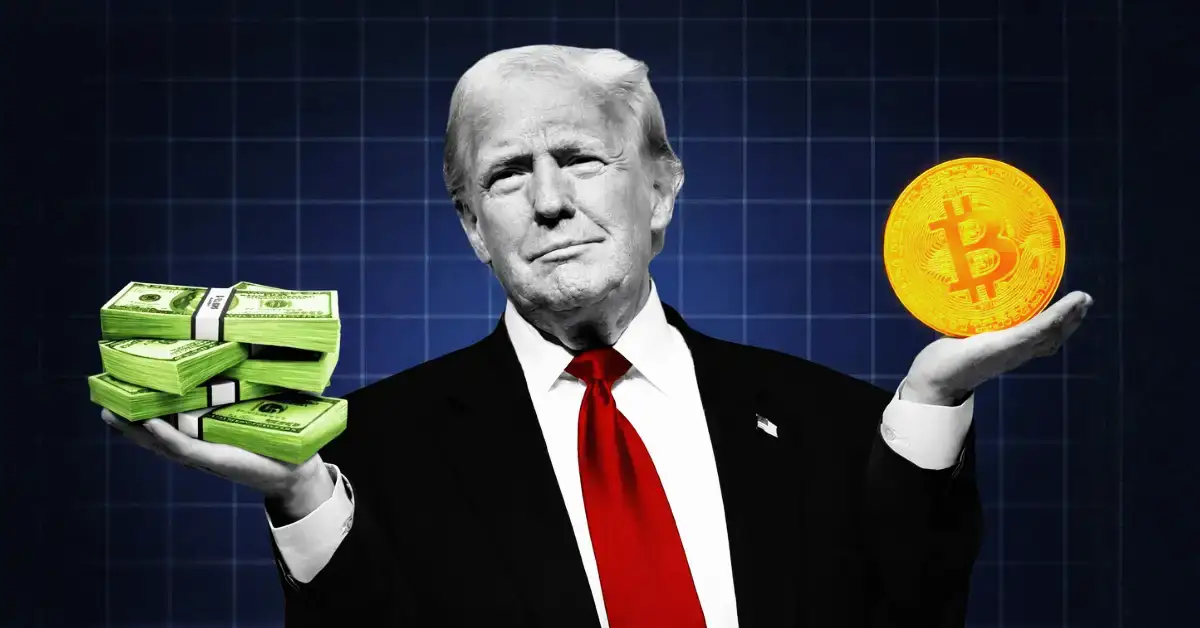
Donald Trump’s pro-crypto policies delivered the most crypto-friendly regulatory environment in U.S. history. The administration introduced a strategic Bitcoin reserve, passed the GENIUS Act, replaced key regulators, and expanded crypto access to retirement accounts.
However, despite these developments, Bitcoin fell nearly 50% from its October 2025 all-time high as macroeconomic factors, tariffs, geopolitical tensions, and Federal Reserve policy outweighed regulatory progress. Turns out, even a “crypto president” can’t outrun macro reality.
Joe Biden served as the 46th President of the United States from January 2021 to January 2025, and under his administration, crypto regulation was in dire straits, with no proper recognition.
He signed Executive Order (EO) 14067, which promoted the study of the risks and benefits of crypto. A strong regulatory framework also deployed government agencies like the SEC and CFTC to pursue actions against unlawful practices in the digital assets space.
These agencies, specifically the SEC under former Chair Gary Gensler, targeted major exchanges like Coinbase and Binance and filed lawsuits alleging that most tokens were unregistered securities. Crypto projects like XRP faced heavy losses due to those claims, which many crypto participants viewed as excessive.
Despite the hostility toward crypto markets and the immense pressure on the industry, the SEC approved the Spot BTC ETF and the Spot ETH ETF, the only good thing that occurred during Joe Biden’s era.
During the second half of 2024, as the 47th U.S. presidential election campaign intensified, Donald Trump positioned himself as a “crypto president” and promised to create a “Strategic National Crypto Stockpile.” His party also became the first major political party to accept crypto donations. Several influential figures publicly supported Trump, with Elon Musk among the most prominent.
Trump also pledged to replace regulators viewed as hostile to the crypto industry and make the United States a global crypto hub. Following his election victory, market sentiment turned strongly bullish. As optimism around his pro-crypto agenda grew, Bitcoin entered a parabolic rally and reached $108,350, its 2024 all-time high (ATH).
Donald Trump officially began his second term as the 47th President of the United States on January 20, 2025. One of his first actions was revoking several Biden-era executive orders, including EO 14067. The order was replaced with policies that explicitly prohibited the creation of a U.S. central bank digital currency (CBDC).
Trump also signed an executive order aimed at supporting the growth and adoption of digital assets. The order created an interdepartmental working group led by David Sacks, who was tasked with evaluating a national digital asset stockpile using crypto assets seized through law enforcement actions.
In March 2025, Donald Trump signed another executive order establishing a Strategic Bitcoin Reserve and a U.S. Digital Asset Stockpile. The reserve was structured using existing seized assets, while the Commerce and Treasury Secretaries were directed to develop budget-neutral strategies for managing both reserves.
In July 2025, Congress passed the GENIUS Act, creating a strict federal framework for stablecoin reserves.
| Date | Main Policy or Event | What it was for? | Result |
| January 23, 2025 | Digital Financial Technology Executive Order (EO) | Created the president’s ‘working group’ on digital assets. | Implemented. Through this order it established the foundational framework for all subsequent crypto rulemaking in US. |
| March 6, 2025 | Strategic Bitcoin Reserve EO | This mainly established a US strategic bitcoin reserve and a separate digital asset stockpile. | Implemented. This was promised during his campaigns and was built with seized bitcoins; no fresh purchases were made. |
| April 21, 2025 | Paul Atkins confirmed SEC chair | Replaced the previous SEC chair, Gary Gensler, with a more pro-crypto person. | His replacement reduced crypto market hostility major structural shift seen, like many enforcements dropped and settled key ongoing cases at that time. |
| June 17 to July 18, 2025 | GENIUS Act Passed in Law (Brought in Senate by R-TN {Bill Hagerty}) | Passed Senate (68-30) and House (308-122). After both chambers passed the bill, the president made it law on July 18th to make the first comprehensive federal stablecoin framework. | Implemented. It mandates 1:1 liquid reserves to be created, it also gives bankruptcy protections, and consumer disclosures. |
| July 17, 2025 | Clarity Act Passes 1 out of 2 chambers of US congress (Brought in House of Rep’s by R-AR {J. French Hill}) | Legislation to clearly define the jurisdiction between sec and cftc over non stablecoins crypto assets. | Not Implemented. It’s stalled in the Senate, but it passed the House of Representatives (294-134) and is halfway to becoming law, pending the Senate’s action. |
| July 31, 2025 | SEC “Project Crypto” Launched by SEC chair Paul Atkins | Agency initiative to establish a formal taxonomy and “super-apps” multi-asset trading rules. | Initiative is an ongoing one. Agencies treat most utility tokens as non-securities; so formal structure rules are still rolling out. |
| August 7, 2025 | 401(K) Alternative Assets EO | This order opened employer retirement plans to digital assets, private equities, and alternative choices. | The rollout is very slow and implementation entirely depends on an individual employer. |
| Sep 5, 2025 | SEC & CFTC Joint Harmonization Statement | Announced regulatory harmonization and proposed “innovation exemptions” for DeFi protocols (safe harbors for peer-to-peer, margin, and perpetual trading). | Implemented. Replaced cross-agency friction with coordinated safe harbors; officially recognized self-custody as a core American value. |
| Sep 17, 2025 | SEC Generic Listing Standards Approved | Approved rule changes allowing national exchanges to use generic listing standards for spot commodity-based trust shares. | Implemented. Eliminated the need for individual 19b-4 rule change filings, fast-tracking future spot crypto ETF rollouts directly through S-1 forms. |
| Sep 30, 2025 | SEC State Trust Custody No-Action Letter | Division of Investment Management issued relief treating state-chartered trust companies as qualified “banks” for crypto custody. | Implemented. Cleared the enforcement cloud, allowing hedge funds, VCs, and registered investment advisers to use state trusts for digital assets. |
| Nov 12, 2025 | SEC Token Taxonomy Defined | Chair Paul Atkins formally categorized digital assets into four types (commodities, collectibles, tools, tokenized securities). | Implemented Framework. Explicitly declared that only tokenized securities fall under SEC purview, reinforcing that most trading tokens are not securities. |
| Dec 11, 2025 | SEC No-Action Letter for DTC Pilot | Division of Trading and Markets approved a tightly scoped, three-year pilot program for the Depository Trust Company. | Pending Launch. Permits DTC to begin tokenizing traditional custodied financial assets on public blockchains in H2 2026. |
| Dec 17, 2025 | SEC Broker-Dealer Crypto Custody Guidance | Issued criteria allowing broker-dealers to satisfy “physical possession” requirements for digital asset securities under Rule 15c3-3. | Implemented. Defined five specific circumstances under which brokerages can legally hold and carry customer crypto asset securities. |
| Jan 28, 2026 | SEC Staff Tokenization Statement | SEC Divisions jointly expanded on the November token taxonomy to map out rules for tokenized securities. | Implemented. Established clear regulatory baselines separating internal issuer tokenization from third-party custodial/synthetic models. |
| Feb 25, 2026 | OCC GENIUS Act Rulemaking | Office of the Comptroller of the Currency issued formal notices of proposed rulemaking for banks. | Ongoing. Establishes the specific capital, operational, and licensing rules for national bank stablecoin issuance. |
| May 21, 2026 | ARMA Act Introduced | Legislative bill aiming to permanently codify the Bitcoin reserve into statutory law via gold revaluation. | Pending in Congress. Seeks to authorize the Treasury to purchase up to 1 million BTC over five years; currently under review. |
| June 2, 2026 | SEC Draft Strategic Plan (FY 2026–2030) | Outlined agency-wide goals designating digital assets and distributed ledger technology as the primary regulatory priority under Goal 1 (Objective 1.1). | Pending Finalization. Formally opened a 30-day public comment window to establish a “rational, coherent, and principled” regulatory baseline, support tokenized offerings, clean up overlapping custody/staking rules, and coordinate jurisdiction with the CFTC. |
Despite these policy changes, market performance moved in the opposite direction. In October 2025, the market faced a devastating $19 billion liquidation event after Donald Trump threatened to impose “massive” new trade tariffs on China.
The announcement triggered a sharp selloff across the crypto market. Bitcoin fell by $15,000 in a single day, a decline of roughly 14%, while many altcoins entered free fall.
Since then, the broader structure of leading crypto assets has remained under bearish pressure, showing that even the most crypto-friendly policy environment could not fully offset the impact of macroeconomic and geopolitical developments.
| Date | BTC Price | Event & Market Reaction |
| Jan 2025 (opening) | $94,000 – $101,000 | Strong ETF inflows; regulatory optimism already priced in |
| Jan 23, 2025 | $105,000 | Digital Asset EO signed; immediate bullish rally |
| Mar 6, 2025 | $87,000 → dip to $84,000 | Strategic Bitcoin Reserve announced; market sold the news on “seized assets only” disappointment; 6% initial dip, then showed recovery |
| Apr–Jun 2025 | $90,000 – $115,000 | Sustained institutional accumulation; ETF inflows continuous |
| Jul 18, 2025 | $117,000 | GENIUS Act signed, first actual U.S. crypto law; market reacted positively |
| Oct 6, 2025 | $126,198 (ATH) | Peak of the entire 2025 cycle |
| Oct 10–11, 2025 | $126K → $103–105K intraday | Donald Trump announces 100% tariff on Chinese imports triggering $19.1B in leveraged positions liquidated in 24 hours; 1.6M trader accounts hit. Largest single-day liquidation in crypto history. |
| Oct 13, 2025 | $114,000 | Partial rebound within 3 days on ETF buying |
| Nov–Dec 2025 | $88,000–$92,000 | Slow bleed; ETF outflows; Fed holds rates; inflation sticky |
| Dec 31, 2025 | $87,000 | Year close, roughly 31% below ATH |
| Jan 2, 2026 | $90,000 | Brief new-year bounce |
| Jan 31, 2026 | $78,600 | Closing price for January, down 10.2% for the month |
| Feb 6th to 28, 2026 | dip to $60,000 on 6th then recovered to Mid-$70,000s | U.S.–Iran conflict begins; oil prices spike; inflation expectations jump |
| Apr – early May 2026 | $80,000 – $82,000 | Brief rebound; didn’t hold |
| May 13, 2026 | $79,800 | Kevin Warsh confirmed Fed Chair; Bitcoin barely reacted |
| Jun 1, 2026 | Sharp intraday selloff | Strategy discloses sale of 32 BTC for $2.5M, first bitcoin sale since 2022 (to fund preferred dividends) |
| Jun 2–4, 2026 | $70,000 → $61,000 | Record ETF outflow streak ($4B over 12 sessions); capital rotation into AI equities; $1.6B in liquidations |
| Jun 20, 2026 (today) | 64,000 | Stabilizing attempt near current lows; 50% below ATH |
For once, Washington delivered several policy changes that had a meaningful impact on the crypto industry.
Many investors bought into the pro-crypto narrative during the election cycle and later learned that policy announcements alone do not guarantee higher prices.
The regulatory environment is significantly clearer than it was a year earlier, but regulatory progress alone has not translated into immediate institutional adoption. The infrastructure is being built, yet macroeconomic conditions continue to influence both market structure and investor sentiment.
Several macroeconomic developments played a major role in Bitcoin’s decline, overshadowing many of the regulatory wins achieved during the period.
Donald Trump’s administration delivered more crypto-related policy changes than any previous administration. These included the GENIUS Act, a Strategic Bitcoin Reserve, a more crypto-friendly SEC, and expanded access to digital assets through 401(k) retirement plans. These are long-term structural changes for the industry.
However, Bitcoin remains nearly 50% below its all-time high.
The outcome highlights an important reality: regulatory progress does not guarantee higher asset prices. While clearer rules can reduce uncertainty and support adoption, market performance is still driven by liquidity, interest rates, inflation, geopolitical events, and broader macroeconomic conditions.
The main takeaway is simple: Donald Trump’s policies improved the regulatory environment for crypto, but they could not override the macroeconomic forces driving global markets.
CoinPedia has been delivering accurate and timely cryptocurrency and blockchain updates since 2017. All content is created by our expert panel of analysts and journalists, following strict Editorial Guidelines based on E-E-A-T (Experience, Expertise, Authoritativeness, Trustworthiness). Every article is fact-checked against reputable sources to ensure accuracy, transparency, and reliability. Our review policy guarantees unbiased evaluations when recommending exchanges, platforms, or tools. We strive to provide timely updates about everything crypto & blockchain, right from startups to industry majors.
All opinions and insights shared represent the author's own views on current market conditions. Please do your own research before making investment decisions. Neither the writer nor the publication assumes responsibility for your financial choices.
Sponsored content and affiliate links may appear on our site. Advertisements are marked clearly, and our editorial content remains entirely independent from our ad partners.
Lead peer-to-peer AI network Bittensor (TAO) has been caught in the wider market downturn, sliding…
Oil prices climbed 4% above $113 a barrel as tensions between the United States and…
Well-known blockchain investigator ZachXBT has told users of Indian crypto exchange CoinDCX to withdraw their…
Celestia (TIA) has a fresh catalyst as Fibre goes live on mainnet, marking what’s described…
Ripple, a blockchain payment solution, has partnered with Swiss-regulated payment platform Arf to bring RLUSD-powered…
Pi Network is trying to stay relevant while its PI token continues struggling near lower…