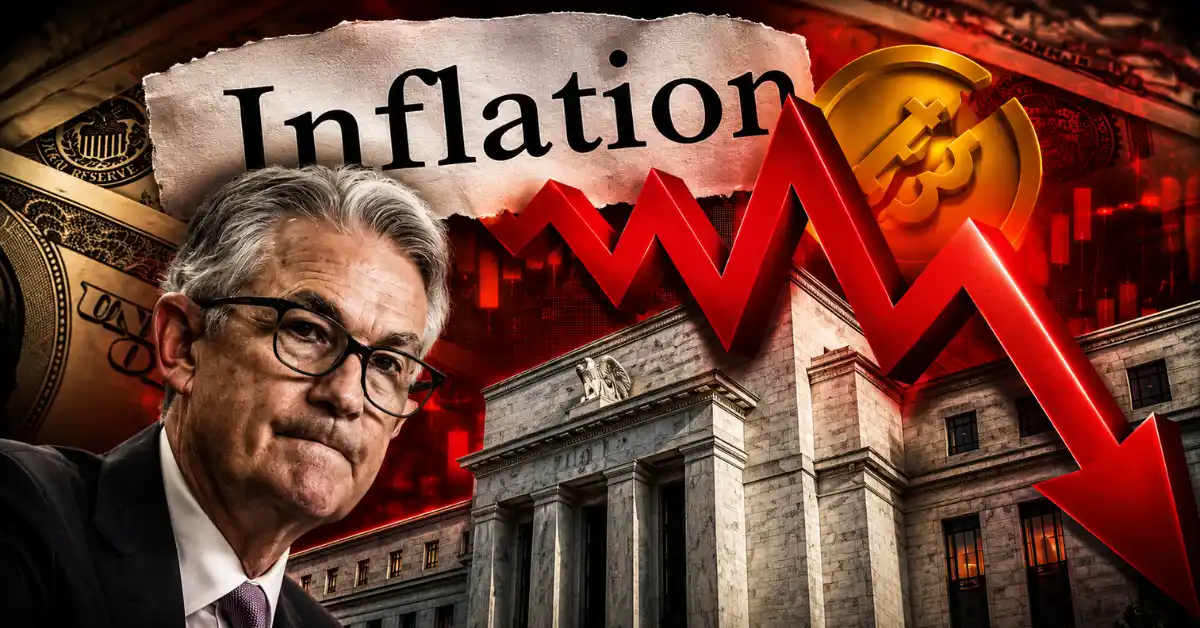
In just the past hour, the crypto market lost nearly $90.3 billion in value, with the total market cap falling 3.37% to around $2.59 trillion. Bitcoin, the world’s largest cryptocurrency, dropped to nearly $77,678, while Ethereum, XRP, Solana, and Dogecoin also saw sharp losses between 3.5% and 6%.
The sudden sell-off has shaken the overall crypto market and pushed investors into panic mode.
The recent crypto sell-off was driven more by macroeconomic pressure than by problems inside the crypto market itself. Bitcoin has recently been moving closely alongside the iShares Russell 2000 ETF (IWM), which tracks small-cap U.S. stocks that are highly sensitive to interest rate expectations.
After new PPI inflation data came in around 6% above forecasts, reducing hopes for Federal Reserve rate cuts, investors started selling risky assets fast.
As small-cap stocks dropped sharply, Bitcoin and the wider crypto market also fell.
Another reason behind today’s crash is the intensified institutional selling pressure. U.S. spot Bitcoin ETFs recorded another $290 million in outflows today, led by BlackRock’s IBIT fund with roughly $136 million in withdrawals.
Overall, Bitcoin ETFs have now seen roughly $1.15 billion in outflows over the past week, ending a six-week inflow streak.
Meanwhile, Ali Martinez reported that Bitcoin miners sold nearly 800 BTC worth roughly $64 million over the past four days, adding more supply pressure to the market.
The selloff accelerated after leveraged long positions started collapsing rapidly. According to CoinGlass data, nearly 154,000 traders were liquidated over the past 24 hours, wiping out roughly $696 million from the derivatives market.
Bitcoin liquidations alone surged 125% to over $235 million.
At the same time, total crypto derivatives open interest dropped more than 25%, showing traders rapidly exited leveraged positions.
Following the drop Crypto trader TED Pillow warned that Bitcoin has now broken below a major multi-month ascending channel on the daily timeframe, with two strong red candles confirming the breakdown.
Analysts say this opens the door for a deeper correction, with the the price could quickly slide toward the $74,000–$75,000.
On the more bearish side it could even touch the $70,000–$68,000 region emerging as the next major downside target.
The weakness wasn’t limited to Bitcoin. Most large-cap altcoins traded deep in the red, with XRP, Solana, BNB, HYPE, ZEC, Dogecoin, SUI, LINK, and ADA recording some of the steepest declines as market sentiment turned risk-off.
CoinPedia has been delivering accurate and timely cryptocurrency and blockchain updates since 2017. All content is created by our expert panel of analysts and journalists, following strict Editorial Guidelines based on E-E-A-T (Experience, Expertise, Authoritativeness, Trustworthiness). Every article is fact-checked against reputable sources to ensure accuracy, transparency, and reliability. Our review policy guarantees unbiased evaluations when recommending exchanges, platforms, or tools. We strive to provide timely updates about everything crypto & blockchain, right from startups to industry majors.
All opinions and insights shared represent the author's own views on current market conditions. Please do your own research before making investment decisions. Neither the writer nor the publication assumes responsibility for your financial choices.
Sponsored content and affiliate links may appear on our site. Advertisements are marked clearly, and our editorial content remains entirely independent from our ad partners.
Injective's INJ price prediction is gaining attention as on-chain activity and developer contributions trend higher.…
Internet Computer's ICP price prediction is attracting attention as network activity rises and the chart…
SEI’s price prediction comes with a tempting target of $1. But the weekly chart remains…
U.S. President Donald Trump is set to announce a federal crackdown on crypto scams as…
Zcash is gaining momentum and is trading around $1,275, with a subsequent increase in buying…
Strategy Inc (NASDAQ: MSTR) has witnessed one of its biggest corrections in recent years. After…
