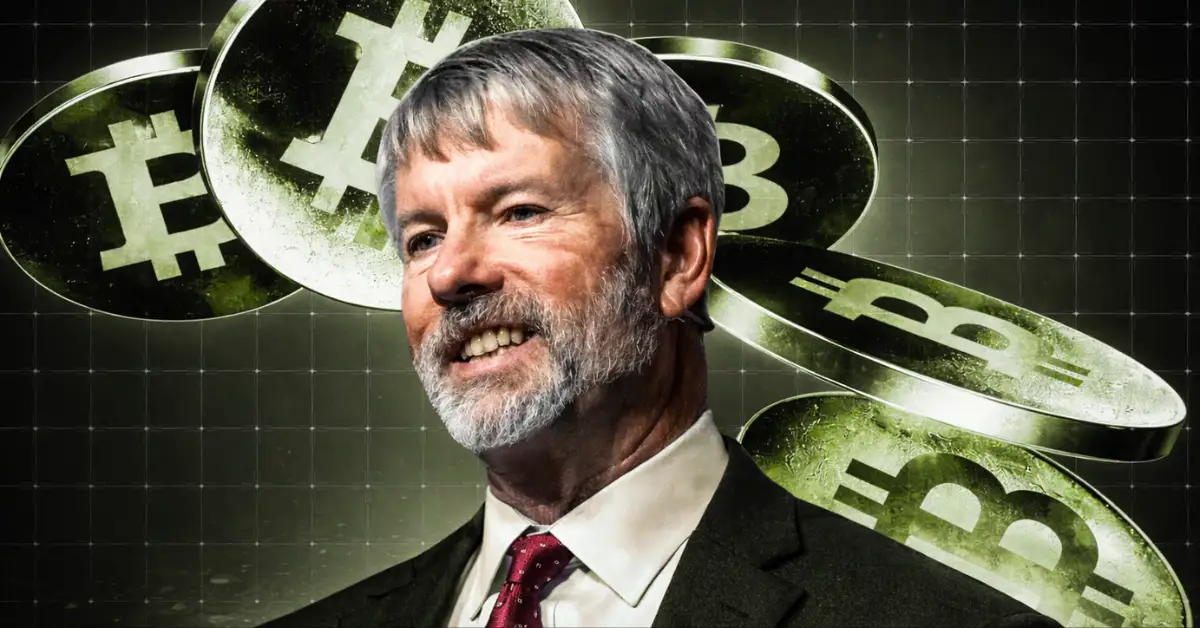
Michael Saylor has built his reputation as one of Bitcoin’s most vocal supporters. For years, his message was simple: Bitcoin is digital property, and companies should hold it.
But at the recent Strategy World 2026 conference, Saylor shifted the conversation.
This time, he wasn’t just talking about Bitcoin. He spoke about the future of digital credit — and said it will run on blockchains like Solana and Ethereum.
Interestingly, XRP didn’t come up.
Saylor described a future where credit isn’t tied to traditional banking systems. Instead of loans moving through legacy rails, he sees them issued directly on blockchains as programmable digital instruments.
In simple terms, credit could become tokenized.
He suggested that lending products in the future may look more like software than paperwork, with built-in yield settings, liquidity controls, and adjustable terms coded directly into the asset. Rather than calling it a new asset class, he framed it as a new financial building block.
And in his view, networks like Solana and Ethereum already have what’s needed: liquidity, scale, and active developer ecosystems.
The reaction was immediate.
Solana jumped more than 13% within 24 hours of his comments, pushing its market value close to $50 billion. Ethereum also saw renewed buying interest as traders interpreted Saylor’s remarks as institutional validation.
When someone with Saylor’s track record talks about infrastructure, markets tend to listen.
For years, Solana and Ethereum have competed to position themselves as the foundation for decentralized finance. Saylor’s comments added fuel to that narrative, especially as institutions explore tokenized assets and on-chain lending.
The real question now is whether this vision turns into action.
It’s one thing to outline a future where credit lives on blockchain networks. It’s another to see major banks or asset managers actually launch large-scale products on those chains.
If that happens, it would mark a major shift in how traditional finance interacts with crypto infrastructure.
For now, Saylor has broadened the conversation. He’s still bullish on Bitcoin — but when it comes to programmable credit, he’s looking at Solana and Ethereum as the rails of the future.
Tokenized credit turns loans into digital assets with coded terms, yield settings, and liquidity rules built directly on-chain.
Smart contract bugs, market volatility, and regulatory uncertainty remain key risks in on-chain lending systems.
Traditional loans rely on banks and paperwork, while tokenized credit uses smart contracts for automation and transparency.
Yes. If large institutions issue on-chain credit products, it could accelerate mainstream blockchain integration.
CoinPedia has been delivering accurate and timely cryptocurrency and blockchain updates since 2017. All content is created by our expert panel of analysts and journalists, following strict Editorial Guidelines based on E-E-A-T (Experience, Expertise, Authoritativeness, Trustworthiness). Every article is fact-checked against reputable sources to ensure accuracy, transparency, and reliability. Our review policy guarantees unbiased evaluations when recommending exchanges, platforms, or tools. We strive to provide timely updates about everything crypto & blockchain, right from startups to industry majors.
All opinions and insights shared represent the author's own views on current market conditions. Please do your own research before making investment decisions. Neither the writer nor the publication assumes responsibility for your financial choices.
Sponsored content and affiliate links may appear on our site. Advertisements are marked clearly, and our editorial content remains entirely independent from our ad partners.
Story Highlights The live price of the Stellar crypto is XLM is holding its $0.13–$0.16…
Story Highlights The live price of the ICP crypto is . If the recovery structure…
Iran’s reported plan to charge oil tankers a fee in Bitcoin or Chinese yuan to…
The crypto market may appear stable on the surface, but underlying activity is cooling rapidly.…
Coinbase stock price teased a bullish spike but then hesitated at the worst possible moment.…
Bittensor (TAO) price posted a strong move over the past few hours, climbing nearly 8%…
