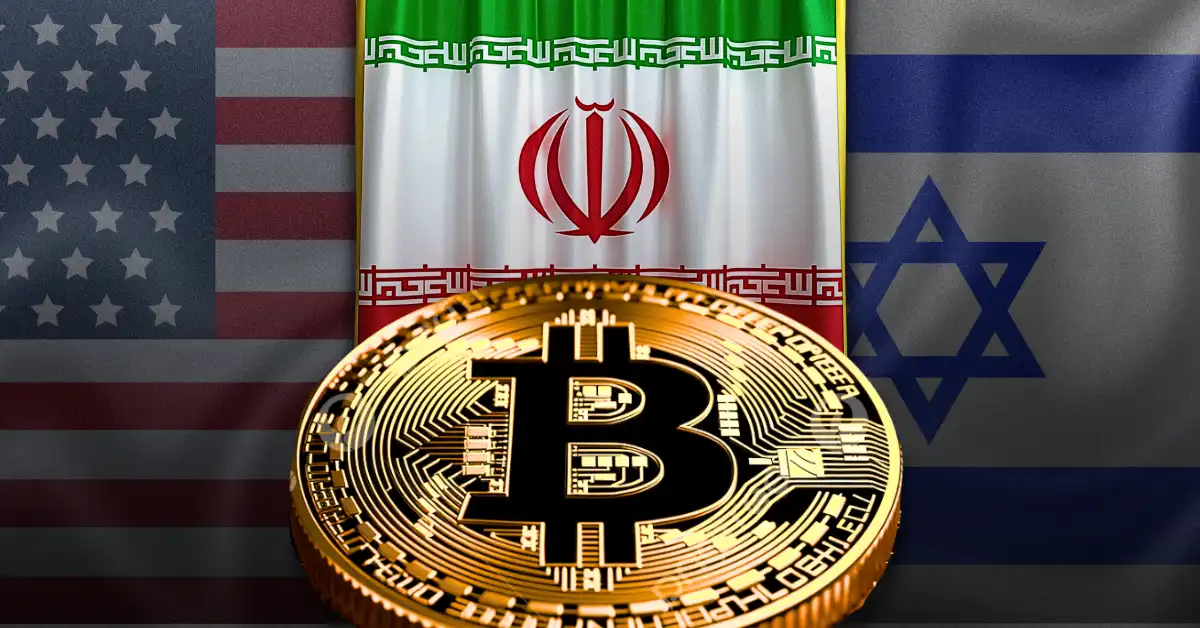
Iran’s cryptocurrency market saw a sharp shock after recent U.S.-Israeli airstrikes, which targeted Tehran, killing its supreme leader. This sent shockwaves through local exchanges as trading volume fell nearly 80% in just two days. Within hours, millions of dollars in digital assets moved out of the country.
While the fighting was military, the financial impact spread quickly into the crypto space. Perhaps the country’s crypto infrastructure remains operational.
Data from blockchain research firm TRM Labs shows that trading volume on Iranian crypto exchanges dropped by nearly 80% between February 27 and March 1.
The sharp fall was mainly linked to the internet blackout imposed after the strikes. With restricted access, many users could not trade normally. At the same time, fear and uncertainty pushed traders to pause activity.
Iran’s central bank also ordered platforms to temporarily stop trading the USDT–toman pair, which connects crypto to the local currency. When trading restarted, liquidity was thin, and prices moved unevenly.
Despite the sudden drop in volume, major exchanges in Iran remain operational in what experts describe as a “risk-managed” mode, with slower withdrawals and tighter controls.
While trading slowed, money was moving fast. Blockchain analytics firm Elliptic recorded a more than 700% jump in crypto outflows from Nobitex, Iran’s largest exchange, within minutes of the first U.S.–Israel strikes.
Roughly $3 million in combined inflows and outflows were tracked as users rushed to transfer funds to overseas exchanges. Analysts believe many citizens were trying to protect their savings by shifting assets beyond Iran’s borders.
Despite the sudden drop in volume, major exchanges in Iran remain operational in what experts describe as a “risk-managed” mode — with slower withdrawals and tighter controls.
The Iran conflict shows how quickly crypto reacts to geopolitical stress involving the U.S., Israel, and Iran.
Bitcoin prices briefly dipped after news of the strikes to near $63K before recovering to now $68K. Meanwhile, Stablecoins such as USDT saw increased demand locally as traders looked for safer digital options.
If tensions rise further, more capital could flow through crypto channels, keeping both regional and global markets on alert.
Yes. In periods of national security tension, authorities such as the Central Bank of Iran may tighten oversight on exchanges, impose temporary trading suspensions, or increase monitoring of cross-border transfers. Such steps are typically aimed at preventing capital flight and stabilizing the local currency during uncertainty.
International platforms may increase compliance checks to meet anti-money laundering standards and sanctions rules. Sudden inflows from sanctioned regions can trigger enhanced due diligence reviews, temporary freezes, or stricter identity verification procedures.
Retail investors and small businesses that rely on crypto for savings or cross-border payments are typically most exposed. Limited liquidity, withdrawal delays, or exchange restrictions can disrupt personal cash flow and short-term financial stability.
CoinPedia has been delivering accurate and timely cryptocurrency and blockchain updates since 2017. All content is created by our expert panel of analysts and journalists, following strict Editorial Guidelines based on E-E-A-T (Experience, Expertise, Authoritativeness, Trustworthiness). Every article is fact-checked against reputable sources to ensure accuracy, transparency, and reliability. Our review policy guarantees unbiased evaluations when recommending exchanges, platforms, or tools. We strive to provide timely updates about everything crypto & blockchain, right from startups to industry majors.
All opinions and insights shared represent the author's own views on current market conditions. Please do your own research before making investment decisions. Neither the writer nor the publication assumes responsibility for your financial choices.
Sponsored content and affiliate links may appear on our site. Advertisements are marked clearly, and our editorial content remains entirely independent from our ad partners.
Solana has had a volatile run this year, with periods of recovery followed by renewed…
Apple (AAPL) set a new all-time high of about $348 on Tuesday, its 22nd record…
Anthropic has warned that self-replicating AI agents, or “AI worms,” could soon hijack connected devices…
XRP is at one of the most extreme readings in its 13-year history. Its monthly…
A London High Court has ruled that Chinese law applies to claims by victims seeking…
Features include Binance Pool, Pool Savings, Cloud Mining, and a Transaction Accelerator, alongside hashrate alerts,…