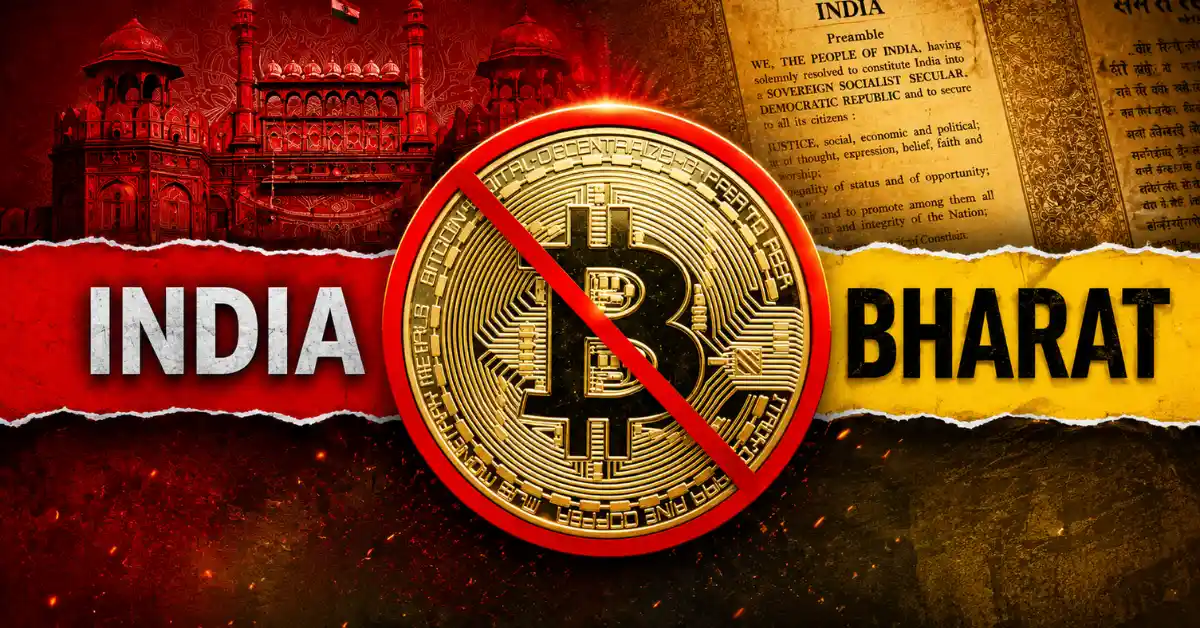
The Indian government, which collected nearly ₹18.38 lakh crore (around $193.5 billion) in tax revenue during the 2025-26 financial year, is set to isolate banks from crypto.
India’s biggest bank, the Reserve Bank of India (RBI), has proposed its ‘containment’ approach to cryptocurrencies, aiming to keep banks away from crypto transactions and private stablecoins while allowing regulated tokenization.
Meanwhile, the Indian government wants to tax the crypto but also wants to keep a distance.
On 2 June, the RBI Deputy Governor Rohit Jain and RBI Executive Director P. Vasudevan appeared before the Parliamentary Standing Committee on Finance and explained the RBI’s official views on cryptocurrencies.
During the appearance, the Governor said that cryptocurrencies should not be used for payments and that banks should stay away from crypto-related businesses.
The central bank also warned that treating crypto like normal financial products could make people think it is safe and officially approved, even though it remains a risky investment.
The reasons behind the RBI’s stance are the rise in financial crimes involving digital assets. During the 2024-25 financial year, 49 cryptocurrency exchanges were registered with the Financial Intelligence Unit (FIU).
According to the agency, crypto transactions were repeatedly linked to scams, online fraud, illegal gambling networks, unaccounted money transfers, and peer-to-peer abuse.
Therefore, the RBI said that banning some crypto activities is still an option.
Actually, what was surprising from the RBI side was that they do not oppose blockchain technology itself.
Instead, it has asked policymakers to clearly separate cryptocurrencies from tokenized financial assets such as government securities and corporate bonds, allowing tokenization to develop without encouraging wider crypto adoption.
Meanwhile, the central bank continues to warn against crypto adoption, but crypto trading remains legal in India. Although digital assets are not recognized as legal tender.
Despite this, investors are still paying a 30% tax on profits and 1% TDS on every transaction.
Also, last month, the FIU asked major crypto exchanges to report over-the-counter (OTC) transactions worth more than $10,000, showing that India is tightening regulation rather than shutting the industry down completely.
Raoul Pal expects the cryptocurrency market to reach $10 trillion within the next 18 to…
XRP has climbed back above $1.40, a level that has acted as a magnet for…
Nvidia’s share of China’s data center AI chip market dropped to 34% in the first…
South Korea will block access to 27 crypto websites operated by unregistered virtual asset businesses.…
Bitcoin’s latest pullback has rattled many investors, but Matt Crosby is not one of them.…
South Korea’s KOSPI fell as much as 6.1% to near 5,996, its fifth straight daily…