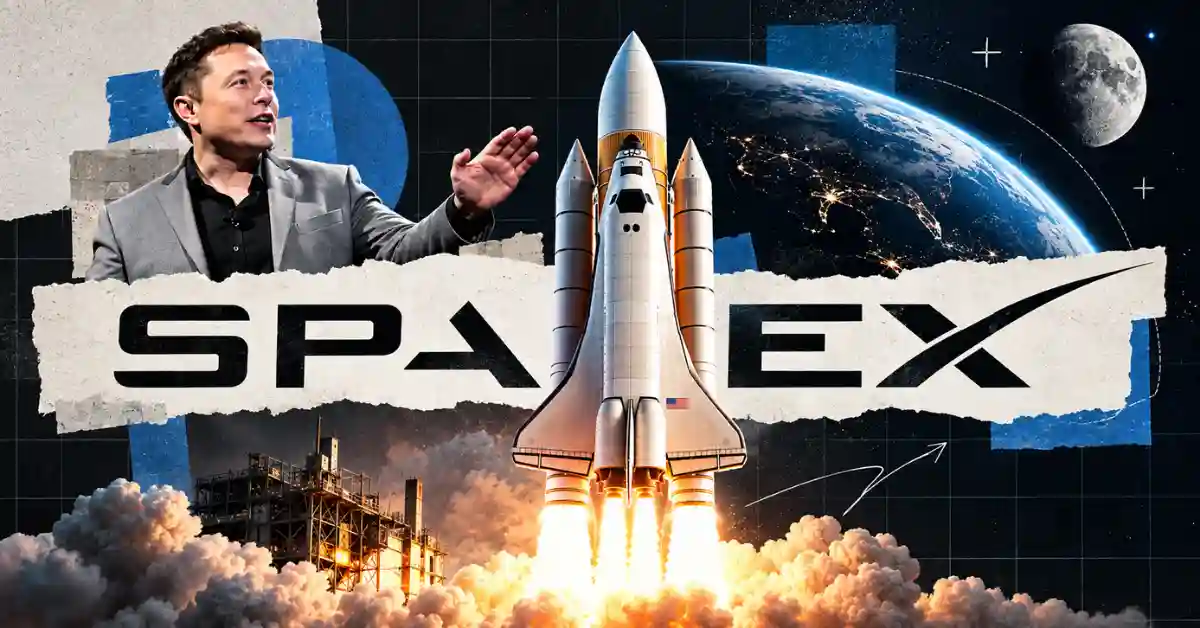
Elon Musk believes SpaceX could reach a $100 trillion valuation within the next decade, far above billionaire investor Ron Baron’s estimate of $20 trillion to $50 trillion. However, Musk sees one major threat to that goal, a world war.
Baron also expects Starlink alone to reach a $15 trillion valuation as satellite internet and space-based data centers drive future growth.
Speaking at the Columbia Business School Distinguished Speaker Series, Baron Capital CEO Ron Baron said SpaceX could become one of the world’s most valuable companies over the next 10 years.
“I think SpaceX stock is going to be thousands of dollars a share. I think its market cap will be worth $20 trillion, $30 trillion, $50 trillion.”
He added that Musk believes his estimate is “way low.”
Responding to Baron’s prediction, Musk said, “Unless there is a major world war, SpaceX probably gets to >$100T in <10 years.”
Despite the long-term forecast, SpaceX (SPCX) stock was trading near $152, down 2.8%, while the market cap is valued at around $2 trillion.
Baron believes Starlink could become a major driver of SpaceX’s future value. He expects Starlink alone to reach a valuation of $14 trillion to $15 trillion over the next decade.
His projections point to a major expansion in users and revenue.
Baron Capital’s modeling suggests Starlink could eventually serve more than 300 million customers globally and generate $1 trillion in annual revenue, with projected annual net profits of $700 billion to $800 billion.
Starlink’s newer V3 satellites are also expected to improve network capacity. To put their potential speed at 1 terabit per second per satellite, around 10 times the capacity of earlier V2-mini models.
Baron also sees orbital data centers as another major growth opportunity. Building data centers on Earth can face challenges involving land, permits, electricity, and cooling.
Meanwhile, in space, solar power could help supply energy without the same ground based constraints. He estimates power costs could be around $2 per watt in space, compared with more than $10 on Earth
On top of it, reusable Starship flights could cut launch costs from $1,500 to $150 per kilogram, making it cheaper to move equipment into orbit.
CoinPedia has been delivering accurate and timely cryptocurrency and blockchain updates since 2017. All content is created by our expert panel of analysts and journalists, following strict Editorial Guidelines based on E-E-A-T (Experience, Expertise, Authoritativeness, Trustworthiness). Every article is fact-checked against reputable sources to ensure accuracy, transparency, and reliability. Our review policy guarantees unbiased evaluations when recommending exchanges, platforms, or tools. We strive to provide timely updates about everything crypto & blockchain, right from startups to industry majors.
All opinions and insights shared represent the author's own views on current market conditions. Please do your own research before making investment decisions. Neither the writer nor the publication assumes responsibility for your financial choices.
Sponsored content and affiliate links may appear on our site. Advertisements are marked clearly, and our editorial content remains entirely independent from our ad partners.
Bitcoin, the broader crypto market, and global markets faced selling pressure as US inflation came…
South Korea’s Financial Services Commission held an emergency meeting on Thursday and said it is…
The global crypto market cap fell 3.2%, wiping out $89.36 billion to reach $2.71 trillion.…
More than $106 million in Ethereum (ETH) long positions were liquidated on Binance within one…
XRP price faces another critical test near $1.25, where a potential rebound could put $1.42…
October 15, 2026 09:12:03 UTC Bitcoin Price Prediction: BTC Sweeps $80,400 Liquidity, $77K Zone Comes…