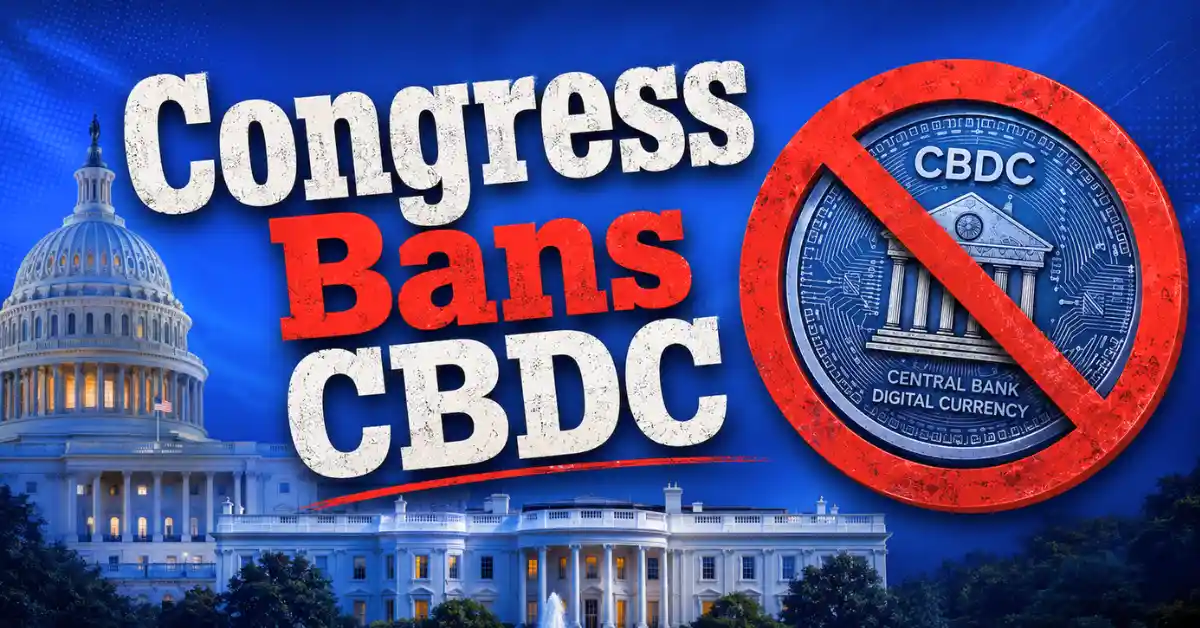
The U.S. Congress has just handed Tether and Circle the biggest advantage in stablecoin history. The U.S. Senate recently voted 89-10 in favor of legislation that would bar the Federal Reserve from creating a digital dollar until at least Dec. 31, 2030.
While China and Europe are moving toward government-backed digital currencies, why is the US banning them?
The provision is included in the updated “21st Century ROAD to Housing Act,” a bipartisan bill backed by Senate Banking Committee Chairman Tim Scott, Senator Elizabeth Warren, Rep. French Hill, and Rep. Maxine Waters.
The language clearly bans the Federal Reserve from issuing a central bank digital currency (CBDC) or any digital asset “substantially similar” to one until 2030. At the same time, lawmakers inserted an important exception.
“Private, permissionless, dollar-backed stablecoins remain fully protected under the bill.”
Most countries are moving toward government-backed digital currencies. Even China has expanded its digital yuan project, while Europe continues working on a digital euro. More than 100 countries have explored CBDCs in some form.
But the United States appears to be taking a different path. Instead of building a government-issued digital dollar, lawmakers are increasingly allowing private companies to lead innovation in digital dollars.
Today, stablecoins already process hundreds of billions of dollars in monthly transaction volume, and its marekt cap already surpasses $318 billion.
The biggest beneficiaries could be stablecoin issuers like Tether (USDT), which remains the largest stablecoin, with a market value exceeding $186 billion, while Circle’s USDC holds more than $75 billion. Together, the two companies control a large share of the global stablecoin market.
With no Federal Reserve-backed digital dollar expected before 2030, both firms now have a clear runway to expand their payment networks, secure new partnerships, and strengthen their position as the leading providers of digital dollars worldwide.
The proposal also aligns with the Trump administration’s broader digital asset strategy.
In January 2025, President Donald Trump signed an executive order halting federal CBDC development. More recently, Treasury Secretary Scott Bessent reiterated that a U.S. digital dollar remains “off the table.”
Instead, policymakers are focusing on stablecoin legislation and the Digital Asset Market CLARITY Act, which aims to establish clearer crypto market rules.
The bill still requires final House approval and presidential sign-off on June 23. But if it passes in its current form, Congress may have quietly made one of the biggest digital asset decisions of the decade.
CoinPedia has been delivering accurate and timely cryptocurrency and blockchain updates since 2017. All content is created by our expert panel of analysts and journalists, following strict Editorial Guidelines based on E-E-A-T (Experience, Expertise, Authoritativeness, Trustworthiness). Every article is fact-checked against reputable sources to ensure accuracy, transparency, and reliability. Our review policy guarantees unbiased evaluations when recommending exchanges, platforms, or tools. We strive to provide timely updates about everything crypto & blockchain, right from startups to industry majors.
All opinions and insights shared represent the author's own views on current market conditions. Please do your own research before making investment decisions. Neither the writer nor the publication assumes responsibility for your financial choices.
Sponsored content and affiliate links may appear on our site. Advertisements are marked clearly, and our editorial content remains entirely independent from our ad partners.
Jio Platforms opened its anchor book on Monday, October 19, two days before its ₹30,213…
Tesla, Meta, SpaceX and Netflix are entering a crucial week as quarterly earnings put their…
Crypto-native traders are chasing Zcash and Hyperliquid. Grayscale’s head of research, Zach Pandl, says the…
Jio Platforms’ initial public offering is drawing strong unofficial demand, with grey market premium (GMP)…
Former Commodity Futures Trading Commission Chairman Chris Giancarlo and venture firm Draper Dragon have publicly…
Japan’s Nikkei 225 fell 2% at Monday’s open, erasing roughly ¥23.5 trillion, or about $150…
